
Pune Police are working on gait analysis to counter defence argument that the man in hoodie at Lohagad Fort was not Chetan Chaudhary, accused in murder of Ketan Agarwal. The case has now taken a more forensic turn, with investigators trying to match the CCTV footage, walking pattern and body structure to the accused.
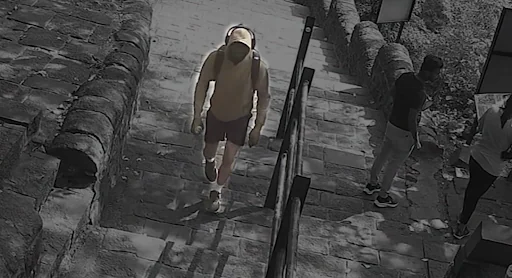
A CCTV footage Image of a man in a hoodie has become central to the murder case against Chetan Chaudhary and Siya Goyal. Image Credit: NDTV
Pune Murder Probe: Pune police are planning a gait analysis in the Ketan Agarwal murder case after the defense argued that the person seen in CCTV footage wearing a hoodie at Lohagad Fort was not Chetan Chaudhary. The accused, along with his alleged girlfriend Siya Goyal, is said to have pushed Agarwal from the fort on June 18 and then tried to make the death look accidental. The footage has become one of the most important pieces of evidence in a case that has gripped public attention in Pune.
The case is serious not only because of the alleged murder but also because investigators believe it may have been carefully planned. Police say the hoodie-clad figure seen in the scorching heat at the fort was following Siya and Ketan closely, which strengthened suspicion. Now, with the defense challenging identity, the police are looking to science to settle the issue. Yeh matter kaafi sensitive hai because it is no longer just about motive—it is also about proving who was actually present at the spot.
Why Police Want Gait Analysis
The main reason police are turning to gait analysis is simple: they want to scientifically establish whether the person captured on CCTV and Chetan Chaudhary are the same individual. The defense has tried to weaken the case by saying the hoodie-wearing man in the footage does not match the accused. In response, investigators want to compare how the person walks, moves and carries his body with Chetan’s own movement pattern. NDTV has covered the full story.
An official involved in the case said Chaudhary would be taken to Lohagad Fort wearing the same type of clothing as the man in the footage so that his body language could be directly compared. The analysis will reportedly examine walking speed, leg length, movement coordination and the angle of foot placement. These details may sound small, but in forensic work they can become extremely useful when direct identification is disputed.
The logic behind this is strong. If the CCTV footage is blurry or the face is partially covered by a hoodie and headset, then physical movement becomes a valuable identifier. Every person walks differently because of body structure, confidence, injury history, stride length and posture. That is why gait analysis is considered a useful scientific aid in cases where image clarity is limited.
What the CCTV Footage Shows
According to police, the CCTV footage from Lohagad Fort showed a man in a hoodie even though the temperature was around 33 degrees Celsius. The unusual clothing choice itself raised suspicion. Chetan was also allegedly wearing a headset over the hoodie and following Siya and Ketan at a distance of just 20-30 feet. That detail mattered because it suggested surveillance rather than casual presence.
Investigators later said they examined photographs and social media profiles linked to Chetan and compared them with the video. Based on that comparison, they believed they had narrowed in on him as a suspect. The defense, however, is now attempting to create reasonable doubt by denying that the person in the footage was Chetan.
This is where gait analysis becomes more than just a technical exercise. In a case built partly on circumstantial evidence, every detail matters. If the prosecution can show a consistent match between the footage and Chetan’s gait, it strengthens the argument that he was present at the fort and involved in the crime. If not, the defense may use that weakness to challenge the case further.
Background to the Case
Police say Ketan left home on the morning of June 18 and picked up Siya Goyal, who was 20 years old, from Kiwale bridge on the Pune-Mumbai highway before heading to Lohagad Fort. At around 10:45 am, Siya allegedly called Ketan’s mother and said he had accidentally fallen into a gorge. At first, the death was believed to be accidental.
But Ketan’s family became suspicious and filed a police complaint. That complaint changed the direction of the investigation. According to the probe, police found indications that Siya and Chetan had been plotting the murder for some time. Officials also said Siya had allegedly tried to kill Ketan in a similar manner at the same fort four days earlier.
That background is important because it shows how the case moved from an apparent accident to a suspected planned murder. Such cases often begin with uncertainty, then become clearer as digital evidence, witness statements and timeline reconstruction come together. In this instance, the fort, the CCTV footage, the phone call and the relationship triangle all became pieces of the same puzzle.
Timeline
June 18 morning: Ketan leaves home and picks up Siya from the Kiwale bridge.
Later that day: The pair goes to Lohagad Fort near Pune.
Around 10:45 am: Siya allegedly calls Ketan’s mother and says he has fallen into a gorge.
After the incident: The death is initially treated as accidental.
Family reaction: Ketan’s family grows suspicious and files a police complaint.
Police investigation: Officers review CCTV footage, photos and social media profiles.
Current development: Defense claims the hoodie-clad man is not Chetan; police plan gait analysis.
Also Read: Cab Driver Says Siya Goyal Was Forced Into Car in Pune Murder Probe Linked to Mumbai Airport Trip
How Gait Analysis Helps
Gait analysis is the scientific study of how a person walks. In criminal investigations, it can help identify a suspect even when the face is unclear, covered or only partially visible. Analysts look at things like stride length, arm movement, posture, upper body tilt and the rhythm of footsteps.
Police officials in this case explained that they would compare the walking speed, leg length, joint structure and body movement of the suspect with the person seen in the footage. They also said the angle and pressure of foot placement could help verify whether both are the same person. In simple words, the body often reveals what the face cannot.
This does not mean gait analysis alone decides guilt. It is one part of a bigger evidentiary chain. But in a case where the defense has questioned identity, it becomes a powerful supporting tool. The stronger the match, the harder it becomes to argue that the hoodie-wearing person was someone else.
Reported Statements
A police official said the team intends to take Chaudhary to Lohagad Fort in the same clothing seen in the CCTV clip so that forensic experts can compare his movements with the footage. The official added that the body language of the person in the video and the accused will be closely studied.
Another investigator explained that gait analysis is used in forensic science because every individual has a distinct walking pattern. That statement reflects the broader logic behind the method: even when a face is hidden, movement can still identify a person. In a case like this, such analysis could become a crucial supporting layer.
Why This Matters
This matters because it shows how modern investigations increasingly rely on scientific methods, not just witness claims. When a murder case involves disputed identity, courts and police need objective evidence. Gait analysis can help bridge the gap between suspicion and proof. Yeh issue kaafi important hai because justice depends on evidence that can stand up in court.
It also matters for public confidence. High-profile cases often shape how people view police investigations. If authorities can show that they used scientific reasoning, digital evidence and careful reconstruction, it strengthens trust in the process. If not, public skepticism grows.
There is also a broader safety angle. The case reminds people how quickly a seemingly normal outing can turn into a major criminal investigation. For families, this is a painful example of why missing details, suspicious behavior and delayed complaint filing should never be ignored.
India Angle
For Indian readers, this story is especially relevant because it combines crime, digital evidence and forensic science in a very relatable setting. In Hinglish, seedhi baat yeh hai: aaj ke time mein CCTV aur mobile evidence bahut powerful ho gaya hai, but courts still need proper scientific support to confirm identity. That is exactly why this case is getting so much attention.
It also reflects how urban and semi-urban crime investigations in India are evolving. Police are no longer depending only on statements; they are increasingly using footage, profiles, timelines and movement analysis. This makes the case important for anyone following modern policing in India.
And because the case involves a well-known fort near Pune, it also touches on public spaces and tourist spots. People visit such places for leisure, but incidents like this can change how visitors think about safety and oversight. That is why yeh matter sirf ek murder case nahi hai, balki investigation standards ka bhi test hai.
Analysis
My opinion is that police are right to use gait analysis here, especially if the face in the footage is not clear enough for direct visual identification. In cases where the defense attacks the identity evidence, scientific comparison can make a big difference. The key, however, is that the analysis must be done carefully and documented properly.
The bigger insight is that this case is not just about who was there but about how investigators prove presence. That is the real legal challenge. A fort, a hoodie, a headset and a phone call may seem like isolated clues, but together they create a timeline that investigators believe points to premeditation. If the gait analysis supports that timeline, the case against the accused could become much stronger.
Still, it is important to remember that an analysis is only as good as the method and the interpretation. In court, every scientific claim must be defensible. So while the police move appears logical, the final impact will depend on how well the evidence is collected and presented.
What Next
The next step will likely be the actual gait analysis, with Chetan Chaudhary taken to Lohagad Fort for comparison with the CCTV footage. Forensic experts may then submit their findings to the investigating team and, eventually, the court.
Police will also continue building the broader case with timeline evidence, digital records, witness statements and any additional forensic material from the fort. If the scientific comparison is strong, it may help counter the defense claim that the hoodie-clad person was someone else.
On the legal side, the case may move into deeper scrutiny during hearings as both sides challenge the evidence. The outcome will depend on how the court views the full chain of circumstances, not just one clip or one forensic test.
Conclusion
The Pune murder case involving Ketan Agarwal, Siya Goyal and Chetan Chaudhary has now reached a crucial stage, with police preparing gait analysis to address the defense claim that the man in the hoodie was not Chetan. The CCTV footage, the fort timeline and the alleged murder plot have made this a closely watched case. If the forensic comparison supports investigators, it could significantly strengthen the prosecution’s version of events. If not, the defense will likely push harder on identity doubt. Either way, this is a case where science, timing and digital evidence will decide the narrative.
Written By A. Jack