
Two schoolgirls, both 15, were electrocuted after stepping on an exposed wire near a bridge in Navi Mumbai, but doctors said they were now conscious and stable. The incident has prompted a new safety review and the utility and civic officials have been asked to explain who was in charge of the dangerous cable.
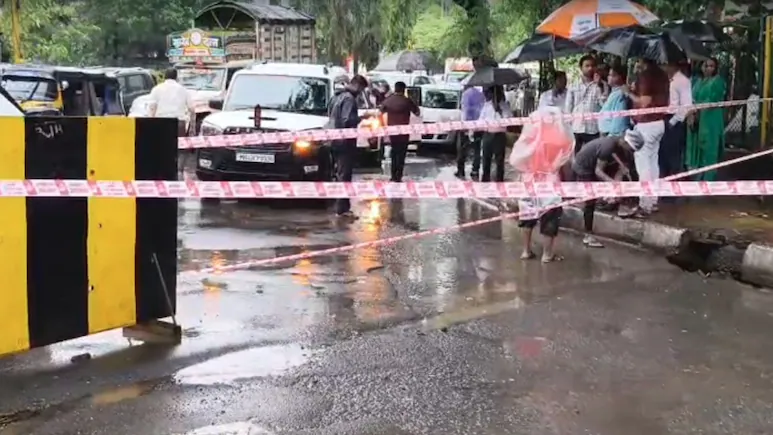
Power officials inspect an exposed wire area in Navi Mumbai after two schoolgirls received an electric shock and were hospitalised. Image Credit: NDTV
A disturbing safety lapse in Navi Mumbai left two teenage schoolgirls injured after they stepped on an exposed wire and received an electric shock while returning home from school. The students, identified as 15-year-old Shubhangi Nalawade and Ujwala Wagh, were first taken to DY Patil Hospital and later shifted to Fortis Hospital in Vashi for further monitoring. Doctors have said both girls are conscious and stable, which is a relief, but the incident has raised serious questions about urban electrical safety.
The shock reportedly occurred after a short-circuit under a bridge spread current through the exposed wire. What should have been a routine school journey turned into a frightening emergency in a matter of seconds. The case is now drawing attention because it highlights how small infrastructure failures can create major risk in a densely populated city. Yeh issue kaafi important hai because it shows how everyday routes can become dangerous if maintenance is ignored.
What Happened
According to officials, the two girls stepped on the exposed wire after a short-circuit occurred under the bridge. The current spread through the wire, causing the electric shock. They were immediately hospitalised, first at DY Patil Hospital and then shifted to Fortis Hospital in Vashi for continued care. NDTV has covered the full story.
The fact that both students are now conscious and stable is encouraging, but the incident itself is alarming. Exposed wiring in public places is a serious hazard, especially near routes used by students and pedestrians. In a city like Navi Mumbai, where people depend heavily on regular foot traffic, buses and roadside movement, such gaps in maintenance can quickly turn into life-threatening incidents.
Mayor Sujata Patil called the incident unfortunate and said the city would seek an explanation from MSEDCL or whichever official entity is ultimately responsible for the line. She also said that similar connections will be inspected and rectified immediately. The main switches have already been turned off to prevent more danger.
Why It Happened
The immediate trigger was the short-circuit under the bridge, which reportedly caused current to spread into the exposed wire. But the deeper question is why the wire was exposed in the first place and whether the damage had been properly repaired. That is where responsibility becomes complicated.
Mayor Patil said the city is trying to determine whether the line belongs to MSEDCL or another authority. This matters because urban infrastructure often involves multiple agencies, and when ownership is unclear, safety oversight can fall through the cracks. The mayor’s remarks suggest that the city suspects a maintenance lapse, a botched repair, or leftover damaged cabling from earlier work.
She also pointed out that underground cabling work is often not restored properly after excavation. In her words, cables are sometimes severed during digging and later left patched with tape. During monsoon conditions, or when road surfaces are disturbed, these temporary fixes can fail and cables can resurface. That creates a very real danger for commuters, workers and children.
That explanation is important because it shows this is not just an isolated electrical fault. It may reflect a broader pattern of weak monitoring, poor patchwork repair and unclear accountability. In simple words, problem sirf ek wire ka nahi lag raha — system ka bhi ho sakta hai.
Official Response
Mayor Sujata Patil has said the city will not allow the matter to be brushed aside. She stated that the issue will be raised in the general body meeting and that a separate meeting will be called with MSEDCL or other relevant officials before that. The aim is to identify the source of the fault and demand immediate corrective action.
She also said that multiple authorities are involved and that each may deny ownership unless records are checked carefully. According to her, if the line had belonged to the municipal body, the connection would have been cut off already. The city is now trying to identify the owner of the cable and has turned off the main switches to remove any immediate threat.
This is the kind of response people expect after a public safety incident. The challenge now is not just calming public concern, but actually following through with inspections, repairs and accountability. If the same issue is left unresolved, the next accident could be worse.
Background and Context
Electrical safety in crowded Indian cities is often more fragile than it appears. Overhead and underground cabling, road excavation, monsoon water seepage and unclear agency boundaries can all create conditions where exposed wires remain dangerous for long periods. In fast-growing urban zones, one weak connection can affect thousands of daily commuters.
Navi Mumbai is a planned city, but even planned urban spaces face maintenance challenges when responsibility is split between civic bodies, power distributors and contractors. That is why incidents like this attract so much attention. They are not just random accidents; they are usually signs that something in the chain of upkeep has failed.
There is also a broader public concern because children are often the first to get exposed to such risks on school routes, footpaths and crossings. A school commute should be one of the safest parts of a child’s day. When it is not, parents start questioning the entire safety system around them.
Timeline
Before the incident: Underground cabling work or a short-circuit creates a risky exposed wire under a bridge.
During school return: Shubhangi Nalawade and Ujwala Wagh step on the exposed wire.
Immediate aftermath: Both girls receive an electric shock and are taken to DY Patil Hospital.
Later: The students are shifted to Fortis Hospital in Vashi.
Official response: Mayor Sujata Patil orders checks, seeks responsibility and says legal action is possible.
Current status: Both girls are conscious and stable, while authorities inspect the cable and turn off main switches.
Why This Matters
This matters because it involves children and a preventable public hazard. When schoolchildren are injured due to exposed wiring, the concern goes beyond one locality and becomes a city-wide safety question. Small lapses in maintenance can have very large consequences, especially in crowded urban spaces. Yeh matter isliye bhi important hai because public safety cannot depend on luck.
It also matters because it exposes confusion over accountability. If one authority says the line is not theirs and another says the same, then dangerous infrastructure can stay unrepaired for too long. That delay can cost lives. People need to know not just who is responsible after an incident, but who was supposed to prevent it before it happened.
For Indian cities, this is a reminder that electrical hazards must be treated as urgent infrastructure risks, not routine complaints. A live wire near a walking path is an emergency, not a minor repair issue.
India Angle
For Indian readers, this story feels familiar because exposed wires, damaged cables and temporary fixes are common complaints in many cities. In Hinglish, seedhi baat yeh hai: jab bacche school se ghar ja rahe ho, tab route pe koi bhi electrical risk bilkul unacceptable hai. Parents trust the city to maintain safe surroundings, and that trust gets shaken when something like this happens.
The incident also speaks to a bigger problem in urban India: agencies often work in silos. One department says the problem belongs to another, and meanwhile the public keeps facing danger. That is why accountability is so important. People do not care about inter-agency confusion when a wire is live; they care about safety.
This story will likely resonate strongly with Indian families because it involves schoolgirls and a basic civic failure. It is the sort of incident that makes people think, “yeh toh kal mere area mein bhi ho sakta hai.”
Analysis
As a news writer, I see this as a high-relevance civic safety story because it combines child safety, electricity, urban maintenance and official accountability. Search interest will likely come from terms like Navi Mumbai electric shock, schoolgirls injured, exposed wire, and mayor Sujata Patil. The incident has clear public value and strong local impact.
My opinion is that the important part here is not only the medical update, which is thankfully positive, but also the infrastructure failure behind it. A live or exposed wire near a public walkway should not exist long enough to injure children. If ownership is unclear, that itself is part of the problem, because the system is not designed to protect the public when responsibility is fragmented.
The mayor’s reaction suggests the city understands the seriousness of the incident. But public confidence will depend on what happens next. A meeting, a statement and a switch being turned off are first steps, not solutions. The real test is whether every similar vulnerable point is inspected quickly and repaired properly.
This is also a reminder that monsoon and post-monsoon conditions often expose weak infrastructure. Underground cabling, surface water and road excavation can interact in dangerous ways. Cities need preventive inspection rather than reactive cleanup.
What Next
The next step is a full identification of which agency owns the cable and which contractor or department handled the installation or repair. That will determine whether negligence occurred and who may face action.
Officials are also expected to inspect similar connections and rectify them immediately. The mayor has already said legal action will be taken against whoever is found responsible. If the investigation finds that maintenance was ignored, penalties or departmental action could follow.
For the families of the two girls, the immediate priority is recovery. For the city, the priority should be a rapid safety audit so that the same kind of accident does not happen elsewhere.
Conclusion
The Navi Mumbai electric shock incident is a troubling reminder that even planned urban areas can have dangerous safety gaps. Two schoolgirls were injured after stepping on an exposed wire, but both are now stable, which is a relief. Still, the central issue remains unresolved: who was responsible for leaving a live danger in a public space? As the city investigates and promises action, the hope is that this becomes a turning point for better electrical safety, clearer accountability and faster repairs across Navi Mumbai.
Written By A. Jack