
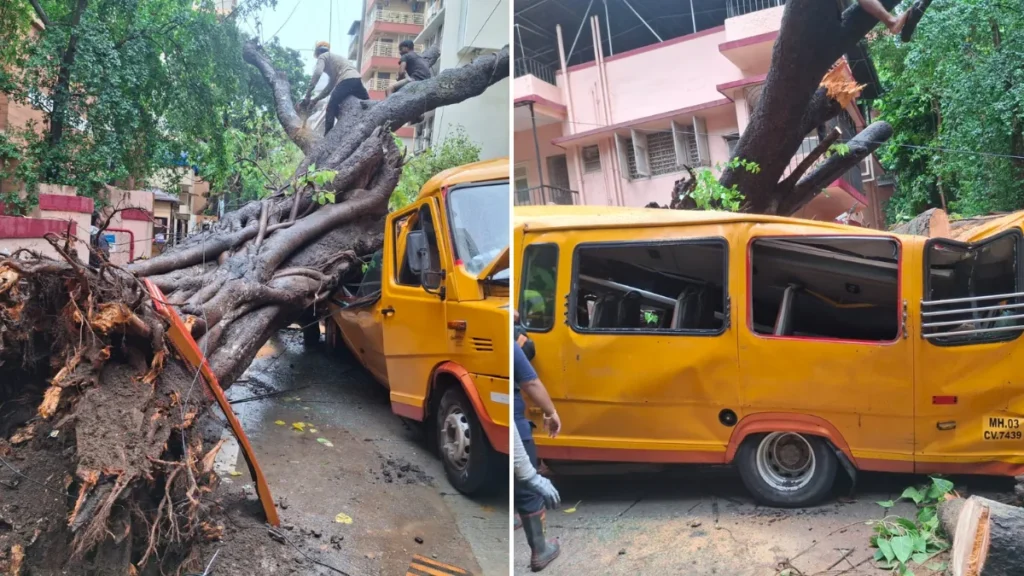
The family of 11-year-old Vihaan Srivastava, who died after a tree fell on a school bus in Mumbai’s Chembur, has demanded a thorough probe and accountability from civic authorities. “Warnings about the dangerous tree had been taken on time and it could have been prevented”, said grief-stricken relatives, neighbours and political leaders.
11-year-old Vihaan Srivastava after the Chembur tree collapse that killed the schoolboy. Image Credit: NDTV
The funeral of 11-year-old Vihaan Srivastava in Mumbai became a scene of deep grief and anger after the boy died when a tree collapsed on his school bus in Chembur. Vihaan, the only child of his parents, was remembered as a bright, affectionate and cricket-loving boy whose sudden death has left his family devastated. As the family mourned, they also demanded answers, saying the incident may have been avoided if earlier warnings about the tree had been taken seriously.
The tragedy has sparked a wave of public concern, with relatives, neighbours and elected representatives questioning whether civic negligence played a role. The family’s sorrow is now tied to a wider demand for accountability. Yeh sirf ek accident nahi lag raha — yeh ek aise failure ki kahani ban gayi hai jahan public safety aur civic responsibility dono par sawaal uth rahe hain.
What the Family Said
Speaking to NDTV, Vihaan’s grandfather, SN Srivastava, said the family believes the incident was preventable. He described the situation as negligence and said the tree had been in a precarious condition and should have been removed. According to him, residents had raised concerns earlier, and the family wants to know why no action was taken. NDTV has covered the full story.
The grandfather also said that while no punishment can bring Vihaan back, justice must be done and those responsible should be held accountable. He added that the family is considering filing a formal complaint and wants criminal action if negligence is established. His words reflect not just grief, but a clear demand for legal and civic scrutiny.
A relative, Anil Kumar Srivastava, echoed those concerns and questioned how authorities could take weak trees lightly. He said trees that pose a risk should be identified and removed urgently, and that maintenance and pruning must be carried out regularly. He also pointed to the need to check whether funds meant for this work are being properly used.
These statements matter because they come from the family closest to the loss. They are not just emotional reactions; they are also a call to investigate whether systems in place were ignored or mishandled.
Remembering Vihaan
Vihaan Srivastava was described by family members as a child who brought joy wherever he went. His loved ones said he was smart, cheerful, affectionate and deeply interested in cricket. In a particularly heartbreaking detail, the family said they cremated him with his cricket ball because the game meant so much to him.
That small detail says a lot about the pain of the family and the age of the child they lost. Vihaan was also remembered as a foodie and someone who often asked relatives what they had eaten. Those memories make the loss feel even more personal, because they show the ordinary, everyday warmth of a child who should have had many more years ahead of him.
When a family loses an only child, the tragedy becomes almost unimaginable. The grief is not only about one life ending; it is about a future disappearing. That is why this incident has touched so many people in Mumbai and beyond.
What Residents Are Saying
Neighbours and local residents who attended the funeral also said the loss has shaken the community. One resident said people had repeatedly raised concerns about the condition of the tree and wanted it to be cut. He described Vihaan as a smart, innocent child and said everyone in the area knew him.
That local testimony is important because it suggests the issue may not have come without warning. If residents had already complained, then the question becomes not whether the tree was dangerous, but whether it was ignored. In civic matters, ignored warning signs often become the core of public anger after a tragedy.
The family and community’s grief has therefore turned into a call for action. People are not just mourning Vihaan; they are asking what could have been done to protect him.
Political Reaction
The tragedy has also drawn sharp criticism from elected representatives, especially over the functioning of the Brihanmumbai Municipal Corporation. MLA Tukaram Kate alleged that complaints about dangerous trees had not been given due attention. He said residents had asked the BMC to conduct surveys and audits, but those concerns were ignored.
MP Anil Desai also called the incident unfortunate and raised questions about the civic administration’s performance. He said that complaints are often raised but not attended to, and stressed that trees need continuous monitoring and maintenance as they grow. His remarks add political weight to the family’s demand for accountability.
When politicians join a tragedy like this, the issue often expands beyond one incident. It becomes a larger debate about civic governance, safety monitoring and whether municipal systems are actually responsive enough to prevent predictable danger.
Background and Context
Mumbai is a city with dense traffic, old trees, crowded roads and heavy monsoon-related risks. Tree collapses are not rare enough to be ignored, and every such incident renews debate on tree audits, pruning schedules and accountability of local bodies. In a city where millions rely on public roads daily, one unstable tree can become a major threat.
Chembur is a busy residential and transit area, which means school buses, pedestrians and vehicles all share the same road spaces. That makes tree safety especially important. When residents say they had already complained, the issue shifts from unfortunate accident to possible preventable failure.
There is also a broader pattern here that many Indian cities will recognise. Civic bodies often promise maintenance, trimming and audits, but implementation is uneven. That gap between policy and practice is what families like the Srivastavas are now pointing to. Yeh issue kaafi important hai because public safety should never depend on whether complaints get lucky attention or not.
Timeline
Before the tragedy: Residents reportedly complain about the dangerous condition of the tree.
Tuesday afternoon: A tree falls on a school bus in Chembur, Mumbai.
Immediately after the incident: Vihaan Srivastava is seriously injured and later dies.
Following the death: Family members and neighbours begin demanding accountability.
Funeral day: Vihaan’s relatives and local residents gather in grief and anger.
Political response: Elected representatives criticise the BMC and ask for action.
Now: The family and community are hoping the investigation will determine whether prior warnings were ignored.
Also Read: 11-Year-Old Student Killed as Tree Falls on School Bus in Mumbai’s Chembur
Why This Matters
This matters because it involves the death of a child in a setting that should have been safe: a school commute. Parents trust buses, roads and city systems to protect their children. When that trust is broken, the impact goes far beyond one family. It shakes public confidence in the civic machinery that is supposed to keep people safe.
It also matters because the case may reveal whether avoidable negligence contributed to the death. If residents had warned authorities earlier, then the failure is not just tragic but potentially actionable. In simple terms, it means the question is not only “what happened?” but also “why was it allowed to happen?”
For urban India, this is a warning about how small maintenance failures can lead to devastating outcomes. Roadside trees, old branches and weak trunks are not minor issues when buses and children are passing under them every day. The lesson is clear: prevention is always better than post-tragedy statements.
India Angle
For Indian readers, this story hits hard because it reflects a very common fear: that ordinary daily life can become dangerous because basic civic maintenance was missed. In Hinglish, seedhi baat yeh hai — parents apne bacchon ko school bhejte hain trust ke saath, aur yeh trust hi sabse important hota hai. If that trust is broken, the emotional and social damage is huge.
This also connects to a bigger Indian urban issue: complaints often move slowly through the system. Residents say they warned the authorities, but action allegedly did not follow. That is a familiar frustration in many Indian cities, not just Mumbai.
The story will likely resonate with parents, school authorities and civic watchdogs across the country. It reminds everyone that safety audits, tree maintenance and prompt response to complaints are not bureaucratic details; they are life-saving responsibilities.
Analysis
My opinion is that this tragedy will remain in public memory not only because of the death, but because of the family’s powerful demand for accountability. The cricket ball detail, in particular, gives the story a human centre that readers will not forget. It turns a civic failure into a deeply personal loss.
The broader lesson is that municipal bodies must treat public complaints as preventive intelligence. If a tree is visibly dangerous, the response should not wait until after a death. That is the real failure this case is forcing people to confront.
There is also a communication lesson here. Civic authorities often respond after disaster with audits and assurances, but that does not restore trust unless it is backed by visible action. For citizens, action is the only proof that lessons have been learned.
What Next
The next step will be the investigation into whether prior warnings about the tree were ignored and whether civic negligence contributed to Vihaan’s death. If the probe finds that complaints were received but not acted upon, the family may move forward with a formal complaint and seek criminal action.
The BMC may also come under pressure to review tree audits, especially in areas near schools and high-footfall roads. That could lead to fresh inspections, pruning drives and removal of risky trees.
Politically, the issue may keep growing if local representatives continue to press the matter. Public grief often turns into public pressure, and that may force the administration to respond more aggressively than it otherwise would.
Conclusion
Vihaan Srivastava’s death has become more than a tragic accident; it is now a test of civic accountability in Mumbai. His family says the tree that killed him was dangerous and should have been removed earlier, while residents and leaders are asking whether warnings were ignored. The grief is raw, the questions are serious and the demand for justice is only growing. If the investigation confirms negligence, then this tragedy must lead to real accountability, because no family should have to bury a child and ask why preventable danger was left standing.
Written By A. Jack