
A horrific accident on the Mumbai-Ahmedabad National Highway in Maharashtra’s Palghar district left 13 people dead and more than 25 injured after a container truck hit a tempo carrying wedding guests and a motorcycle. The crash happened on Tuesday near Dahanu, turning a family journey to an engagement ceremony into a deadly tragedy.
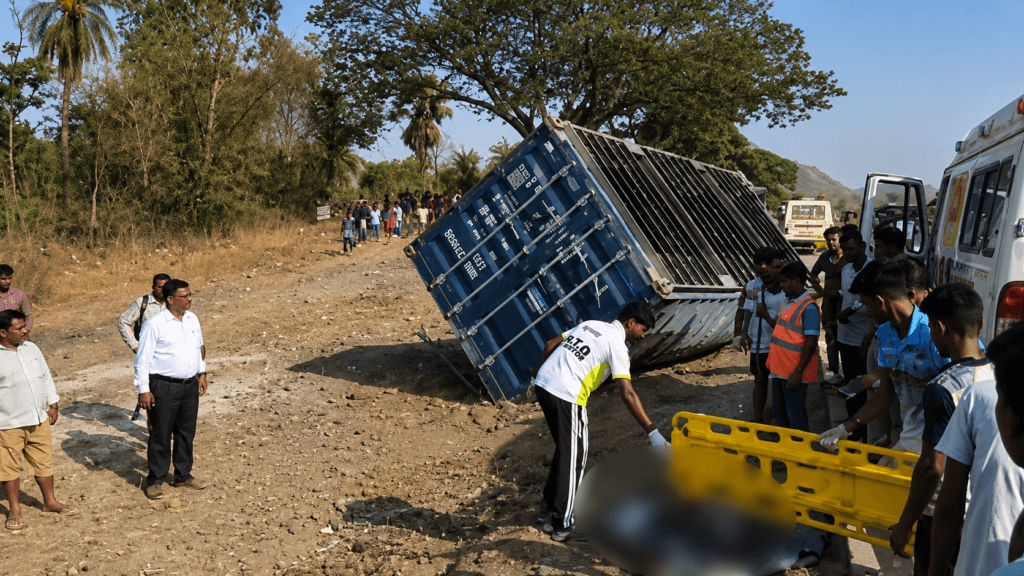
Rescue operations are underway after a container truck and a tempo carrying wedding guests collided on the Mumbai-Ahmedabad Highway in Palghar, killing 13 people. [This Image A.I Generated only for representation.]
13 Killed in Palghar Road Accident
A major road accident in Maharashtra’s Palghar district has claimed at least 13 lives and injured more than 25 people after a container truck rammed a tempo carrying wedding guests on the Mumbai-Ahmedabad National Highway. The victims were travelling from Bapugaon in Dahanu to attend an engagement ceremony in Dhanivari when the collision occurred on Tuesday around 4 pm.
According to officials, the impact was severe enough to overturn the truck onto the tempo, trapping several passengers inside. The accident also involved a motorcycle. Of the 13 dead, 11 died while undergoing treatment at Kasa Sub-District Hospital, and two others died at Vedanta Hospital in Dahanu. Yeh ek bahut hi tragic incident hai because it involved a family event that turned into a mass-casualty crash within seconds.
What Happened
Initial reports suggest the tempo was carrying more than 40 passengers and was traveling on the wrong side of the highway, allegedly to avoid a detour of around one kilometer. At the same time, the container truck coming from Gujarat towards Mumbai reportedly lost control near a village stretch. The truck’s container section struck the left side of the tempo, and a motorcycle was also caught in the collision. NDTV has covered the full story.
Police said the truck then overturned and fell onto the tempo, trapping multiple people inside. That detail is especially important because it explains why the death toll rose so quickly. In crashes like this, the weight of a container truck can make rescue operations extremely difficult, especially when passengers are packed into a tempo and the vehicle is crushed or pinned down. In simple words, it was not just a collision; it was a multi-vehicle disaster with severe impact force.
Official Response
Maharashtra Chief Minister Devendra Fadnavis expressed grief over the deaths and announced compensation of Rs 5 lakh for the families of the victims. His public statement reflected the seriousness of the incident and the government’s attempt to provide immediate relief to the affected families.
Fadnavis said he was deeply saddened after hearing about the accident and offered condolences to the families who lost their loved ones. Such statements are often more than political formalities in moments like this. They signal that the administration is treating the case as a major emergency, while also acknowledging the emotional trauma that families are now facing.
Palghar Superintendent of Police Yatish Deshmukh said the primary investigation suggested the accident may have occurred due to an error by the tempo driver, though a detailed probe is still underway. The district administration has ordered an inquiry to establish the exact cause. Palghar MP Hemant Savara and SP Deshmukh visited the site to review the situation, while local MLA Rajendra Gavit demanded compensation and expressed grief over the tragedy.
Why the Crash Happened
Based on the early information, the biggest risk factor appears to be the tempo of travelling on the wrong side of the highway. On a busy national highway, even a short wrong-side stretch can become deadly when combined with speeding, poor visibility, or sudden lane movement. If the tempo driver indeed chose the wrong side to avoid a one-kilometer detour, that decision may have proved catastrophic.
At the same time, investigators will also look at the truck driver’s control, the condition of the vehicle, road geometry, traffic flow, and possible mechanical issues. In large highway accidents, more than one factor can contribute. But the use of the wrong side by a passenger vehicle on a high-speed road is already a major red flag. That is why this case is being described as a possible preventable tragedy rather than a freak accident.
Background
The Mumbai-Ahmedabad National Highway is one of the busiest stretches in western India, connecting major commercial and residential zones across Maharashtra and Gujarat. High traffic volume, heavy vehicles, mixed-speed movement, and local road diversions can make such routes especially dangerous.
Road crashes involving overloaded passenger vehicles are also a recurring problem in India. Tempos, jeeps, and similar vehicles are often used to carry large groups for weddings, religious events, and family functions, especially in rural and semi-urban areas. When these vehicles are overloaded or take unsafe routes to save time, the consequences can be devastating. This accident is a reminder that even routine social travel can turn fatal when road discipline breaks down.
Timeline
Before the crash: Wedding guests from Bapugaon in Dahanu were travelling to Dhanivari for an engagement ceremony.
Around 4 pm: The tempo, carrying more than 40 passengers, reportedly moved on the wrong side of the highway.
At the same time: A container truck traveling from Gujarat towards Mumbai lost control near a village stretch.
Collision: The truck’s container hit the tempo, and the motorcycle was also involved.
After impact: The truck overturned on top of the tempo, trapping passengers.
Hospital phase: 11 people died at Kasa Sub-District Hospital and two at Vedanta Hospital.
Official response: CM Fadnavis announced compensation, and district authorities ordered an inquiry.
Why This Matters
This matters because road accidents remain one of India’s deadliest public safety issues. A single bad decision on a highway can claim multiple lives in seconds, especially when buses, tempos, and trucks share the same road space. The Palghar crash shows how vulnerable passengers are when vehicles are overcrowded, drivers take shortcuts, and highways are treated casually.
It also matters because the victims were traveling for a family celebration. That emotional contrast makes the tragedy even harder to process. A trip meant for joy became a scene of death, injury, and trauma. Families across India can relate to such journeys, which is why the story resonates far beyond Palghar. Yeh issue kaafi important hai because it shows how everyday negligence can destroy entire families.
India Angle
For Indian readers, this story connects directly to a familiar and painful reality. Many people still rely on shared tempos and local transport for weddings, religious events, and village travel. In several parts of India, people pack into vehicles far beyond safe limits because it is cheaper and more convenient. This accident underlines why that practice is so dangerous.
There is also a broader road safety angle for India. National highways are supposed to be safe, but they often become sites of fatal mistakes due to lane violations, overloading, and poor driving discipline. The crash in Palghar should push conversations around stricter enforcement, safer passenger transport, and better driver accountability. In simple Hinglish, yeh sirf ek accident nahi tha; it was a warning about unsafe travel habits that still exist across the country.
Analysis
My opinion is that the most disturbing element is the alleged wrong-side movement of the tempo. If that detail holds up in the inquiry, it points to a completely avoidable risk that turned fatal. It also highlights a structural issue in Indian road safety: people often take shortcuts to save a little time, but on highways those shortcuts can become lethal. The presence of a motorcycle in the crash further shows how quickly a single lapse can spread across multiple vehicles.
What’s Next?
The district administration’s inquiry will now focus on establishing the exact chain of events, including whether the tempo was indeed on the wrong side and whether the truck driver could have avoided the impact. Police and transport authorities may also examine the speed, condition, and route choices of both vehicles.
The families of the deceased are likely to receive the compensation announced by the state government, but financial aid cannot undo the loss. In the coming days, medical teams will continue treating the injured passengers, and investigators may gather witness statements, vehicle data, and roadside evidence. If the inquiry confirms negligence, stricter action could follow. More broadly, the incident may prompt renewed calls for tighter enforcement against overloading and wrong-side driving on highways.
Conclusion
The Palghar crash is a heartbreaking reminder of how quickly a joyful journey can become a mass casualty disaster. Thirteen people died and more than 25 were injured after a container truck rammed a tempo carrying wedding guests on the Mumbai-Ahmedabad Highway, with early signs pointing to a dangerous wrong-side move by the passenger vehicle.
As the investigation continues, the focus will be on accountability, compensation, and preventing a repeat of such a tragedy. For families in Maharashtra and across India, this case is a painful lesson in why road discipline, safe driving, and responsible travel choices are absolutely essential.
Written By A. Jack