19-Year-Old NEET Aspirant Student’s Tragic Death Sparks Fresh Debate Over NEET Pressure, Exam Reforms, and Student Mental Health
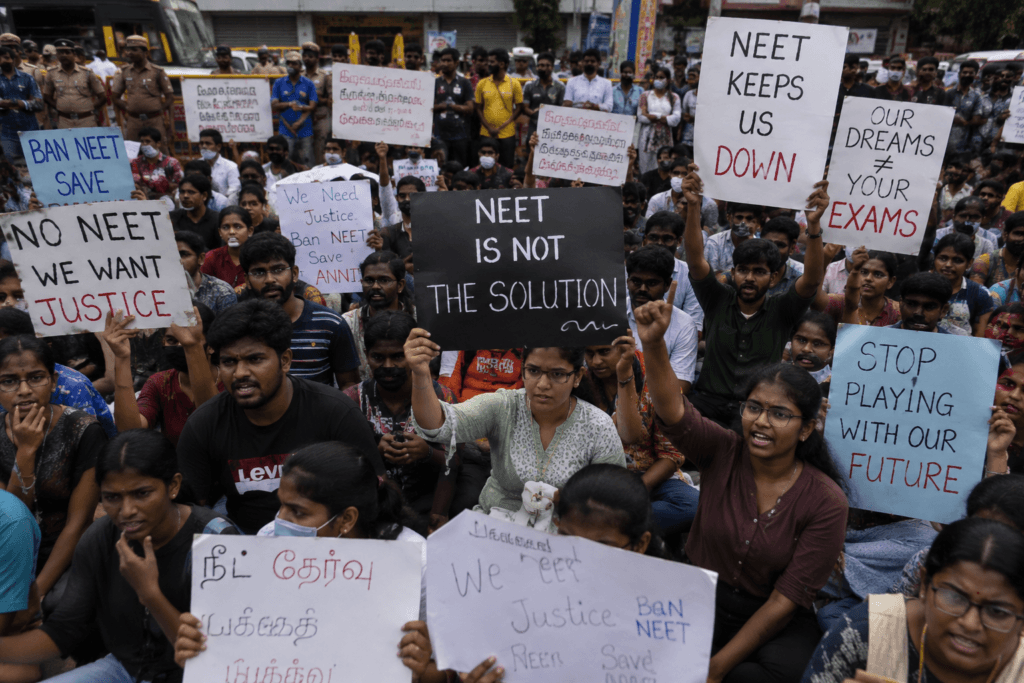
Students and activists participate in a protest against NEET in Tamil Nadu following the death of a 19-year-old medical aspirant in Coimbatore. | Image is created AI
The National Eligibility-cum-Entrance Test (NEET) is once again in the news, following a tragic incident in the Coimbatore district of Tamil Nadu. A 19-year-old medical aspirant identified as Anunkeerthana allegedly committed suicide while preparing to reappear for the exam. The incident has sparked protests across the state, rekindled political debates over NEET and raised fresh concerns about the huge pressure faced by students fighting for medical seats in India.
Police officials said Anunkeerthana had already taken the NEET exam twice and was preparing for a third attempt. Investigators said she was distressed after she had to reappear for the examination after developments related to the recent NEET question paper leak controversy, leading to more uncertainty for candidates. The incident once again brought into focus the emotional and psychological toll of high-stakes competitive exams as authorities continue to investigate the circumstances surrounding her death.
What Happened in Coimbatore?
Police officials confirmed the incident took place in the Coimbatore district, where Anunkeerthana was preparing for the medical entrance examination. The student, who reportedly wanted to get admission to a medical college, had put in years of effort to achieve that goal.
She had appeared for NEET twice earlier and was preparing for the third time, investigators said. Reports indicate she was upset at the idea of another round of exams after the controversy surrounding the NEET process caused more uncertainty for students.
Media reports quoted a senior police officer as saying the frustration of having to re-sit the test may have been a factor in her distress. However, officials have said the investigation is continuing and no conclusions have been drawn.
Police said no suicide note was recovered from the scene. An investigation has been opened to clarify all circumstances and carry out the necessary legal procedures.
The incident was widely reported across Tamil Nadu and drew concern from students, activists, and political groups about the toll that repeated examination pressures were having on young aspirants.
Protests Erupt Across Tamil Nadu
The news of the student’s death led to protests in different parts of Tamil Nadu soon after. Protesters demanded reforms in the examination system and again demanded the abolition of NEET as a mandatory entrance test for admission to medical colleges.
The ruling DMK has announced state-wide protests, reiterating its long-standing demand for exemption from NEET for students of Tamil Nadu.
Political leaders said that students coming from rural and economically weaker sections often face a disadvantage as compared to the candidates who have access to costly coaching facilities and a number of preparation resources.
So the incident has become more than a local tragedy. It is now an open discussion about educational equity, student welfare, and the structure of India’s medical admission process.
Understanding the NEET Debate
NEET was introduced as a common entrance exam for admission to medical colleges across India to bring in a uniform admission process in India for undergraduate medical courses. Its supporters say the test provides transparency, standardization, and merit-based admissions.
But Tamil Nadu has always opposed the exam. Critics say NEET is too focused on standardized testing and could be discriminatory against students who studied in state board systems.
Over the years, political parties, educational experts, and student organizations in Tamil Nadu have argued that the examination contributes to stress and creates hurdles for students from less privileged backgrounds.
The recent incident has only intensified these concerns, and the calls for policy review have been renewed.
Background and Context
Tamil Nadu’s opposition to NEET is not new. Since its inception, the examination has been the subject of a number of protests and political campaigns in the state.
There have been several previous incidents involving students preparing for NEET that have caught the nation’s attention and evoked debates on academic pressure and mental health issues among young aspirants.
The state government has passed resolutions seeking exemption from NEET several times on the grounds that the examination affected social justice and equal opportunity in medical admissions.
NEET proponents, on the other hand, say that a common national examination helps in maintaining uniform academic standards across the nation.
This ongoing debate has made NEET one of the most controversial education policies of India.
Timeline of Key Developments
Anunkeerthana had appeared for the NEET exam twice earlier to fulfill her dream of becoming a doctor. The process of examination had seen controversies in recent times with question papers getting leaked and re-examinations creating uncertainty among the candidates preparing for medical admissions.
The student was said to be upset at having to go through the examination process again but was preparing for another try.
The incident took place in the Coimbatore district, and police have begun an inquiry. The tragedy saw news flash through Tamil Nadu like wild fire, sparking protests and renewed political calls for an exemption from NEET.
Later the DMK announced agitations across the state, reiterating the state’s long-standing stand against the examination.
Why This Matters
This episode is important because it is indicative of larger issues that are not just about one exam. Millions of students across India compete for limited seats in medical colleges, engineering institutions, and other prestigious educational programs.
The pressure that attaches to these exams can be enormous. Students invest years of preparation, significant financial resources, and the expectations of their families.
This is a very important issue because it raises difficult questions about how society measures academic success and how educational systems can better support student well-being.
The tragedy has also sparked a debate on the issue of mental health support in schools, coaching institutes, and colleges. The case for emotional resilience and psychological support to be central to education is gaining momentum among experts.
Why the Story Resonates Nationally
While the incident took place in Tamil Nadu, its repercussions are pan-India. Each year, over two million students take the NEET exam, one of the most competitive examinations in the country.
Students from towns, cities, and villages spend months or even years preparing for the exam. Families often do whatever they can to help their children fulfill their dreams of becoming doctors.
So news related to NEET strikes a chord with Indian viewers. The competition for admission in the medical field is so high that all the parents, teachers, policymakers, and students know it.
For many Indians, this tragedy serves as a reminder that academic success should not come at the cost of emotional well-being. The conversation has moved beyond exam results to questions about support systems for students, counseling services, and educational reforms.
Analysis
The event reminds us that the challenge of finding the right balance between academic excellence and student welfare from a policy and journalism standpoint is increasingly urgent.
The truth is that the competitive exams are not going to disappear, particularly in a country where the demand for professional education is far greater than the available seats. Policymakers could consider whether existing systems are sufficiently addressing the emotional toll students are experiencing.
As a news writer, I think the most important thing to take away is more than just the political debate on NEETs. Rather, it is an urgent need for increased awareness of mental health, counseling services, and more supportive educational environments.
The post-event discussion should be solution-based, not sensationalized. Responsible reporting means the facts should be checked and the reporting should spur useful conversations about student welfare.
What Next?
The police investigation into the circumstances leading to Anunkeerthana’s death will be the next immediate step.
Protests against NEET are likely to continue at the political level in Tamil Nadu. State leaders will be expected to ramp up their campaign to be exempt from the exam, while national policymakers may find themselves under renewed pressure to address concerns raised by students and parents.
This moment could also be an opportunity for educational experts to push for better counseling programs, stress management initiatives, and student support structures.
The wider debate about the NEET is unlikely to go away any time soon. Instead, this incident may prove to be one more significant chapter in the ongoing discourse on educational reform in India. |This story also covered by NDTV
Conclusion
Communities across Tamil Nadu and beyond are heartbroken over the death of 19-year-old NEET aspirant Anunkeerthana in Coimbatore. As police continue to investigate, the tragedy has reignited discussions about NEET, student stress, educational equity, and mental health support.
As protests continue and political leaders reiterate calls for reform, the incident is a stark reminder that behind every examination statistic is a young person with hopes, ambitions, and challenges. What follows is a conversation that must focus not only on policies and procedures but also on creating an educational climate in which students feel supported, valued, and heard.