Petrol prices were raised for the fourth time this month in Mumbai and Delhi. Petrol now costs ₹111.21 a litre in Mumbai and ₹102.12 a litre in Delhi. The latest hike is caused by sustained pressure from higher global crude prices and continued uncertainty in the international energy market.
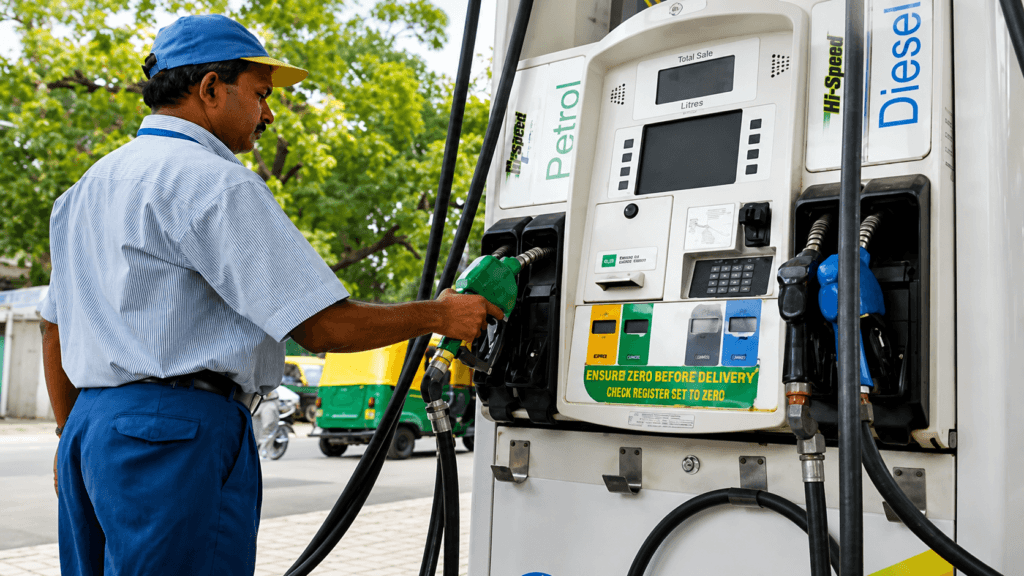
Fuel prices were displayed at a petrol station after another round of rate hikes in major Indian cities.
Petrol Price Hike
Fuel prices across India rose again on Monday, with state-owned oil marketing companies increasing petrol by ₹2.61 per litre and diesel by ₹2.71 per litre. In Delhi, petrol now costs ₹102.12 per liter, while in Mumbai it has climbed to ₹111.21 per liter, adding fresh pressure on household budgets, transport costs, and business operations.
This is the fourth fuel price hike in May and comes after a series of sharp revisions that have pushed up retail rates by nearly ₹7.5 per liter since daily changes resumed on May 15. The latest increase has once again placed fuel inflation at the center of public concern, especially in urban areas where commuting and logistics costs are already high. Yeh issue kaafi important hai because even a small fuel hike quickly affects daily life, from grocery prices to cab fares and delivery charges.
What Caused the Increase
The immediate reason for the rise is the continued impact of surging international crude oil prices. Oil marketing companies have been passing on the cost pressure to consumers as global supply worries remain elevated. According to the report, the uncertainty is linked to a lack of breakthrough in US-Iran talks and concerns around the Strait of Hormuz, a vital global oil shipping route. Hindustan times has covered the full story.
When crude oil becomes expensive or supply risks increase, India, which imports a large share of its oil needs, feels the pressure quickly. That is why domestic petrol and diesel prices can rise even if the change seems sudden to consumers. The mechanism is straightforward: higher global crude prices raise import costs, and those costs are transferred into retail fuel prices.
There is also a timing factor. Fuel price revisions had been frozen for a prolonged period before daily changes resumed on May 15. Once that freeze ended, prices began adjusting faster to reflect market conditions. Since then, the combination of repeated revisions has made the increase feel even sharper to consumers.
City-Wise Fuel Rates
The new rates show how sharply fuel prices now vary across major Indian cities. Delhi, Mumbai, Kolkata, Chennai, and Bengaluru all saw increases, but the absolute prices differ due to local taxes and state levies.
Delhi: Petrol rose from ₹99.51 to ₹102.12 per litre, while diesel climbed from ₹92.49 to ₹95.20 per litre.
Mumbai: Petrol is now ₹111.21 per litre after a hike of ₹2.72, and diesel is ₹97.83 per litre after a rise of ₹2.81.
Kolkata: Petrol increased to ₹113.51 per litre, while diesel reached ₹99.82 per litre.
Chennai: Petrol now costs ₹107.77 per litre, while diesel is priced at ₹99.55 per litre.
Bengaluru: Petrol is retailing at ₹110.69 per litre and diesel at ₹98.69 per litre.
These city-wise differences matter because they show how fuel taxation and local pricing structures influence what consumers pay. In simple words, har city ka fuel bill same nahi hota. The price at the pump is shaped not just by crude oil but also by local taxes and transport costs.
Why Prices Are Rising Repeatedly
This month’s repeated fuel hikes are tied to the larger global energy picture. When the international market faces uncertainty, Indian fuel companies usually adjust prices to avoid absorbing losses for too long. Since India imports much of its crude requirement, even a modest shift in global prices can quickly affect retail rates.
The reported closure of the Strait of Hormuz is especially important because the route is one of the world’s most critical oil corridors. Any disruption there can raise fears of supply shortages or shipping delays, which then pushes crude prices upward. Likewise, the absence of a deal in US-Iran talks keeps geopolitical risk elevated and markets nervous.
From a consumer perspective, the challenge is that fuel prices do not move in isolation. A petrol hike affects auto fares, delivery costs, transport expenses, and eventually the prices of essential goods. That means the effect is not just at the petrol pump. It spreads into inflation, household budgeting, and business operations.
Background and Context
Fuel prices in India are among the most closely watched daily economic indicators because they influence almost every part of the economy. When prices stay stable, the impact is manageable. When they rise repeatedly, especially in quick succession, public concern rises sharply.
The recent sequence of hikes began after a prolonged freeze in daily revisions. The first rise of ₹3 came on May 15, followed by another increase of 90 paise on May 19. On Saturday, the government announced an average hike of 90 paise per liter across all fuel variants, and Monday brought another bigger increase of ₹2.61 on petrol and ₹2.71 on diesel. Together, these revisions add up to nearly ₹7.5 per liter in a short span.
That kind of movement is significant because fuel prices are a core driver of inflation sentiment. Even if the broader economy remains stable, consumers quickly feel the effect when petrol crosses psychologically important levels such as ₹100 in cities like Delhi and much more in places like Mumbai and Kolkata.
Timeline
May 15: Daily fuel price revisions resume after a long freeze; first hike of ₹3 is announced.
May 19: Second increase of 90 paise per liter.
Saturday: Average hike of 90 paise per liter across fuel variants.
Monday: Petrol rises by ₹2.61 per litre and diesel by ₹2.71 per litre.
Current rates: Delhi petrol reaches ₹102.12; Mumbai petrol reaches ₹111.21.
Also Read: Eight Killed as SUV Falls into Gorge in Maharashtra’s Raigad
Why This Matters
This matters because fuel is not just a vehicle expense. It is a major input cost for transport, food distribution, logistics, and many small businesses. When petrol and diesel prices rise, the entire cost chain can feel the pressure. A shop owner, cab driver, delivery worker, or farmer may all experience the impact differently, but they all feel it.
It also matters because repeated increases can affect consumer confidence. Households may cut back on discretionary spending, while businesses may raise prices to compensate for higher transport and operating costs. Over time, this can contribute to broader inflation pressure. Yeh point bahut important hai because one fuel hike can quietly touch almost every Indian family’s monthly budget.
India Angle
For Indian readers, fuel prices are always a daily reality, not just an economic headline. In a country where millions depend on two-wheelers, cars, taxis, buses, and commercial vehicles, even a small rise in petrol or diesel has an immediate effect. The India angle here is especially strong because Delhi has now crossed ₹102 per liter and Mumbai is above ₹111, which makes the hike very visible to ordinary commuters.
The issue also has a strong urban-rural divide. City residents may notice the change at the pump, while rural users may feel it through higher prices of farm inputs, transport, and goods movement. In Hinglish, seedhi baat yeh hai: fuel mehenga hoga toh har cheez ka kharcha dheere-dheere upar jaata hai. That is why fuel pricing always remains a sensitive issue in India.
Analysis
My opinion is that this round of hikes will keep public attention on both global oil markets and domestic pricing policy. The numbers are important, but the speed of the increases matters just as much. When prices rise four times in one month, consumers begin to lose the buffer of predictability. That can influence travel choices, spending habits, and even political mood. The deeper insight is that fuel pricing in India is never just about oil; it is about the intersection of global geopolitics, taxation, and the everyday economy.
What Next
The next few days will depend on global crude trends and whether market conditions stabilize. If international prices ease, the pace of hikes may slow. If supply concerns continue, further revisions are possible and consumers could face more pressure.
For now, city-wise fuel prices will likely remain a key talking point, especially in metros where commuting costs are already high. People may also watch whether authorities step in with any tax-related relief or whether oil companies continue to adjust prices in line with global signals. The next revision cycle will be closely watched because consumers are now highly sensitive to every new jump.
Conclusion
Petrol and diesel prices have risen again, pushing Delhi above ₹102 per litre and Mumbai above ₹111 per litre. The latest hike adds to an already sharp increase this month and reflects persistent global crude pressure, supply uncertainty, and resumed daily price revisions.
For Indian consumers, the impact goes far beyond the fuel station. It affects travel budgets, transport costs, business pricing, and overall household spending. As fuel prices continue to move, the biggest concern will be how long the pressure lasts and whether further hikes are on the way.
Written By A. Jack