
The accident has cast a pall of gloom over the sacred Wari, an annual procession that attracts thousands of devotees in Maharashtra. The crash has raised fresh fears about road safety, convoy management and protection of pilgrims during religious yatras.
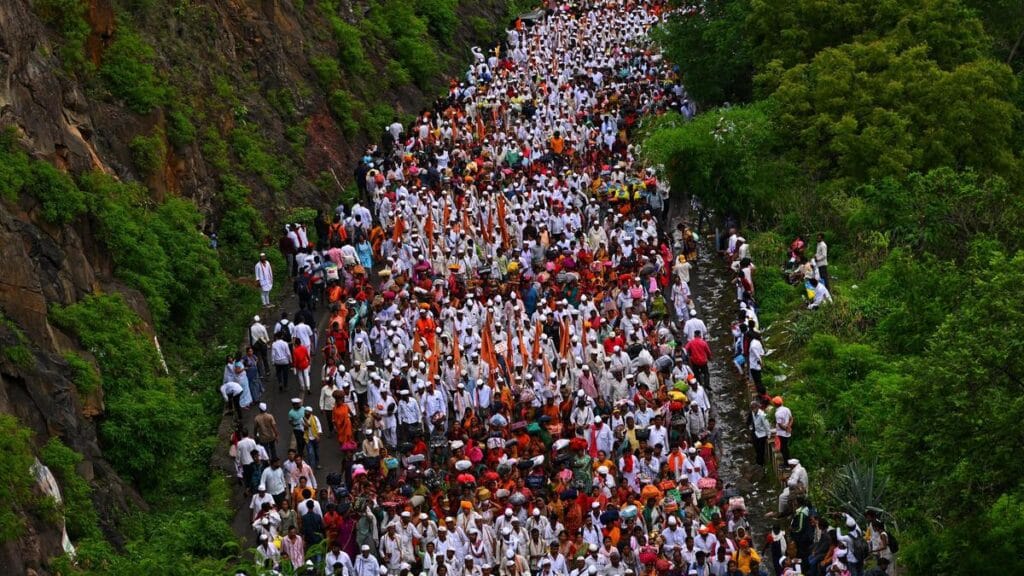
As the Dnyaneshwar Maharaj palki (pallanquin) passes through the Dive ghat close to Pune, Warkaris follow it. Image Credit: The Hindu
Pune Pilgrims’ Truck Accident: A tragic road accident in the Pune district on Monday claimed the lives of three warkaris and left 10 others injured after a truck hit a group of pilgrims walking on the road during the Ashadhi Wari. According to Pune Police, the accident occurred on the Saswad-Jejuri Road, where one of the Wari trucks rammed into the group of devotees.
Police said the truck involved in the incident was carrying warkaris from Nanded district, while the group that was struck had come from Kasbedigraj in Sangli district. The loss of life during such a sacred and deeply followed religious journey has left devotees and local residents shocked. Yeh incident kaafi painful hai because the Wari is usually seen as a journey of devotion, discipline and collective faith, not tragedy.
What Happened
The accident took place when the truck, part of the Wari movement, hit a group of pilgrims walking on the road. Three people died on the spot or shortly after the crash, while 10 others were injured and required medical attention. The exact reason for the collision has not been detailed in the available report, but the incident appears to have happened amid a large and moving procession of pilgrims and support vehicles. This story was also covered by The Hindu.
Road accidents involving pilgrims are especially dangerous because the movement often includes both pedestrians and vehicles in close proximity. In this case, the truck was reportedly carrying pilgrims from Nanded, while the group on foot came from Sangli. That detail suggests the accident happened in a crowded and highly coordinated religious environment where even a small lapse in driving attention or movement control can have devastating results.
Police will likely need to determine whether the driver lost control, whether visibility was poor, whether speed was a factor, or whether traffic arrangements along the pilgrimage route were not followed properly. These are the kinds of questions that matter in a case like this because accountability depends on exactly how the crash occurred.
Why the Wari Context Matters
Ashadhi Wari is one of Maharashtra’s most important religious pilgrimages, and it carries deep cultural meaning for millions of devotees. Warkaris walk long distances to reach Pandharpur, and the journey is marked by singing, devotion, discipline and community participation. Because of its scale, the procession requires careful coordination between pilgrims, transport vehicles, police and local authorities.
That is why a fatal accident like this is so alarming. The Wari is meant to be a sacred act of devotion, and safety should be part of that spiritual experience. When pilgrims are killed by a vehicle connected to the same journey, it becomes both a human tragedy and a management failure. Yeh issue kaafi important hai because religious events of this scale need strong safety planning, not just faith and tradition.
The emotional impact is also significant. Families who send their loved ones on pilgrimage expect them to return safely. When deaths happen on the route itself, the shock is deeper because the journey is viewed as spiritually rewarding and socially shared. The loss is not only personal; it affects the entire devotional community.
Background and Context
The Wari tradition has a long history in Maharashtra and remains one of the most respected religious gatherings in the state. Every year, lakhs of devotees participate in foot marches, community singing and collective worship on the way to Pandharpur. Because the event is so large, vehicle movement and road traffic must be managed extremely carefully to avoid accidents.
Pune district often becomes a key passage in such religious movements, and roads like Saswad-Jejuri see intense activity during pilgrim travel. That means local police, traffic teams and organisers usually need to coordinate the flow of both walking groups and support vehicles. Even when the system is well planned, the volume of people can create risk.
This tragedy also reflects a broader transport issue in India: road safety during mass gatherings. Whether it is a religious procession, political rally or festival crowd, Indian roads become especially vulnerable when pedestrians and vehicles are mixed together. The Pune accident is a grim reminder that safety planning must be more than a formality.
Timeline
Monday: A truck carrying warkaris from the Nanded district moves along Saswad-Jejuri Road.
At the same time: A separate group of pilgrims from Kasbedigraj in the Sangli district is walking on the road.
Collision: The truck rams into the walking group.
After the accident: Three pilgrims die and 10 are injured.
Police response: Pune Police confirm the details and begin further investigation into the crash.
Also Read: Delhi Police Constable Shoots Wife Dead in Kalyanpuri After Argument, Leaves Her on Road
Why This Matters
This matters because the victims were not just road accident statistics; they were pilgrims on a sacred journey. In India, accidents involving devotees during religious travel always hit harder because they mix faith, community and loss. This is especially true in Maharashtra, where the Wari is a cherished tradition. Yeh topic kaafi sensitive hai because it reminds us that safety must travel with devotion.
It also matters because the incident raises questions about how vehicles and foot pilgrims are managed together. If trucks carrying pilgrims are operating in the same space as walking groups, there must be strict route control, speed regulation and separation protocols. Otherwise, one mistake can turn into a deadly crash.
There is also a public policy lesson here. States and district administrations often focus on crowd management at the main destination, but accidents can happen on the route itself. That means road safety during pilgrimage must be treated with the same seriousness as the event at the final venue.
India Angle
For Indian readers, this story has direct cultural and emotional relevance. Warkari pilgrimages are not just religious events; they are a living part of Maharashtra’s identity. In Hinglish, seedhi baat yeh hai: jab itni pious journey mein road accident hota hai, toh dukh aur bhi gehra ho jaata hai. The incident will likely prompt discussions in Maharashtra about transport discipline and devotional procession safety.
This is also a reminder for the wider country. India sees thousands of large religious gatherings every year, and many of them involve road travel, processions and temporary traffic management. A single mistake can have a big human cost. So the lesson from Pune is not limited to one district; it is applicable across India.
The accident may also draw attention to the safety of trucks and support vehicles used during pilgrimages. These vehicles often move with large groups and may be under pressure to keep pace with the procession. That makes driver alertness, vehicle condition and route supervision absolutely essential.
Analysis
My opinion is that this story should not be framed only as an unfortunate accident. It should also be seen as a systems issue. When a truck hits a group of walkers in the middle of a pilgrimage, the question is not just “what happened?” but “how was such a collision allowed to happen in the first place?” That is where traffic planning, convoy discipline and enforcement become crucial.
I also think the fact that the truck was carrying warkaris from Nanded while the victims were from Sangli underscores how mixed and complex these processions are. Different groups, routes and vehicles often overlap. Without strong control, such overlaps can turn dangerous very quickly. In a procession of faith, even a few seconds of inattention can change many lives.
From an editorial perspective, the story also has strong emotional value because it combines devotion and loss. The headline is naturally attention-grabbing, but the article should stay respectful and grounded in facts. That balance matters in reporting tragedies involving religious pilgrims.
What Next
The immediate next step will likely be a detailed police investigation into the driver, the truck’s speed, the route conditions and any traffic control failures. Authorities may also examine whether the vehicle was following the right movement protocol for the procession. Post-accident medical care for the injured pilgrims will remain an urgent priority.
District officials may also review safety arrangements for the ongoing Wari movement. That could include better separation of pedestrian pilgrims and support vehicles, clearer route marking, stricter speed checks and more police deployment at critical stretches. If the accident is taken seriously, it could lead to tighter safety rules for future pilgrimages.
For families and the wider Warkari community, the focus now will be on mourning the dead and supporting the injured. Religious leaders and local organisers may also call for stronger safeguards so that future yatras do not end in similar tragedy. That is likely to become a major part of the public conversation in the coming days.
Conclusion
The deaths of three warkaris and injuries to 10 others in the Pune truck accident have turned a sacred Ashadhi Wari journey into a scene of mourning. The crash on Saswad-Jejuri Road is a reminder that large pilgrimages need not only devotion and discipline, but also strict road safety and better coordination. As police investigate the exact cause, the larger lesson is clear: faith journeys must be protected by strong public safety systems. Only then can tradition continue without such heartbreaking loss.
Written By A. Jack