
Railway officials said the 8.33 am train suffered a technical glitch and the cooling system failed around 9.26 am during peak hour operations. Local Titwala-CSMT. The incident has brought up urgent questions about passenger comfort, emergency response and maintenance readiness in Mumbai’s AC locals.
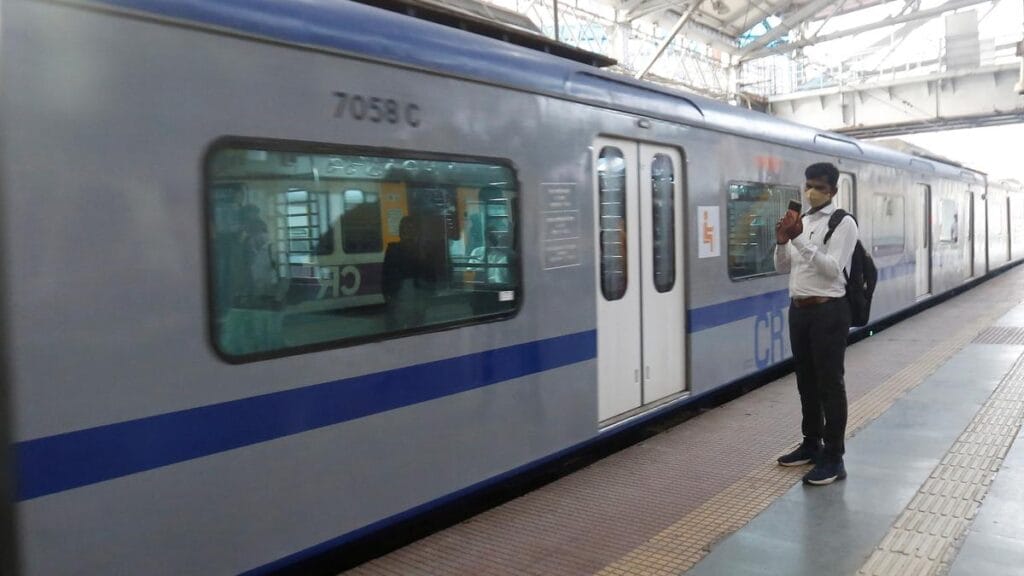
An AC local train at Mulund station after the cooling system failed. Image Credit: The Hindu.
A routine Monday commute on Mumbai’s suburban rail network turned uncomfortable and frightening when the cooling system of an air-conditioned local train failed at Mulund station, leaving passengers feeling suffocated and panicked. According to railway officials, the incident occurred around 9.26 a.m. when the AC system of the 8.33 a.m. Titwala-CSMT local developed a technical fault and shut down the cooling system while the train remained halted at the station.
One commuter lost consciousness and had to be hospitalised, while two others reportedly suffered breathing difficulties. The episode quickly drew public attention after videos of distressed passengers inside the train spread widely on social media. Yeh incident kaafi serious hai because it shows how quickly a daily commute can turn into a health emergency when basic train systems fail.
What Happened
The train involved was an AC local running from Titwala toward Chhatrapati Shivaji Maharaj Terminus, one of the busiest commuter corridors in the city. During peak morning hours, when passenger demand is already high and trains are tightly packed, the cooling system reportedly developed a technical error. Once the cooling shut down, the inside of the train became increasingly uncomfortable, and passengers began complaining of suffocation. This story was also covered by The Hindu.
Railway officials said the incident took place while the train was halted at Mulund station. That detail is important because even a short stoppage in a packed AC coach can become difficult for commuters if ventilation or cooling fails. In normal circumstances, the AC system is meant to keep the air inside comfortable and regulated. But when it stops working during a crowded rush period, the coach can quickly feel stifling.
One passenger fainted and was hospitalised. Two others struggled with breathing, which indicates that the problem was not just discomfort but a genuine health concern. The exact cause of the technical error has not yet been detailed publicly, but the failure itself was serious enough to require immediate attention and likely service-level review.
Why the Incident Became So Alarming
The main reason this incident gained attention so quickly is that it happened in an AC local, which passengers generally choose for comfort and relief from heat and crowding. When that system fails, expectations collapse almost instantly. People board such trains believing they will have a safer and more comfortable ride than ordinary non-AC coaches. So when the cooling stops, the sense of trust is broken.
Another reason the incident became alarming is the way it was captured online. Videos of passengers struggling to breathe and looking visibly distressed spread rapidly on social media. In today’s news cycle, such clips intensify public reaction because they make the discomfort visible and immediate. People do not just hear that something went wrong; they can see the panic in real time.
Mumbai’s suburban railway network carries millions of passengers every day, which means even a single failure can affect public confidence. This was not a derailment or collision, but it was still a serious service disruption because it affected commuter health and safety. In a city where train travel is part of daily life, such incidents matter a lot.
Background and Context
Mumbai’s AC locals were introduced to provide a more comfortable commuting option in one of India’s most densely used rail systems. They are especially valued during the city’s humid months, when normal local trains can become extremely crowded and uncomfortable. For many commuters, AC trains represent a premium but necessary alternative to regular services.
However, with that premium comes an expectation of reliability. If the cooling fails, the entire point of the service is compromised. That is why this incident is likely to trigger questions about preventive maintenance, response time and how railway staff handle mid-route technical failures.
Suburban rail safety in Mumbai often focuses on overcrowding, delays and infrastructure strain. But this episode shows that comfort-related failures can also become health concerns, especially for elderly passengers, children or people with breathing issues. In an overcrowded city, even a technical fault inside a coach can quickly turn into a public safety issue.
Timeline
8.33 a.m.: The Titwala-CSMT AC local departs on schedule.
Around 9.26 a.m.: The train’s AC system develops a technical error.
Soon after: The cooling system shuts down while the train is halted at Mulund station.
Immediately afterward: Passengers complain of suffocation and breathing discomfort.
During the incident: One commuter falls unconscious and is hospitalised.
Later: Videos of the distress inside the coach circulate on social media.
Why This Matters
This matters because public transport is supposed to be dependable, especially in a city like Mumbai where millions rely on trains to reach work, school and appointments on time. When a train’s cooling system fails so badly that passengers feel suffocated, the issue is no longer just about comfort. It becomes a question of commuter safety and trust. Yeh issue kaafi important hai because commuters need to know that the service they pay for will remain functional in basic ways.
It also matters because incidents like this can affect how people view AC local trains overall. If riders start worrying that the cooling system may fail during peak hours, they may lose confidence in the service. That can reduce ridership, increase frustration and put pressure on the railway administration to respond more visibly.
There is also a health and emergency response angle. One passenger had to be hospitalised, which means train operators must be prepared for medical incidents, especially in crowded compartments. Quick evacuation, first aid and communication are essential in such situations.
India Angle
For Indian readers, this story connects directly to everyday urban commuting. In Hinglish, seedhi baat yeh hai: Mumbai mein train sirf transport nahi, logon ki daily life ka backbone hai. When that backbone shows cracks, thousands of people feel the impact immediately. The issue is not isolated to one train or one station; it reflects the pressure on India’s busiest rail network.
This also raises a bigger Indian transport question: as cities modernise and add premium services like AC locals, are maintenance systems improving at the same pace? A premium service should not just look better; it should work better and be more reliable. If basic cooling fails during rush hour, that sends a worrying signal.
The incident will also resonate with people in other Indian metros that depend on crowded public transport. Whether it is Delhi, Mumbai, Bengaluru or Kolkata, commuters expect modern systems to function without creating new risks. This is why the story has relevance beyond one train route.
Analysis
My opinion is that the most important issue here is not the viral video but the system failure behind it. Viral content may bring attention, but the real story is about maintenance standards and emergency readiness. If the AC system developed a technical error during peak hours, railway officials will need to examine whether it was a one-off fault or part of a larger service gap.
I also think this incident could push the railways to review how it handles halted AC coaches in high-density conditions. A train full of people with no cooling can become unsafe very quickly. There should be clear protocols for such breakdowns: prompt announcements, rapid technical intervention, and if needed, passenger deboarding at the earliest safe point. Those are the kinds of practical lessons that matter more than public statements alone.
Another point is passenger expectations. AC locals are marketed as comfort trains, so their reliability becomes part of the product itself. When they fail, the disappointment is more intense than with a standard local. That is why such incidents often travel fast online and get strong public reaction.
What Next
The next step will likely involve a technical inspection of the affected train and its AC system. Railway officials may review what caused the shutdown, whether spare systems responded as expected and whether maintenance schedules need to be tightened. If a recurring fault is found, it could lead to stronger checks across similar rakes.
There may also be a review of emergency handling at Mulund station. Officials may want to know how quickly passengers were assisted, whether medical help reached the unconscious commuter in time and whether the train crew followed the right procedure. Such reviews are important because they help improve response during future incidents.
For passengers, the main hope is simple: that this does not repeat. People can tolerate delays and even routine discomfort to some extent, but a suffocation-like situation inside a train is a different matter. The railway system will need to reassure commuters that AC local services are being monitored more carefully.
Conclusion
The failure of the cooling system in a Mumbai AC local at Mulund station turned a regular Monday commute into a frightening health scare, with one passenger hospitalised and two others struggling to breathe. The incident has exposed how a technical fault in a crowded train can rapidly become a public safety concern, especially during peak hours. For Mumbai commuters, it is another reminder that reliable maintenance is just as important as new services. As the railways investigate the cause, the big question is whether this will lead to real improvements or remain just another viral commuter crisis.
Written By A. Jack