
The boy was playing around his home at about 10:30am when he fell into one of many unguarded pits dug for sewage and rainwater drainage. The incident raises new questions about safety checks, contractor accountability and local civic oversight.
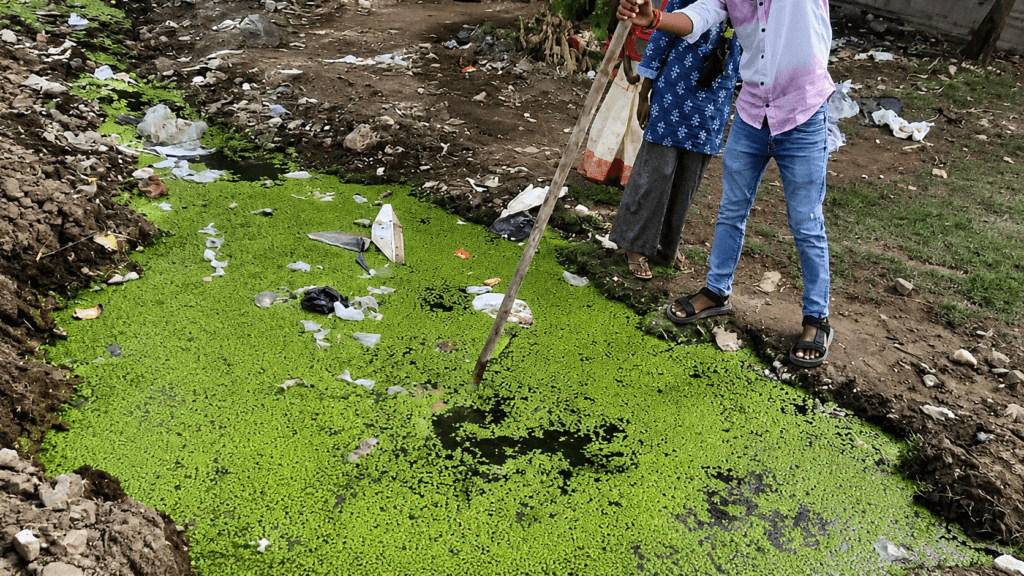
A sewage and rainwater drainage pit in Pune, where two-year-old Soham Lakhan Kasbe drowned after falling. Image Credit: NDTV
A heartbreaking accident in Pune claimed the life of two-year-old Soham Lakhan Kasbe on Thursday morning after he fell into a rainwater-filled sewage pit near his home in the Loni Kalbhor area. Police said the child was playing in front of his house around 10:30 am when he slipped into one of the unguarded pits and drowned before help could arrive. A case has now been registered against an unidentified contractor, as allegations grow that the pits had been left open without any proper safety measures.
The incident has shocked local residents and once again brought attention to a recurring civic failure in Indian cities and towns: open pits, incomplete drainage work and poor site protection. In a setting where children play close to homes, even a small lapse can turn fatal within minutes. Yeh tragedy kaafi painful hai because it involved a very young child and an entirely preventable hazard.
What Happened
According to the police, Soham was playing outside his home when he fell into one of four pits dug for sewage and rainwater drainage. These pits were allegedly left open without barriers, warning tape or other safety arrangements. Because they had filled with rainwater, the danger was not visible from the surface, which made the spot even more hazardous. NDTV has covered the full story.
That detail is especially important. Open pits are dangerous enough on dry ground, but when rainwater collects inside them, they can appear like shallow puddles while actually hiding a deep cavity. For a child, there is no way to assess that risk. A simple slip can become fatal almost instantly.
The exact sequence of rescue efforts was not detailed in the provided information, but the outcome was tragic. By the time the child was pulled out, it was too late. The case has now become a criminal matter, with Loni Kalbhor police registering a case against an unidentified contractor involved in the work.
Why the Pit Was So Dangerous
The allegations suggest that four pits were dug for sewage and rainwater drainage and then left open without safety measures. If true, that means the site lacked the most basic precautions: fencing, barricades, warning signs and supervised access control. These are not optional extras; they are standard safety steps on any excavation site.
In India, construction and utility work often happens in residential areas where children, elderly residents and pedestrians move close to the work zone. When contractors fail to secure open pits, the burden of risk shifts unfairly onto the public. The result is not just inconvenience but also a serious safety hazard.
This incident also highlights how rain increases the danger. A pit filled with rainwater is harder to identify and can be mistaken for a harmless patch of ground. For a toddler, who cannot be expected to recognise danger, the risk becomes extreme. That is why local site management matters so much. Even a few hours of negligence can lead to irreversible loss.
Police and Legal Action
Pune’s Loni Kalbhor police have registered a case against an unidentified contractor. That is an important first step, because it shows that authorities are treating this as more than an accident. The legal process will likely focus on how the pits were left open, who was responsible for maintaining site safety and whether negligence directly contributed to the child’s death.
A case against an unnamed contractor also suggests the investigation is still at an early stage. Police will need to determine which company or individual was managing the work, whether the site had safety instructions and whether workers had failed to follow mandatory precautions. In such cases, liability can extend beyond one person if multiple layers of negligence are found.
The broader question is whether this death could have been prevented. Based on the available details, it appears that adequate precautions may not have been in place. If that is confirmed, the case will become another painful example of how regulatory enforcement often arrives only after tragedy.
Background and Context
This incident comes at a time when Maharashtra is already facing a wave of civic-safety complaints and fatal accidents. In the same week, an 11-year-old boy, Vihaan Srivastava, was killed in Mumbai’s Chembur when a tree collapsed on his school bus. Residents there have alleged that repeated complaints about unsafe trees were ignored by local bodies.
In another case, a 55-year-old man in Mumbai died after falling into an open manhole amid heavy rain. That death led the civic body to suspend four officials and order a high-level inquiry. The pattern is disturbing: different cities, different hazards, same underlying issue — preventable danger left unattended.
The Pune toddler’s death now adds another layer to this pattern. It is not just about one pit or one contractor. It is about how civic agencies, contractors and local authorities manage everyday risk in densely populated neighbourhoods. The recurring theme is simple but serious: complaints, warnings and visible hazards are not being addressed quickly enough.
Timeline
Before the incident: Four pits are reportedly dug for sewage and rainwater drainage in the area.
Thursday morning, around 10:30 am: Soham Lakhan Kasbe is playing in front of his house.
Moment of accident: The toddler falls into one of the unguarded rainwater-filled pits.
After the incident: The child is declared dead.
Police action: Loni Kalbhor police register a case against an unidentified contractor.
Wider context: The death comes amid other fatal civic-safety incidents in Maharashtra this week.
Also Read: 2 Electrocuted as Water Tanker Touches Power Line in Maharashtra; 1 Dies in Sambhajinagar
Why This Matters
This matters because a two-year-old child should never die in a place where he was simply playing near home. The tragedy is not only emotional; it is also a failure of duty. Safety barriers, warning signs and basic supervision could have made a life-saving difference. Yeh issue kaafi important hai because it shows how one overlooked site can turn into a death trap.
It also matters because such accidents erode trust in civic systems. When families see open pits, broken roads, exposed wires or unguarded manholes, they begin to feel that the city is unsafe even in ordinary spaces. That fear has a real social cost. Parents become more anxious, neighbourhoods become more cautious and communities lose confidence in local oversight.
For India’s growing urban and semi-urban areas, this is a warning. Infrastructure projects cannot be measured only by completion rates and budgets. They must also be judged by how safely they are managed during the work itself.
India Angle
For Indian readers, this story feels painfully familiar because many neighbourhoods across the country deal with similar hazards. In Hinglish, seedhi baat yeh hai: jab kaam chal raha ho, tab safety chhoti cheez nahi hoti — wahi sabse important hoti hai. A pit without barriers near homes is not just a construction issue; it is a public risk.
This also connects to a broader Indian problem: the gap between infrastructure development and on-ground safety. A drainage or sewage project may be necessary, but if it is not properly secured, the people living around it bear the danger. Children are especially vulnerable because they are naturally curious and cannot judge depth or hidden water.
In cities like Pune, where residential areas often sit close to active repair and drainage works, local bodies and contractors need to take visible precautions. Public awareness matters too, but the primary responsibility lies with those who dig the pits and leave them open.
Analysis
My opinion is that this case highlights a recurring failure of site discipline. Open pits in residential areas should never be left unsecured, especially during the rainy season. Even when work is ongoing, the risk management plan should be non-negotiable. A child’s death should never be the price of administrative laziness.
What makes this more troubling is that this tragedy happened alongside other preventable deaths in Maharashtra. That pattern suggests there may be a wider enforcement problem, not just one bad site. Civic authorities need to inspect work zones proactively, not after an accident makes headlines. Prevention is the real test of governance.
I also think the contractor angle is critical. In many such cases, responsibility gets blurred between contractors, supervisors and civic departments. That is exactly why investigators must identify the chain of accountability. If a pit was left open, someone made that choice. The law should find out who and why.
What Next
The police investigation will now focus on identifying the contractor and checking whether safety norms were ignored. Investigators may also look at whether the pits were marked, fenced or covered, and whether residents had previously complained about the site.
If negligence is proven, the case could lead to stronger legal action and possibly departmental review of similar drainage works in the area. Local authorities may also be pushed to inspect other open pits and construction zones before more harm is done.
For the family, the immediate concern is grief and justice. For the city, the next step should be prevention. This means covering pits, enforcing site barriers and making sure no residential excavation is left exposed again.
Conclusion
The death of two-year-old Soham Lakhan Kasbe in a rainwater-filled sewage pit is a devastating reminder that civic negligence can be fatal even in the most ordinary settings. A child playing outside his house should have been safe, but open and unguarded pits turned the space into a hazard. With police now investigating and a contractor under scrutiny, the case has become part of a larger warning for Pune and other Indian cities: infrastructure work must be made safe before it becomes deadly.
Written By A. Jack