A 44-year-old man from Agra, Uttar Pradesh, who was reported missing by his wife for over 45 days, was allegedly murdered by her with the help of an accomplice. Police investigations uncovered a carefully planned crime that shocked the local community.
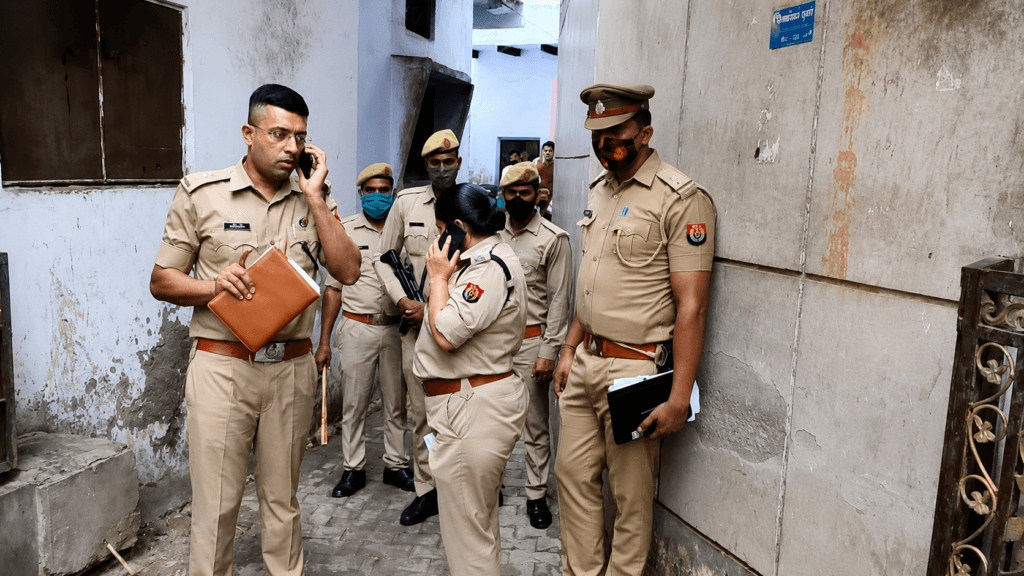
Police officials investigate the alleged murder of a 44-year-old Agra man after a 45-day missing person complaint led to the arrest of his wife and her alleged accomplice
The police in Uttar Pradesh revealed that a woman who claimed that her husband had gone missing for nearly 45 days was allegedly behind his murder, shocking Agra and the entire state. Investigators say the victim, a 44-year-old man, was killed in a pre-meditated conspiracy and his wife tried to dupe police and family members by filing and perpetuating a missing person narrative.
The shocking revelation came after a sustained police investigation that identified inconsistencies in the woman’s statements and led officers to question her further. Investigators say they uncovered evidence during questioning that she and an alleged accomplice planned and executed the murder, then tried to cover it up.
The case has once again highlighted how missing persons cases can sometimes cover up much more serious crimes, emphasizing the need for thorough police investigations.
How the Police Uncovered the Alleged Murder Plot
Police officials said the victim was missing for approximately 45 days. In that time, his wife reportedly told relatives and authorities that he disappeared under mysterious circumstances. The family kept looking, and police began a routine missing persons investigation.
However, investigators soon began to notice contradictions in the woman’s statements and evidence collected during the inquiry. Technical surveillance, witness accounts and other investigative inputs had allegedly raised questions over the sequence of events she described.
The police pressed harder and harder, and the investigation supposedly revealed a murder plot. The crime is thought to be premeditated and police are of the belief that a second person, who is thought to be an acquaintance of the suspect, helped carry it out.
Investigators are exploring potential motives for the killing, such as possible domestic disputes, financial disagreements and personal relationships. Officials have said all angles are still being explored till the charge sheet is filed.
Critical evidence has been recovered by the police in the course of the investigation and further forensic material is being collected to build the case for the prosecution.
Investigation Reveals a Carefully Planned Crime
Police officials said the accused tried to create an impression that the victim has voluntarily disappeared. Investigators say the accused kept up the missing person story for more than six weeks in the hope that suspicion would eventually fade.
Digital evidence, including mobile phone records and other forensic leads, helped expose the alleged conspiracy, authorities said. Officers also used statements from witnesses who said they saw strange behaviour after the victim disappeared.
The investigation reveals how modern policing increasingly relies on technology, surveillance data and forensic science rather than just eyewitness testimony.
Officials said more investigation is ongoing to determine whether other people assisted in planning or covering up the alleged crime.
Police Statement
The question came up as police officers asked questions and got inconsistent answers, senior police officers said.
Police said in a statement that the investigation into the missing person gradually revealed facts pointing to foul play. During the inquiry, the accused was grilled and several facts about the alleged murder came to light from the evidence collected against the accused.
Investigators have said all legal procedures are being followed and scientific evidence will play a major role in the prosecution case.
If proven in court, alleged attempts to destroy evidence or mislead investigators could lead to additional criminal charges on top of murder, legal experts say.
Also read:Siya Goyal Lover Chetan Chaudhary Sent to 14-Day Judicial Custody in Pune Murder Case
Family Left Devastated
Reports said the victim’s family had been searching for him for weeks, thinking he had mysteriously disappeared. Family members were hopeful he would one day return home, unaware police were slowly piecing together a picture of a much more sinister truth.
The alleged crime has shocked the community and the case has been called deeply disturbing by local residents.
The increasing number of domestic disputes that have become violent has many residents worried and points to the need for timely intervention in serious family conflicts.
Background
There have been several cases in India where people were reported missing and later found to be homicide victims. In many of these investigations, family members or those close to the victim have been identified over time as prime suspects.
In these instances, police forces started to rely more and more on forensic science, digital footprints, CCTV footage, mobile tower data and financial transaction records.
Missing person complaints are no longer a routine administrative matter, experts say. Many police departments across the country are employing sophisticated investigative techniques that can now detect suspicious patterns much earlier.
Investigators know that in many cases, getting evidence early is key to uncovering a hidden crime, although each missing person case is different.
Timeline of Events
The victim is thought to have disappeared around 45 days before police cracked the case. His wife soon notified authorities and family members when he disappeared.
In the following weeks police carried out routine inquiries, spoke to relatives and examined the evidence available. But as the investigation continued, officers’ suspicions were reportedly raised as they found inconsistencies.
Further questioning, technical evidence and witness testimony allegedly revealed the plot to kill. The police later arrested the suspect and continued to gather evidence related to the case.
The investigation continues with forensic examinations and legal processes underway.
Why This Matters
“This is a huge case because it shows that no missing person investigation should ever be dismissed. What seems to be a disappearance may actually hide a crime that is well concealed.
It also shows the growing role of forensic technology in criminal investigations. Digital evidence often tells a story that human statements can’t hide forever.
For society, the case serves as a reminder that domestic conflicts can sometimes spiral into tragic violence if left unresolved. This is a very important issue that reiterates the need for better family counseling, mental health awareness and early reporting of suspicious behaviour.
Such investigations are also important for public confidence in policing. If police can detect covert crimes through patient investigation, it boosts faith in law enforcement agencies.
India Angle
This case has wider implications than Agra for Indian readers. Police departments across the country receive thousands of missing person complaints each year. The result is usually safe, but there are cases that unfortunately reveal serious crimes.
The incident also highlights evolving investigative techniques in India. Today’s policing includes traditional field investigation, digital surveillance, forensic science, cyber analysis, and behavioral assessment.
It’s an important reminder for aam logon as well that if someone goes missing under unusual circumstances, every detail matters. “Families should report suspicious developments immediately and cooperate with investigators fully rather than assume that a person has simply left voluntarily.
With India’s criminal justice system continuing to modernize, cases like this show how technology is making it increasingly difficult for offenders to cover up serious crimes.
Analysis
The headlines hide a much more serious social problem. A lot of violent crime is unresolved domestic violence that eventually escalates over time. While investigations often lead to the identification of suspects, the prevention of such tragedies lies in greater awareness of family counseling, conflict resolution and mental health support.
Another important message is the power of patient detective work. The investigators would not take the missing person story at face value and insisted on looking at the evidence until the inconsistencies came out.
It is also a reminder that criminal investigations, increasingly, are driven by evidence, not by confessions. Solving complex cases often depends on mobile records, forensic findings, CCTV footage and witness timelines.
But it is as important for us as journalists to bear in mind that allegations are still under judicial scrutiny. Everyone charged with a crime has the right to a fair trial. In the end, the court decides whether the person is guilty or not guilty based on the evidence presented during a legal trial. This story also covered by Times of India
What Happens Next?
Police are expected to complete the forensic examination, gather more witness accounts and complete the charge sheet before the matter is taken to court.
Also investigators may be looking into if anyone else helped plan or cover up the alleged murder
The accused will be tried under the relevant provisions of the Indian criminal law, while prosecutors will attempt to prove the alleged conspiracy through documentary, forensic and digital evidence.
Criminal liability will be determined by the court after taking into account all evidence and hearing arguments from the prosecution and defense.
Conclusion
The Agra murder case is a grim reminder that some missing person investigations conceal heartbreaking realities. What began as a search for a missing husband ultimately transformed into a murder investigation that allegedly implicated the very person who reported his disappearance.
The case highlights the importance of scientific investigation, patient police work, and forensic evidence in uncovering the truth. It also raises broader questions about domestic violence, trust within families, and the warning signs that often go unnoticed until tragedy strikes.
As legal proceedings move forward, investigators will continue collecting evidence while the courts determine the outcome. Until then, the case remains a powerful reminder that every missing person report deserves thorough investigation because the truth may be far more disturbing than it initially appears.