A plea has been moved in the Delhi High Court seeking urgent intervention for activist Sonam Wangchuk who is on an indefinite hunger strike and may not survive beyond two days if the protest continues. The petition asks the court to order that he be taken to a government hospital and force-fed to save his life.
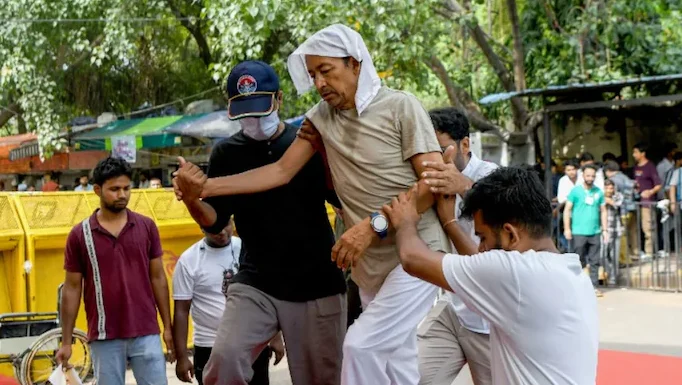
The Delhi High Court is set to hear an urgent plea seeking medical intervention in activist Sonam Wangchuk’s hunger strike. Image Credit: NDTV
A plea filed before the Delhi High Court has ignited a new debate on protest rights, state responsibility and the limits of hunger strikes in India. Activist Sonam Wangchuk, who has been on an indefinite hunger strike since June 28, may not survive more than two days if his fast continues, the petition says, and the court should order his immediate medical care.
The plea, filed by lawyer Rakesh Kumar Saini, says the activist has lost around 8.5 kg and is in a dangerously weak condition. It argues that the government has been “least concerned and insensitive” and seeks directions for admission into a government hospital and to force feed him with nutrients, vitamins and liquids necessary for survival. The Delhi High Court, which noted that no one appeared on behalf of the Union government during the hearing on Thursday, will hear the matter on Friday. This is a very serious issue as it lies at the intersection of protest, law and the state’s duty to protect life.
What the Petition Says
The petition is based on a strong case – the right to demonstrate peacefully in a public place is a fundamental democratic right. If Wangchuk dies due to starvation, it would be a shame for the country and the world, the petitioner says. The plea said the courts would not allow the state to see a citizen dying of hunger before its eyes.
The petition calls for medical intervention to be made mandatory. The “simple thing” to do, the lawyer says, would be to take Wangchuk to a government hospital and give him liquid nutrition, minerals and vitamins so his body can survive. The petitioner further submits that the inaction of the government may amount to abetment of suicide. These are grave words, and they illustrate how easily a protest can turn into a constitutional and ethical emergency. This story was also covered by NDTV.
The petition also claims the government has treated the activist like a “hardcore criminal, terrorist or traitor to the nation” and has not cared for his health. That kind of language is unusually sharp but it gets across the urgency that the petitioner wants the court to feel. The legal argument is that if hunger strikes become life threatening, then the state cannot simply stand by.
Why the Case Has Reached Court
The petition mentioned that Sonam Wangchuk has been on an indefinite hunger strike since June 28. His protest is tied to the demands of the group he joined, the Cockroach Janta Party, which calls itself a “political front of the youth, by the youth, for the youth.” The immediate provocation mentioned in the report is Wangchuk’s call for the resignation of Union Education Minister Dharmendra Pradhan over alleged irregularities in the NEET examination.
That link is important because it explains why the case is about more than just one activist’s health. It is also about public anger on education-related issues, especially among the students and youth. When the protest is on an issue such as exam irregularities, the emotional quotient kicks in very fast as it touches lakhs of families and students across India. This is not a fringe issue, this is a national concern.
A hunger strike also adds moral weight to a protest. Now, there is a long political history of fasting in India but it is always dangerous when prolonged. Once the body starts to decay, the distinction between symbolic protest and medical emergency is very thin. That is exactly what the Delhi High Court is now being asked to grapple with.
Court Proceedings to Date
No one appeared for the authorities and a bench headed by Chief Justice D.K. Upadhyaya and Justice Tushar Rao Gedela adjourned the hearing till Friday. The delay was ascribed to an ongoing work abstention by the High Court Bar Association. The court would also ask the registry to serve the order on the authorities on the same day.
This is a procedural point that matters because it means the court is not dismissing the issue. Instead it is proceeding cautiously and allowing the government a chance to respond. The usual judicial caution on health issues, the right to protest and possible involuntary treatment. The court will probably have to balance personal freedom against the state’s obligation to protect life.
The posting of the matter for the next day also indicates urgency. Courts generally do not expedite hearings unless the matter is considered time-sensitive. Here the petitioner has alleged that if the strike continues, Wangchuk may not have long to live. This lends the case immediate legal heft.
Background and Context
Sonam Wangchuk is a household name as an activist and a face of education reform, with public notoriety far exceeding one protest. That means his hunger strike is likely to draw high-profile interest from students, civil society groups and political observers alike. When a public figure of this sort chooses a fast unto death, the response tends to be bigger than the immediate protest site.
India has had many hunger strikes over the years, but not all of them end up in courts. This one is because the petitioner believes that the protest has crossed over from life threatening. When the activist starts to lose significant amounts of body weight and the risk of death is reported, the question is not about “should the protest be allowed?” but “how should the state react?” That’s the big shift here.
There is also a larger context of continuing public concern about NEET and exam fairness. The moment there are allegations of irregularities in a national entrance exam, the issue turns political. Students feel it directly, parents feel it deeply and the government is intensely scrutinised. In such an atmosphere, protests can easily escalate beyond their original cause. This case is right in the middle of that pressure cooker.
Timeline
June 28: Sonam Wangchuk starts indefinite hunger strike.
During the strike: He participates in protests led by the Cockroach Janta Party.
He had lost around 8.5 kg by Thursday, the plea before the Delhi High Court said.
Thursday hearing : Court hears matter briefly and posts it for Friday.
Friday: Delhi High Court is likely to hear the plea seeking urgent medical intervention.
Why This Matters
This matters because it forces a direct conversation about the limits of protest in a democracy. Peaceful protest is protected and important, but when a protest becomes medically dangerous, the state cannot ignore the risk to life. This is an important question, because it asks whether the government should simply watch and not act, or intervene to prevent a possible death.
This matters to students and the education system as a whole. If the protests are about grievances related to NEET then it is an issue that concerns millions of young people whose future depends on a fair examination. For many families, exam credibility is not an abstract legal issue. It’s a life choice, a career and social mobility.
There is a human angle to be considered also. Someone on an 18-day hunger strike, and with serious weight loss, is already in a very fragile physical condition. Whether you agree with his politics or not, the question of his survival becomes central. The court is being asked to decide whether medical intervention, persuasion or continued deference to protest is the correct response.
India Angle
This story is particularly relevant for us Indians, for the politics of protest runs through our democratic culture. Fasts and sit-ins have long been a part of public life, appearing in student movements, farmer protests and civil rights campaigns. Seedhi baat yeh hai, in Hinglish: Protest is not seen only as a slogan in India but as a democratic tool. But every tool has its limits in health.
The NEET angle also strikes a chord in India as lakhs of students in almost every state are affected by the fairness of the exam. People follow such cases not only as politics but also as a question of merit, opportunity and trust. “When a high-profile activist links his hunger strike to this issue, the impact extends beyond Delhi.
This case is also a case in point of how Indian institutions react under pressure. The High Court is being asked to intervene, the government is being asked to explain its response and the public is being asked to decide where sympathy and responsibility should lie. That makes it a big national story, not just a legal story.
Analysis
The most powerful part of the plea, in my view, is not its attack on the government but its emphasis on survival. Courts tend to tread more carefully when the issue is one of immediate life and death. The petition states Wangchuk may not survive for more than two days and once this is asserted, it can no longer be dealt with as an ordinary protest politics. Then the legal system has to think of health, dignity and state responsibility.
I think the request for force feeding will also bring about debate. Some will say it protects life, some will see it as an infringement on protest autonomy. Both views will have their strength. But the court is likely to consider whether there are less intrusive ways to save the activist while respecting his rights. That balance is what makes this case tricky.
From a civic point of view, the episode illustrates the changing nature of protest movements in India. They are no longer restricted to street protests. They are often legal battles, media spectacles and constitutional showdowns all in one. The case is a neat illustration of that change. This isn’t just about one hunger strike, it’s about what democracy does to a body in crisis.
What Next
The next step is the Friday hearing in the Delhi High Court. The government will probably be asked to give instructions and outline what medical or administrative steps, if any, have been taken. Before giving any immediate direction, the court may call for a report on Wangchuk’s health condition.
If the medical risk is serious, the court can make urgent orders for hospitalisation or supervision. If it takes the more cautious route, it might ask for more details first. In any event the next hearing will be important because the plea has a time factor.
Public opposition is apt to increase too. Depending on what the court rules, the case could morph into a larger discussion about protest rights, state obligations, and exam grievances. The outcome could set the precedent for how similar hunger strikes are handled in the future.
Summary
The petition moved before the Delhi High Court for urgent intervention in Sonam Wangchuk’s hunger strike has turned a protest into a major legal and humanitarian issue. The petition says he may not survive two days without intervention, and the court is being asked to weigh democratic rights to protest against the state’s duty to preserve life. But Wangchuk’s health is not the only reason the case is important; it also raises larger questions about India’s response when protest becomes a medical emergency. Friday’s hearing is being followed closely and has implications that could reach far beyond the fast of one activist.
By A. Jack