
At least 25 people have been killed and nearly 100 injured after violent clashes erupted between two groups inside Sri Lanka prison overcrowded Negombo jail. Authorities have deployed the military to help restore order as investigations into the deadly incident continue.
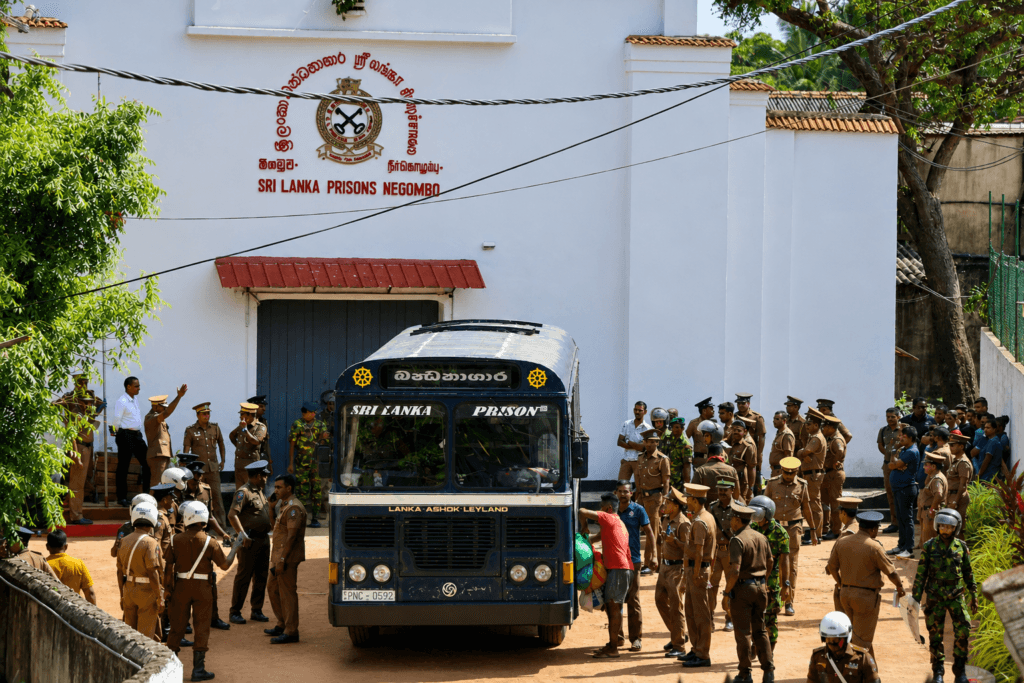
Security personnel stand outside Negombo Prison in Sri Lanka after a deadly clash between inmates left at least 25 people dead and dozens injured. |Credit to PTI
At least 25 people were killed and about 100 others injured in violent clashes between rival groups of prisoners at overcrowded Negombo Prison, one of the deadliest prison incidents in Sri Lanka in recent years. The unrest started on Sunday and spilled over into Monday, and authorities called in the Sri Lankan military to restore order at the prison.
The clash was between convicted prisoners and detainees awaiting legal proceedings, local media and Reuters reported. Violence quickly spread through parts of the prison, with many casualties. “Inmates and prison staff were reported to have been victims,” indicating the seriousness of the incident.
Again, the tragic episode has brought the spotlight on Sri Lanka’s prison system, where overcrowding, poor infrastructure and limited resources have long been challenges. Security has been beefed up around the prison complex and authorities have launched an investigation into the precise cause of the clash.
How the Fatal Clash Unfolded
On Sunday, violence was said to have erupted inside Negombo Prison, a correctional facility in the coastal town of Negombo some 40 kilometers north of Colombo. Officials said tensions had been building between convicted inmates and those awaiting trial or other legal proceedings.
Witnesses said that what began as a fight between some inmates quickly turned into a full-blown riot that spread through several prison blocks. The prison authorities found it difficult to control the unrest as the situation spiraled out of control.
Reports said inmates had used improvised weapons in the clashes and prison staff had attempted to separate rival groups. The violence continued for several hours before more security forces reached the prison.
The Sri Lankan government appealed for military assistance on Monday to restore order, fearing the situation could spiral out of control if immediate action was not taken.
Emergency medical teams rushed dozens of injured prisoners and prison officials to nearby hospitals, where many are still being treated.
What Sparked the Violence?
It’s not yet known what set off the fight, but initial reports indicate it was between convicted inmates and people being held in detention.
Experts think that several structural problems may have been the cause of the violence.
Overcrowding remains one of the biggest concerns. Negombo Prison, like many prisons in Sri Lanka, is severely overcrowded, holding many more prisoners than it was built to accommodate. Overcrowded conditions often generate tensions over scarce resources, such as space, food, sanitation, healthcare and security.
Experts on prison management also point to the problems of housing convicted criminals with under-trial detainees. These arrangements can lead to friction, especially when rival groups of inmates vie for influence in correctional facilities.
Authorities are also looking into whether organized prison gangs or old disputes may have been behind the rise in the confrontation.
The investigation is ongoing but authorities have warned the public not to speculate until the results are confirmed and made public.
Military Called In to Restore Order
With violence escalating, the Sri Lankan authorities turned to the military for assistance in bringing stability to the prison environment.
Military personnel were deployed around the prison complex to support the prison officers, secure the facility and prevent further disturbances.
Their immediate priority was to keep prison staff and inmates safe and to make sure the violence did not spread beyond the prison walls, officials said.
Since then security has been beefed up around Negombo Prison with more personnel deployed at entry points and surrounding areas.
Authorities have also started transferring some prisoners to other prisons as part of emergency measures to ease tension.
Casualties Include Prison Officials
One of the most disturbing aspects of the incident, perhaps, is the report that prison officials were among the victims, along with inmates.
Local TV channel Hiru said several correctional officers died trying to intervene in the violence.
The deaths of prison staff highlight the dangerous conditions faced by correctional officers in overcrowded facilities with limited resources.
Medical authorities said nearly 100 people were injured to different degrees. Doctors treat survivors as hospitals in the area remain on alert.
Authorities have not released the identities of all victims as work continues to notify families.
Government Response
The Sri Lankan government has expressed deep concern over the incident and ordered a full investigation into the violence in the prison.
Prison officials are expected to review prison security measures, inmate management, staffing levels and emergency response systems.
Government representatives have assured the public that accountability will be ensured if negligence or misconduct was involved in the tragedy.
The government’s immediate priority was to restore order, then identify the root causes behind the deadly confrontation, a senior official said.
Human rights groups are also expected to closely monitor the investigation for transparency.
Background
Sri Lanka has long suffered from overcrowding in its correctional facilities.
There are several prisons that are over capacity and this puts enormous pressure on infrastructure, sanitation, health care services and prison administration.
Human rights groups have expressed concerns over prison conditions, prolonged detentions of under-trial prisoners and inadequate rehabilitation programs.
The COVID-19 pandemic has also highlighted the weaknesses of the prison system as overcrowded prisons have struggled to put in place health and safety measures.
Prison unrest in Sri Lanka in recent years has included overcrowding, security concerns and inmate protests.
Experts have long been calling for prison reforms, better classification of inmates, more correctional facilities and faster judicial processes to help ease overcrowding.
Timeline of the Incident
On Sunday, the convicted prisoners and the detainees inside the Negombo Prison reportedly clashed. several parts of the prison during the next hours, causing a heavy death toll.
Authorities confirmed at least 25 deaths and nearly 100 injuries by Monday morning.
Investigators have begun probing the cause of the incident, and the government later sent military personnel to help prison authorities to restore order.
Medical teams continued to treat survivors while authorities assessed the full extent of the damage.
Why This Matters
The deadly prison clash is not merely a security incident but raises larger questions about prison management, criminal justice reforms and public safety in Sri Lanka.
Correctional facilities are designed to rehabilitate offenders and to ensure the security of inmates and staff. Prison overcrowding and lack of resources increase the risk of violence substantially.
The incident also highlights the need for segregation of prisoner categories, better prison staffing and the enhancement of mechanisms to prevent conflicts.
This is an important issue because prison violence is often a symptom of larger systemic problems that go beyond the prison walls.
Without significant reform, these types of incidents could happen again, and the danger to correctional staff and inmates would remain.
India Angle
The incident happened in Sri Lanka but has important lessons for India and other South Asian neighbors.
India also has one of the largest prison systems in the world and many correctional facilities are suffering from overcrowding problems.
The debate on prison reform in South Asia is ongoing and is focused on developing infrastructure, expediting judicial proceedings, better rehabilitation of inmates and better training of staff.
Given Sri Lanka’s close diplomatic and geographic relationship with India, developments arising from the investigation will be closely watched by Indian policymakers, legal experts and security professionals.
The prison incident is unlikely to affect directly Indian tourists visiting Sri Lanka. But as a precaution, authorities may temporarily increase security measures in sensitive areas.
Analysis
The Negombo prison tragedy is a reflection of deeper structural issues in terms of journalism and public policy, not an isolated act of violence.
The use of the military illustrates the seriousness of the situation but also illustrates the inadequacy of existing prison management systems.
Prisons need comprehensive reforms addressing security, rehabilitation, mental health services, infrastructure development and judicial processes.
The knee-jerk reaction to such events is often simply to tighten security, which solves the short-term problem but may not address the underlying causes.
For Sri Lanka, this tragedy should be a chance to revisit prison policies and to invest in sustainable reforms that will lessen overcrowding and ensure institutional safety.
“Transparency during the investigation will be critical to maintain public confidence as well. This story also covered by The Indian express
What Happens Next?
Authorities are expected to conduct a full investigation into the circumstances of the deadly violence.
The government could order an independent inquiry to establish whether prison overcrowding, administrative failures or security lapses contributed to the incident.
The families of the victims will want answers about how both inmates and prison officials died.
Prison reform may also be back on the national political agenda, especially if investigators uncover systemic failures.
Officials said they’ll review existing protocols and heightened security will continue at all correctional facilities.
International human rights organizations may also monitor the investigation and propose reforms to prevent similar tragedies in the future.
Conclusion
One of the worst incidents that have taken place in a Sri Lankan prison in recent times was the deadly clash at the Negombo Prison. At least 25 people were killed and nearly 100 injured, and the tragedy has brought to the fore long-standing worries about overcrowding, prison management and institutional safety.
First things first, it’s about restoring order and treating the wounded. But the bigger concern is with the structural weaknesses that enabled the violence. Such incidents can be avoided in the future only through meaningful prison reforms, transparency and accountability.
The incident serves as a reminder for India and the entire South Asian region that prison safety is directly linked to the broader criminal justice reforms. The probe’s findings, as it proceeds, could have ramifications for correctional policies far beyond Sri Lanka.