Tejaswin finished third behind Grenada’s Paris Olympics bronze medallist Lindon Victor (gold, 8,096 points) and Canada’s Damian Warner (silver, 8,036 points). His performance caps a remarkable comeback after a heartbreak in the high jump and cements his place among India’s greatest multi-event athletes.
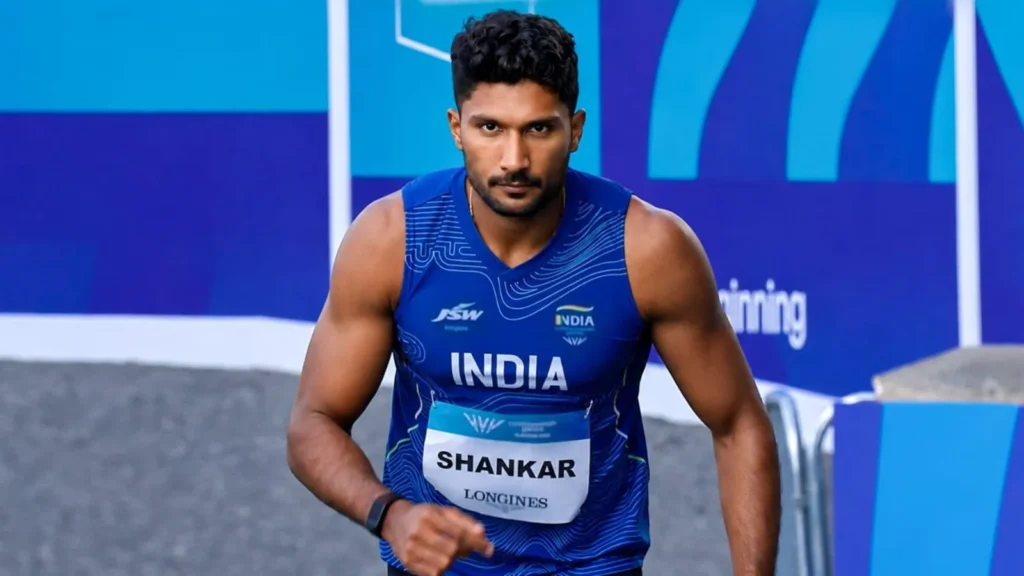
Tejaswin Shankar won the decathlon bronze at the Commonwealth Games 2026 in Glasgow. Image Credit: NDTV
In a defining moment for Indian athletics, Tejaswin Shankar has become the first Indian to win a decathlon medal at the Commonwealth Games, clinching bronze at the 2026 edition in Glasgow. The 27-year-old, who holds the Indian national record of 8,057 points, finished with 7,976 points over the two-day, 10-event competition despite competing with chronic patellar tendinitis, a long-standing knee injury that had earlier forced him to withdraw from the men’s high jump event at these Games.
Tejaswin’s performance is all the more remarkable because he was in tears after being forced to pull out of the high jump following his opening attempt due to a flare-up of the injury. Yet, he returned for the decathlon, finished second overnight after five events, and held on to third place after the final 1500m to secure a historic medal for India.
What happened in the decathlon?
The decathlon is one of the most demanding events in athletics, testing speed, strength, technique and endurance across 10 disciplines over two days. Tejaswin was second overnight after five events, trailing Canada’s Damian Warner, who eventually took silver with 8,036 points.
Tejaswin jumped to third place after the ninth event, the javelin throw, and maintained that position with a fifth-place finish in the 1500m, the final event. Paris Olympics bronze medallist Lindon Victor of Grenada took gold with 8,096 points, narrowly edging Warner and Tejaswin in a tightly contested battle. This story was also covered by NDTV Sports.
For Tejaswin, the medal is a personal triumph as much as a national first. He had been managing chronic patellar tendinitis for months, a condition that affects the tendon connecting the kneecap to the shinbone and is common among jumpers and multi-event athletes. The injury had flared up in Glasgow, forcing him out of the high jump, but he chose to compete in the decathlon and delivered when it mattered most.
Why this performance stands out
Tejaswin’s bronze is historic because no Indian had ever won a decathlon medal at the Commonwealth Games before. India has produced strong performances in individual events like high jump, long jump and middle-distance running, but the decathlon — often called the “king of events” — requires mastery across sprints, jumps, throws and endurance races.
His national record stands at 8,057 points, set earlier in 2026 at the National Federation Senior Athletics Championships, where he became the first Indian decathlete to surpass the 8,000-point mark. In Glasgow, he finished just 81 points short of that record, a remarkable feat given the pain and limitation caused by his knee injury.
Yeh issue kaafi important hai because it shows that Indian athletes can compete at the highest level in multi-event disciplines, not just in单项 events. Tejaswin’s medal opens the door for more investment, training and focus on decathlon and heptathlon in India.
Background and context
Tejaswin rose to prominence in the high jump after setting the Indian national record of 2.29m in 2018. He further cemented his place in Indian athletics history at the 2022 Commonwealth Games in Birmingham, where he won a bronze medal in the high jump, becoming the first Indian male high jumper to secure a medal at the Games.
In 2023, he added a bronze medal in the decathlon at the Asian Athletics Championships. He followed this with a silver medal at the 2025 Asian Athletics Championships. The 2026 season proved to be another landmark year in Tejaswin’s career. He clinched the heptathlon gold medal at the Asian Indoor Athletics Championships, setting a new national record with 5,993 points.
Later that year, he created history by becoming the first Indian decathlete to surpass the 8,000-point mark, recording a new national record of 8,057 points at the National Federation Senior Athletics Championships. That progression—from high jump specialist to multi-event medallist—is rare in Indian athletics and underscores his versatility and work ethic.
Timeline
2018: Tejaswin sets the Indian high jump national record of 2.29m.
2022: Wins high jump bronze at the Commonwealth Games in Birmingham.
2023: Wins decathlon bronze at Asian Athletics Championships.
2025: Wins decathlon silver at Asian Athletics Championships.
2026 (early): Wins heptathlon gold at Asian Indoor Athletics Championships with a national record.
2026 (mid): Sets the decathlon national record of 8,057 points at the National Federation Senior Athletics Championships.
2026 (Glasgow CWG): Withdraws from high jump due to knee injury; returns to win decathlon bronze with 7,976 points.
Why This Matters
This matters because decathlon medals are rare for India, and this performance proves that Indian athletes can excel in the most demanding combined events. It also matters because Tejaswin achieved this while managing a chronic injury, showing mental toughness and resilience that young athletes can look up to.
For Indian athletics, the medal is a signal that multi-event training programmes, sports science support and international exposure can yield results. Too often, the focus has been on单项 events, but Tejaswin’s success shows that decathlon and heptathlon deserve more attention, funding and coaching infrastructure.
In simple Hinglish, jab ek athlete injury ke saath bhi medal jeet sakta hai, toh yeh dikhata hai ki mental strength aur sahi training kitni important hai.
India angle
For Indian readers, this story is directly relevant because it adds another chapter to India’s growing list of Commonwealth Games athletics medals. From Neeraj Chopra in javelin to Hima Das in sprints and now Tejaswin in decathlon, Indian athletes are increasingly competitive on the global stage.
The India angle also includes the inspiration factor. Young athletes in schools and academies often look for role models who have succeeded in complex events. Tejaswin’s journey—from high jump record holder to decathlon medallist—provides a blueprint for those who want to diversify and take on multi-event challenges.
There is also the policy angle. If India wants more decathlon and heptathlon medals, it will need better coaching, sports science support, injury management and competition exposure. Tejaswin’s medal should push federations and governments to invest more in these disciplines.
Analysis
My opinion is that Tejaswin’s performance is one of the most significant Indian athletics achievements of the 2026 cycle. It is not just about the medal; it is about breaking a psychological barrier. Before this, many may have assumed that decathlon was too demanding for Indian athletes to meddle in at the CWG level. Tejaswin has shown that it is possible.
I also think the injury context adds depth to the story. Competing with chronic patellar tendinitis is not easy, especially in an event that requires explosive jumping, sprinting and throwing. His ability to manage pain and still perform at a high level is a testament to his preparation and mental strength.
What Next
The immediate next step for Tejaswin will be recovery and rehabilitation of his knee injury. Given the chronic nature of patellar tendinitis, long-term management will be essential to ensure he can continue competing at a high level without risking further damage.
In terms of competition, Tejaswin may now set his sights on global championships, including the World Athletics Championships and future Olympic Games. With a national record above 8,000 points and a CWG bronze, he has the credentials to aim for a top-eight finish at the world level.
For Indian athletics, the challenge is to build on this success. More decathletes and heptathletes need to be identified, trained and supported with the right infrastructure. If Tejaswin’s medal leads to increased investment in multi-event training, the long-term impact could be significant.
Conclusion
Tejaswin Shankar’s decathlon bronze at the Commonwealth Games 2026 is a historic achievement for Indian athletics, marking the first time an Indian has won a decathlon medal at the CWG. Battling a chronic knee injury that had forced him out of the high jump, Tejaswin delivered a resilient performance to finish third with 7,976 points, behind Lindon Victor and Damian Warner.
His journey—from high jump record holder to multi-event medallist—is a testament to versatility, hard work and mental strength. For India, the medal is a reminder that with the right support, athletes can compete and win in the most demanding disciplines. The question now is whether this moment becomes a turning point for decathlon and heptathlon development in the country.
Written By A. Jack