
Vietnam Boat A tourist speedboat carrying 32 Indian tourists and four crew members capsized near Hon May Rut Ngoai Island off Vietnam’s Phu Quoc coast, leaving at least 15 Indians dead as rescue teams continue search and recovery efforts.
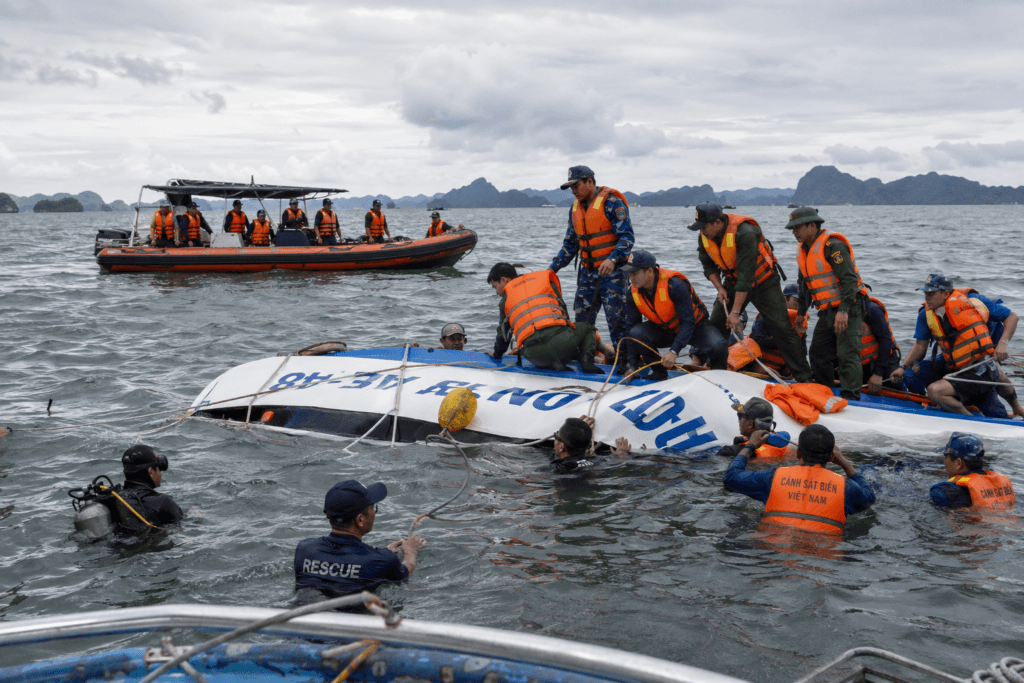
This image is illustration only | made by AI
In a tragic boating accident in southern Vietnam, at least 15 Indian tourists lost their lives when the tourist speedboat capsized off the coast of Hon May Rut Ngoai Island, close to the popular tourist destination of Phu Quoc. The incident took place on Saturday when the vessel, named AG 26751, operated by Ocean Pearl Island Company (Minh Huy Phu Quoc Trading and Tourism Co. Ltd.), was returning from Hon May Rut to An Thoi Port.
Vietnamese authorities said the boat was believed to be carrying 32 Indian tourists and four crew members when it capsized about 400 meters off the island, throwing everyone on board into the water. Rescue teams, local fishermen, border guards and emergency responders rushed to the scene and rescued 21 people, while authorities confirmed the deaths of at least 15 Indian nationals. Authorities worked overnight to account for all people on board and search and rescue efforts continued for hours.
The tragedy has shocked both India and Vietnam. The Indian Embassy has activated emergency response mechanisms and is working closely with Vietnamese authorities to help survivors and families of victims.
How the Tragedy Unfolded
Initial reports suggest the speedboat had left Hon May Rut Ngoai Island after a sightseeing trip and was heading to An Thoi Port, a busy tourist gateway in Phu Quoc.
Minutes into the return trip, the vessel capsized about 400 meters offshore. The sea was rough and the waves were high at the time of the accident, witnesses said. “Several passengers were thrown directly into the water and others were reportedly trapped inside the capsized vessel, making rescue operations extremely difficult. Vietnamese authorities are investigating whether bad weather, mechanical failure or other operational issues caused the accident.
Other tourists and local fishermen came to their aid while waiting for official rescue teams to arrive. The survivors were then brought ashore and sent to hospitals nearby, some with injuries and shock. Officials said two rescued passengers were in critical condition.
Also read: Apple Sues OpenAI and Two Former Employees Over Trade Secrets Theft Claims
Rescue Operations Continue
Vietnamese border guards, coast guard, marine police forces and local rescue agencies launched a coordinated operation as soon as they received distress calls.
Divers scoured the capsized vessel as rescue boats patrolled nearby waters for missing passengers. Emergency medical teams set up treatment facilities near An Thoi Port to provide immediate care to survivors.
The Indian embassy in Hanoi said it had set up emergency response centers in Hanoi and Ho Chi Minh City to help families caught up in the disaster and to liaise with Vietnamese authorities. “We are in continuous touch with the local agencies on identification procedures, documentation and repatriation arrangements,” said embassy officials.
The Prime Minister of Vietnam has also ordered authorities to investigate the accident thoroughly and review maritime safety measures to avoid such tragedies in the future.
Also read:Mumbai Boat Capsizes Near Khar Danda, One Fisherman Dies and Another Injured
Official Statements
The Indian Embassy in Vietnam issued a statement calling the incident a tragic accident and reassuring families that every possible effort was being made to assist survivors and relatives of the dead.
Vietnamese officials expressed condolences to victims’ families and said all available emergency resources had been mobilized.
Maritime safety experts said it would take a detailed technical investigation of weather conditions, the condition of the vessel, its operational procedures and compliance with safety regulations to determine the precise cause of the capsize.
Background
Phu Quoc Island has become one of the fastest-growing tourist destinations in Southeast Asia in recent years. It is known for its white sand beaches, island-hopping tours, reefs of coral and water sports. The island receives millions of domestic and international tourists every year.
The increase in the number of Indian tourists visiting Vietnam has been facilitated by the development of direct flights, the simplification of visa procedures and the increasing popularity of Southeast Asian destinations among Indian tourists. Tourism data shows that India is one of the fastest-growing tourism markets for Vietnam, with hundreds of thousands of Indian tourists coming to the country in recent years.
The sea around Phu Quoc is generally considered safe for boating. But there have been cases of maritime accidents when the weather is bad. It is important to comply strictly with safety measures.
Timeline of Events
The tourist speedboat AG 26751 left Hon May Rut Ngoai Island with 32 Indian tourists and four crew members on Saturday afternoon. The boat capsized about 400 meters from the shore just after leaving the island and was heading for An Thoi Port. Nearby boats rushed to help straight away before Vietnamese rescue agencies launched a full-scale search operation. At least 15 Indian tourists were confirmed dead and 21 were rescued alive. The Indian Embassy set up emergency assistance centers as Vietnamese authorities began investigating the cause of the accident.
Why This Matters
This tragedy is not just a tragic loss of Indian lives but also raises larger issues about the safety of tourists while traveling abroad. gn countries for leisure every year, especially in Southeast Asian destinations where water-based tourism is very popular. These incidents also serve as a reminder to travelers that safety procedures at sea, weather advisories, emergency preparedness and operator standards are key to ensuring safe tourism experiences.
This is a very important point since even well-developed tourist locations can become dangerous in case of bad weather or operational breakdown.
The incident is also likely to spur the authorities in both India and Vietnam to step up awareness on travel safety and emergency response coordination.
India Angle
The tragedy has hit home for families across India, especially since many of the victims were from southern Indian states, reports said.
The Ministry of External Affairs through the Indian Embassy has been in close touch with the Vietnamese authorities for assistance to the survivors, identification of the victims and facilitating communication with the relatives.
The accident is also an important reminder for Indian travelers planning holidays abroad. Tourists should heed weather advisories, wear life jackets when necessary, verify the credentials of the operators and be aware of emergency procedures before taking part in boat excursions.
As India’s outbound tourism continues to grow rapidly, the need to strengthen international emergency coordination between governments will only become more important.
Analysis
On the public safety side, the boat tragedy in Vietnam is an example of how quickly recreational activities can turn into life-threatening emergencies.
Investigations are underway, with initial reports pointing to rough weather as a major contributing factor, while some reports suggest investigators are also examining if a mechanical failure or other operational factors played a role in the capsizing. But it is too early to point fingers of blame until the official findings are released.
As a news, it’s just as important to not speculate on developing stories. Good reporting based on known official information gives readers a sense of what is happening as it happens without misinformation.
The tragedy should remind tourism operators and travelers that safety must come before convenience, especially in bad weather. This story also covered by The Hindu
What Happens Next?
Vietnamese authorities are expected to continue investigating in detail the exact cause of the accident.
Technical experts will most likely inspect the vessel; weather data will be analyzed; survivors and crew members will be interviewed; and operational records will be reviewed before a final investigation report is released.
The Indian Embassy will continue to help the affected families in documentation, identification procedures and repatriation of the remains of the victims. Diplomatic coordination between India and Vietnam is expected to continue till all the affected families get the required support.
Maritime safety inspections and operational procedures for tourist boats around Phu Quoc Island could also be imposed by the authorities.
Summary Conclusion:
The capsizing of a tourist speedboat near Phu Quoc Island in Vietnam has been one of the deadliest overseas travel tragedies for Indian tourists in recent years. The accident has claimed the lives of at least 15 Indians and injured several others and rescue teams and authorities continue their work.
The incident is a stark reminder that tourism safety requires constant vigilance by all involved—operators, regulators and travelers. The exact cause of the disaster will be established by the investigations, but the immediate priority is to support survivors, help bereaved families and ensure that lessons from this tragedy improve maritime safety standards.
As India and Vietnam work together to manage the fallout from this unfortunate incident, it is hoped that improved safety procedures, better emergency preparedness and stricter operational oversight will help prevent similar tragedies in the future.