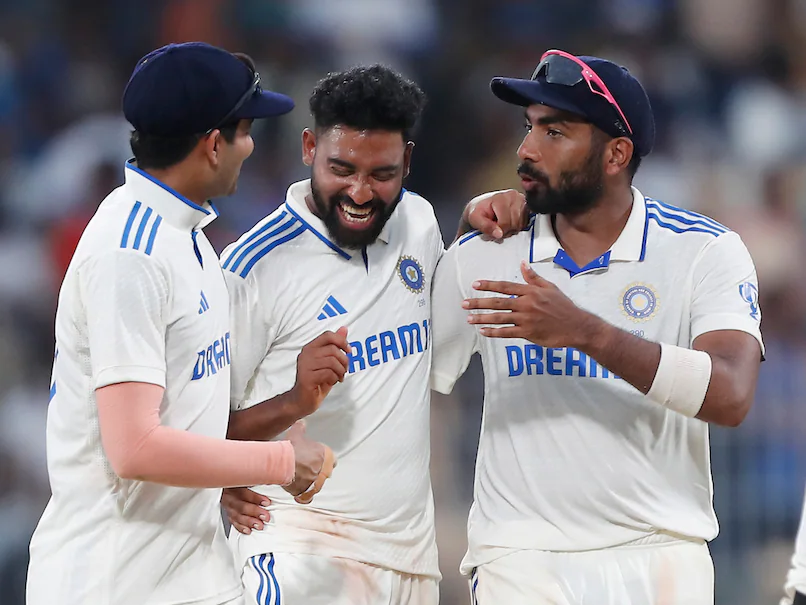
Pakistan register lowest-ever women’s T20I score as Charani and Rawat pick 3 wickets each; India captain becomes first cricketer to lead in 150 T20Is
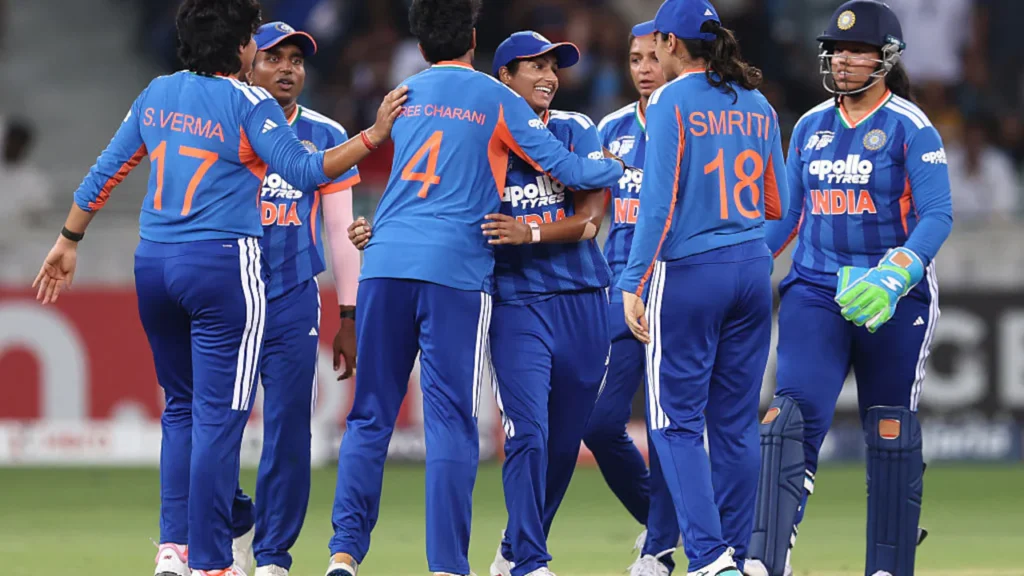
The Indian women’s cricket team celebrates after bowling out Pakistan for a record-low 55 runs in their Women’s Asia Cup 2026. Image Credit: NDTV Sports
Women’s Asia Cup 2026: In a one-sided contest that will be remembered for Pakistan’s batting collapse and India’s clinical dominance, the Indian women’s cricket team bowled out Pakistan for their lowest-ever women’s T20I score of 55 before chasing down the target in just 8.4 overs to clinch a massive seven-wicket victory in their Women’s Asia Cup 2026 Group A clash at the Dubai International Cricket Stadium on Saturday.
Pakistan captain Fatima Sana’s decision to bat first backfired spectacularly as India’s spinners ran riot, with Shree Charani and Prema Rawat picking up three wickets each, Deepti Sharma taking two, and Shafali Verma chipping in with one. India lost three wickets in the chase but reached 57/3 with 68 balls to spare, securing their third straight win and finishing atop Group A.
The match also witnessed a historic milestone as India captain Harmanpreet Kaur became the first cricketer, male or female, to captain a national team in 150 T20 International matches—a testament to her longevity and leadership in the shortest format.
Pakistan’s Batting Implosion and India’s Spin Mastery
The story of this match was written in the first 18.1 overs, when Pakistan’s batting lineup disintegrated under the pressure of India’s spin attack on a Dubai pitch that offered turn and bounce. After winning the toss and electing to bat first—a decision that looked questionable even before the first ball was bowled—Pakistan found themselves in trouble early and never recovered. This story was also covered by NDTV Sports.
Openers Muneeba Ali (13) and Shawaal Zulfiqar (14) offered brief resistance, but once they departed, the Pakistani innings collapsed like a pack of cards. Shree Charani, the left-arm spinner, was unplayable, finishing with figures of 3 for 7 from her four overs, including a spell that left Pakistani batters clueless. Prema Rawat matched her with 3 for 9, exploiting the turn and extracting a sharp bounce that troubled batters throughout.
Deepti Sharma, the experienced off-spinner, chipped in with 2 wickets, including the crucial dismissal of captain Fatima Sana, while Shafali Verma, used as a surprise bowling option, picked up 1 wicket to complete the rout. Pakistan were bowled out for 55 in 18.1 overs—their lowest-ever total in women’s T20 Internationals, surpassing their previous record low of 59 against England in 2022.
In reply, India’s chase was never in doubt, though they lost three wickets along the way. Captain Harmanpreet Kaur led from the front with an unbeaten 18 off 18 balls, while Deepti Sharma contributed 12 not out to see India home. Pakistan’s best bowler was captain Fatima Sana, who took 3 for 17, but with only 56 runs to defend, even that wasn’t enough to create genuine pressure.
Quotes and Reactions
Indian spinner Shree Charani, whose 3 for 7 was the pick of the bowling performances, praised teammate Prema Rawat after the match. “Prema is a natural talent. We knew if we stuck to our plans and exploited the conditions, we could put Pakistan under pressure. The pitch had turned, and we used it well,” Charani said in the post-match presentation.
Pakistan captain Fatima Sana admitted her team’s batting was below par. “We didn’t execute our plans. The pitch had something for the bowlers, but 55 is not a total we can defend. We need to learn from this and bounce back stronger,” Sana said, acknowledging the pressure of the India-Pakistan rivalry.
Cricket experts and former players took to social media to praise India’s dominance. Former India captain Mithali Raj tweeted, “Clinical performance from Team India. The spinners were exceptional, and the chase was professional. Harmanpreet’s 150th match as captain is a fitting milestone in a dominant win.”
India-Pakistan Women’s Cricket Rivalry and Asia Cup Context
This victory extends India’s dominance over Pakistan in women’s T20Is to a staggering 9-1 record. The two teams have met 10 times in T20 Internationals, with India winning nine and Pakistan managing just one upset—during the 2022 Asia Cup in Bangladesh, when they defeated India by five wickets.
The Women’s Asia Cup 2026, being held in the UAE, features eight teams divided into two groups. India, placed in Group A alongside Pakistan, Thailand, and Hong Kong, had already sealed their semi-final spot with wins over Thailand and Hong Kong before this match. The victory over Pakistan ensured they finished atop the group, setting up a likely semi-final clash against the second-placed team from Group B, which includes Sri Lanka, Bangladesh, and others.
For Pakistan, this defeat is a major setback. After showing promise in recent years, including their 2022 Asia Cup win over India, the team has struggled with consistency. The record-low score of 55 will be a psychological blow, and questions will be asked about batting depth, shot selection, and the decision to bat first on a pitch that clearly favored bowlers.
Key Moments from India’s Dominant Victory
September 5, 2026, 6:30 PM LOCAL: Pakistan wins toss, elects to bat first at Dubai International Cricket Stadium.
6:30–7:15 PM: Pakistan innings—openers Muneeba Ali (13) and Shawaal Zulfiqar (14) provide brief resistance before India’s spinners strike.
7:15 PM: Shree Charani and Prema Rawat run through Pakistan’s middle and lower orders; Pakistan bowled out for 55 in 18.1 overs—their lowest-ever women’s T20I total.
7:30 PM: India begins chase—early wickets create minor tension, but Harmanpreet Kaur and Deepti Sharma stabilize.
8:10 PM (approx. 8.4 overs): India reaches 57/3, clinching victory with 68 balls to spare; Harmanpreet Kaur finishes unbeaten on 18.
Post-match: Harmanpreet Kaur becomes the first cricketer to captain in 150 T20Is; India finishes atop Group A, and Pakistan faces scrutiny over batting collapse.
Why This Matters
Yeh issue kaafi important hai for multiple reasons. First, this match showcases the growing gap between India and Pakistan in women’s cricket. While Pakistan has invested in women’s cricket and produced talented players, India’s system—backed by the BCCI’s resources, domestic structure, and exposure to high-quality competition—has created a team that is consistently dominant.
Second, Harmanpreet Kaur’s milestone of 150 T20I matches as captain is not just a personal achievement—it’s a statement about the evolution of women’s cricket. When she started captaining, women’s T20I cricket was in its infancy. Today, it’s a professional, high-profile sport with global viewership, and her longevity reflects the increasing stability and opportunities in the women’s game.
Third, the performance of young spinners like Shree Charani and Prema Rawat signals India’s depth. For years, India relied heavily on a few key players—Harmanpreet, Smriti Mandhana, and Jhulan Goswami. Now, a new generation is stepping up, and that bodes well for India’s prospects in upcoming World Cups and major tournaments.
For Pakistan, this match is a wake-up call. Batting collapses like this don’t happen in isolation—they reflect systemic issues in technique, temperament, and preparation. Without addressing these, Pakistan will continue to struggle against top teams.
India Angle
For Indian readers, yeh match sirf cricket nahi hai—yeh national pride ka issue hai. India-Pakistan contests, whether in men’s or women’s cricket, carry emotional weight that transcends sport. Every boundary, every wicket, every moment of dominance is celebrated as a statement of superiority.
Agar aapko lagta hai ki women’s cricket doesn’t get attention, think again. The viewership for India-Pakistan women’s matches has grown exponentially, thanks to social media, broadcast deals, and the BCCI’s push for women’s cricket. Harmanpreet Kaur is now as recognizable as Virat Kohli among younger fans, and that’s a testament to how far the women’s game has come.
The BCCI’s investment in women’s cricket—better pay, central contracts, domestic tournaments, and exposure tours—has paid dividends. Compare that to the PCB’s struggles with funding, infrastructure, and consistency, and you understand why India dominates. Yeh sirf talent ka fark nahi hai—yeh system ka fark hai.
Analysis
India’s spin strategy was textbook. Charani and Rawat bowled tight lines, exploited the turn, and didn’t offer free hits. They varied their pace, used the crease well, and kept Pakistani batters guessing. Deepti Sharma’s experience showed in her two wickets—she waited for batters to make mistakes and pounced.
Pakistan’s batting approach was flawed from the start. On a pitch that clearly had turned, they should have played more cautiously, rotated strike, and built partnerships. Instead, they tried to hit against the spin and lost wickets in clusters. The decision to bat first was questionable—toss winners in Dubai have often preferred to chase under lights.
Harmanpreet’s milestone is underrated. Captaining in 150 T20Is requires not just skill but mental toughness, adaptability, and the ability to handle pressure. She’s led India through transitions—aging stars retiring, new players coming in, and format changes—and maintained consistency. That’s leadership.
The gap between India and Pakistan is widening. It’s not just about this match—look at the head-to-head record, the domestic structures, and the exposure. Pakistan needs to invest heavily in women’s cricket if they want to compete. Otherwise, these 55-all-out collapses will become more frequent.
What Next
In the immediate term (next 3–7 days):
Semi-final draw: India, having topped Group A, will likely face the second-placed team from Group B (probably Bangladesh or Sri Lanka) in the semi-final. Pakistan, depending on their other group match results, may still qualify for the semi-finals or face elimination.
Team combinations: India may experiment with batting order and bowling combinations in the semi-final to test different strategies before a potential final.
Pakistan review: PCB will likely conduct a post-mortem of the batting collapse, with questions on selection, shot selection, and mental preparation.
Longer-term (weeks to months):
World Cup preparation: The Women’s Asia Cup is a stepping stone to the 2026 ICC Women’s T20 World Cup. India will use this tournament to fine-tune combinations, while Pakistan needs urgent course correction.
Player development: Young spinners like Charani and Rawat will be groomed for bigger roles, while Pakistan needs to identify and nurture batting talent.
Bilateral series: Expect more India-Pakistan women’s contests in bilateral series and multi-nation tournaments, given the viewership and commercial appeal.
For fans, the semi-final is the next big date. India will be favorites, but cricket is unpredictable. If Pakistan can regroup, they could still be dangerous. But on current form, India looks unstoppable.
Final Thoughts
India’s 55-run demolition of Pakistan and 8.4-over chase was more than a win—it was a statement. A statement of dominance, of depth, of a system that produces winners.
Harmanpreet Kaur’s 150th T20I as captain is a milestone that will be remembered for years. In a sport where careers are short and pressure is immense, her longevity is remarkable. She’s not just a captain; she’s an institution.
For Pakistan, this match is a mirror. It reflects their weaknesses, their inconsistencies, their gap with the top teams. But mirrors can be tools for change. If they learn from this, invest in their system, and build for the future, they can bounce back.
For Indian fans, enjoy this moment. Your women’s team is not just competitive—they’re dominant. And with young talent emerging and experienced leaders like Harmanpreet at the helm, the future looks bright.
Written By A. Jack