IMD warns of intense rainfall with thunderstorms; IndiGo and Air India issue travel advisories; Geeta Colony, Connaught Place, and Akbar Road are among the worst-hit areas
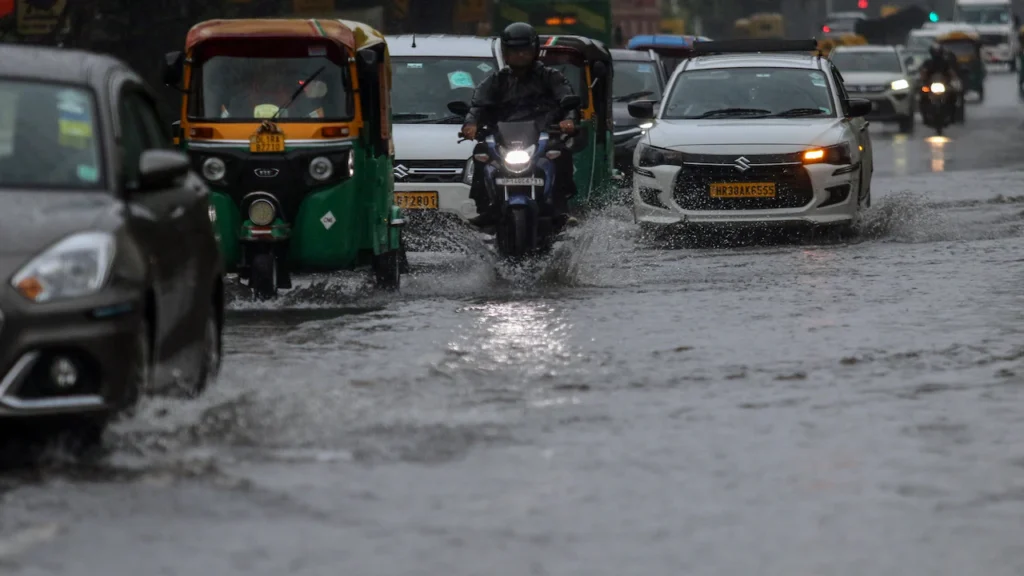
This Image is only for illustrations. Image Credit: NDTV
Heavy rainfall has left several areas in Delhi and adjoining National Capital Region (NCR) waterlogged, disrupting traffic, normal life, and flight operations at the Indira Gandhi International (IGI) Airport, prompting the India Meteorological Department (IMD) to issue a red alert warning for various parts of the national capital.
Several airlines, including IndiGo and Air India, have issued advisories to passengers, warning of potential flight delays and urging travelers to check their flight status before leaving for the airport. While Delhi Airport authorities said flight operations were normal as of Saturday morning, GMR, the operator of IGI Airport, cautioned that inclement weather was expected in the vicinity based on IMD forecasts.
Waterlogging was reported in multiple localities, including Geeta Colony, Akbar Road, and Connaught Place, where rainwater accumulated along the Outer Circle, prompting authorities to deploy pumps to drain excess water. Parts of Greater Noida and Noida also received heavy showers, while several areas of Delhi witnessed significant rainfall that brought down the minimum temperature to 24.8 degrees Celsius—3.4 degrees lower than the previous day.
Monsoon Fury Strikes Delhi-NCR
The heavy rainfall that battered Delhi on Friday and continued into Saturday morning is part of a broader monsoon system that has been active over northern India. According to IMD data, Safdarjung recorded 0.7 mm of rainfall between 11:30 PM on Friday and 5:30 AM on Saturday, followed by another 1.3 mm in the subsequent three hours up to 8:30 AM.
While these figures may seem modest, the intensity and concentration of rainfall over short periods overwhelmed Delhi’s drainage infrastructure, leading to waterlogging in low-lying areas. The situation was exacerbated by poor drainage maintenance, clogged stormwater drains, and inadequate pumping capacity in critical zones. This story was also covered by NDTV.
At IGI Airport, the downpour turned parts of the terminal area and approach roads into waterlogged stretches, with passengers struggling to reach gates with their luggage. On Friday alone, at least 11 flights were diverted—5 to Jaipur, 4 to Lucknow, and 1 each to Ahmedabad and Chandigarh—while more than 400 flights were delayed, according to flight tracking website Flightradar24.
The aviation disruption extended beyond the airport perimeter. Waterlogging on roads leading to the airport, particularly on the Delhi-Gurgaon Expressway and NH-48, slowed vehicular movement, causing passengers to miss check-in deadlines and airlines to operate with delayed turnarounds.
Official Statements and Airline Advisories
India’s largest airline, IndiGo, issued a travel advisory on X (formerly Twitter), stating, “Bad weather is currently affecting Delhi, leading to possible delays in flight operations. Our teams are closely monitoring the situation. If you’re travelling today, we recommend checking your flight status on our website or app before leaving for the airport.”
Tata Group-owned Air India echoed similar concerns, warning passengers that flight operations to and from Delhi could be affected due to adverse weather conditions. Both airlines advised travelers to allow additional time for their journey, as waterlogging and slower road movement could affect access to the airport.
Delhi Airport operator GMR, in an advisory issued at 10:30 AM on Saturday, said, “As per the Indian Meteorological Department’s forecast, inclement weather conditions are expected in the vicinity of Delhi Airport. However, flight operations at Delhi Airport are currently normal. Our on-ground teams are working diligently with all stakeholders to ensure your journey remains hassle-free.”
Despite the reassurances, the ground reality told a different story. Passengers shared videos and images on social media showing flooded entry areas at the airport, with people wading through ankle-deep water to reach terminals. One traveler tweeted, “Delhi Airport looks like a swimming pool. How is this acceptable infrastructure for India’s busiest airport?”
Delhi’s Annual Rain Woes and Infrastructure Gaps
This is not the first time Delhi has faced severe waterlogging during monsoon. Every year, the capital grapples with drainage failures, flooded roads, and disrupted transport when heavy rain strikes. Despite promises from successive governments to upgrade infrastructure, the problem persists—pointing to systemic issues in urban planning, maintenance, and accountability.
The IGI Airport, despite being one of Asia’s busiest and most modern aviation hubs, has repeatedly faced criticism for its vulnerability to waterlogging. In 2023, similar incidents led to flight diversions and passenger inconvenience. Yet, concrete measures to prevent recurrence—such as improved drainage, elevated walkways, and better pumping systems—remain inadequate.
The IMD’s red alert indicates the possibility of intense rainfall accompanied by thunderstorms, lightning, and gusty winds. Such weather systems are common during the active phase of the southwest monsoon, but their impact is magnified by poor urban infrastructure.
From First Showers to Flight Chaos
September 4, 2026 (Friday afternoon): Heavy rain begins across Delhi-NCR; IMD issues red alert for isolated areas.
3:30–5:00 PM: At least 11 flights diverted from IGI Airport due to poor visibility and waterlogged runways; over 400 flights delayed.
Evening: Waterlogging reported in Geeta Colony, Akbar Road, Connaught Place Outer Circle; pumps deployed to drain water.
11:30 PM–5:30 AM (Saturday): Safdarjung records 0.7 mm rainfall; minimum temperature drops to 24.8°C.
5:30–8:30 AM (Saturday): Additional 1.3 mm rain recorded; waterlogging persists in low-lying areas.
10:30 AM (Saturday): GMR issues advisory; flight operations normal but inclement weather expected.
Throughout Saturday: IndiGo and Air India issued travel advisories; passengers were urged to check flight status.
September 6 (Sunday): IMD predicts rain activity to decline considerably; light to very light showers are likely at isolated places.
Why This Matters
Yeh issue kaafi important hai for multiple reasons. First, it exposes Delhi’s chronic infrastructure deficits. A city of 30 million people—with a GDP exceeding $150 billion—should not grind to a halt because of routine monsoon rainfall. Yet, every year, the same story repeats: waterlogged roads, flooded airports, and stranded commuters.
Second, the economic cost is staggering. Flight delays and diversions cost airlines lakhs of rupees in fuel, crew overtime, and compensation. Passengers miss business meetings, medical appointments, and family events. Small businesses in waterlogged areas—like shops in Connaught Place—suffer inventory damage and lost revenue.
Third, there’s a public safety dimension. Waterlogged roads increase the risk of accidents, electrocution from exposed wiring, and waterborne diseases. Vulnerable populations—daily wage workers, street vendors, and slum dwellers—bear the brunt, as they lack the resources to cope with disruption.
For a capital city that hosts government institutions, foreign embassies, and international businesses, such repeated failures damage India’s global image. If Delhi can’t manage monsoon rain, what does that say about its preparedness for more extreme climate events?
India Angle
For readers across India, yeh sirf Delhi ki problem nahi hai—yeh ek national epidemic ban chuka hai. From Mumbai’s airport floods to Bengaluru’s Silk Board junction turning into a lake, from Chennai’s submerged streets to Kolkata’s drainage failures, Indian cities are woefully unprepared for monsoon rainfall.
Agar aapko lagta hai ki yeh issue sirf monsoon season tak limited hai, toh sochiye dobara. Climate change is making extreme weather events more frequent and intense. What was once a “100-year flood” is now happening every few years. Cities that can’t adapt will face mounting economic losses, public health crises, and social unrest.
The aviation sector is particularly vulnerable. India’s major airports—Delhi, Mumbai, Bengaluru, and Chennai—are all in coastal or flood-prone zones. Without climate-resilient infrastructure, flight disruptions will become the norm, not the exception.
Analysis
The drainage problem is solvable. Cities like Tokyo, Singapore, and Amsterdam face heavier rainfall but don’t flood because they’ve invested in robust drainage, retention ponds, and pumping systems. Delhi spends crores on beautification projects, flyovers, and metro expansions—but stormwater drains remain clogged, undersized, or nonexistent.
Airport infrastructure needs an urgent upgrade. IGI Airport handles over 70 million passengers annually. It should have elevated walkways, covered drop zones, and high-capacity pumps to handle heavy rain. Instead, passengers wade through flooded entry areas—a shameful sight for India’s flagship airport.
Early warning systems exist but aren’t leveraged. IMD forecasts are accurate, yet authorities react only after flooding occurs. Pre-emptive measures—deploying pumps, clearing drains, issuing traffic advisories—should happen before rain, not after.
Accountability is missing. Who is responsible for drainage maintenance? The Municipal Corporation of Delhi (MCD)? The Public Works Department (PWD)? The Delhi Jal Board? When everyone is responsible, no one is accountable.
What Next
In the immediate term (next 24–48 hours):
Rain decline: IMD predicts rain activity will decline considerably on Sunday, September 6, with only light to very light showers likely at isolated places from morning to afternoon.
Drainage clearance: MCD and PWD teams are expected to clear clogged drains and deploy additional pumps in waterlogged areas.
Flight normalization: Airlines anticipate normal operations by Sunday evening, pending weather conditions.
Traffic restoration: Water receding should improve road conditions, though potholes and debris may cause lingering delays.
Longer-term (weeks to months):
Infrastructure audit: The Delhi government may order a comprehensive audit of drainage capacity, pumping infrastructure, and flood-prone zones.
Airport upgrades: GMR may announce plans for elevated walkways, improved drainage, and flood-resilient terminal design.
Policy reforms: Expect calls for integrated urban water management, stricter building codes, and climate adaptation planning.
Public pressure: Citizen groups and media scrutiny may push authorities to prioritize drainage maintenance and accountability.
For travelers, the advice is clear:
Check flight status: Before leaving for IGI Airport, verify your flight’s status via airline apps or websites.
Allow extra time: Waterlogging and slower road movement can delay airport access—plan accordingly.
Avoid waterlogged routes: Steer clear of Geeta Colony, Akbar Road, Connaught Place Outer Circle, and other known flood zones.
Stay updated: Follow IMD forecasts and Delhi Traffic Police advisories for real-time updates.
Final Thoughts
Delhi’s waterlogging crisis is not just about rain—it’s about governance, priorities, and accountability. A city that hosts the national government, international summits, and millions of aspirational citizens deserves better than flooded streets and stranded flights.
The IMD’s red alert was a warning. The waterlogged roads and disrupted flights were the consequence. But the real failure is the lack of preparation, investment, and accountability that allows this to happen year after year.
For passengers wading through flooded airports, shopkeepers pumping water out of their establishments, and commuters stuck in traffic for hours, this is not a news story—it’s daily reality. And until authorities treat urban infrastructure as a priority, not an afterthought, Delhi will continue to drown—every time the sky opens up.
The rain will stop. The water will recede. But the questions remain: Will Delhi learn? Will it invest? Will it build a future where monsoon means relief, not chaos?
Written By A. Jack