In Assam, five cases were registered with 13 arrests. The state has said there will be no adverse legal action against protesters. The government said withdrawal process will also start in a timely manner under the law.
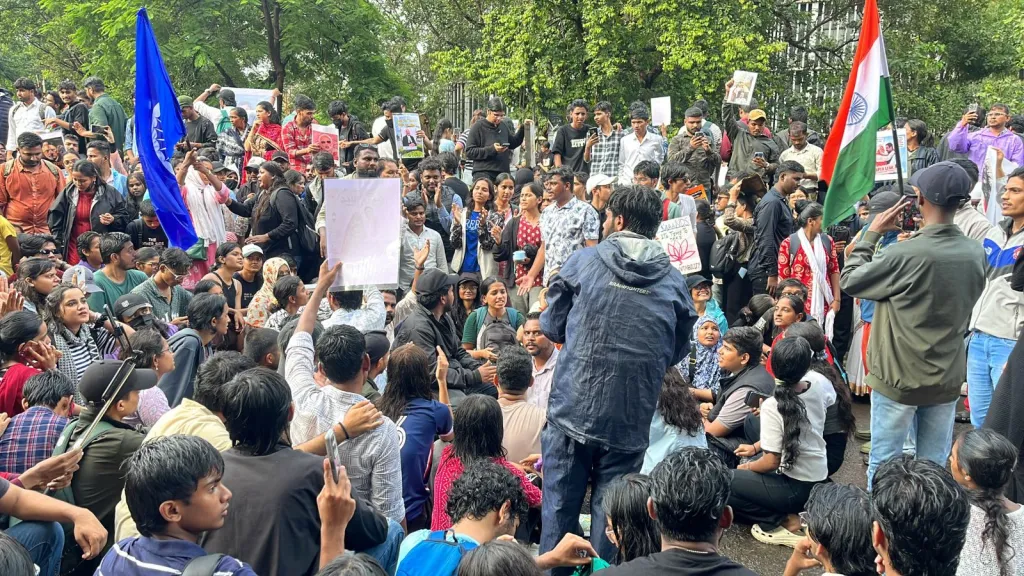
Protesters demanding action over alleged NEET-UG irregularities, as the Assam government announces withdrawal of cases and no future action against participants. Image Credit: SBKINews
In a significant development in the NEET-UG protest fallout, the Assam government on Monday announced that it will withdraw all cases and related legal proceedings initiated against people who took part in the agitation over alleged examination irregularities. The decision was formalised through a press release issued by the Home and Political Department, Assam.
According to the statement, five cases had been registered in the state in connection with the protests, resulting in the arrest of 13 people. The government said it has decided that no adverse legal action will be initiated by police authorities against those involved in these protests before 6 pm on 26.07.2026.
This means the state is not only stopping further punitive action, but also beginning the process to close pending cases and review the arrests already made. The move is being seen as part of a wider political and administrative response to the student protest wave that has grown around NEET-UG irregularities.
What the Assam government said
The Home and Political Department said the decision was taken after “careful consideration of all aspects of the circumstances” and in the interest of strengthening accountability and carrying out systemic reforms in the examination and higher education ecosystem. That phrasing matters because it shows the government is presenting the decision as both a legal and reform-orientated step. This story was also covered by NDTV.
The press note further said that the process to withdraw the registered cases, regardless of their stage in the legal process, will begin promptly as per law. It also stated that the review of arrests and release of detained persons will be initiated expeditiously. In plain language, the government is saying it wants to unwind the legal action already taken.
Perhaps most importantly, the government said it does not propose to take any further adverse action against the individuals involved and that the matter will be treated as closed without any future proceedings on this account. That is a strong statement, because it goes beyond case withdrawal and signals a complete administrative closure.
Why the decision was taken
The Assam government’s move appears to be a response to the widening political and social pressure around the NEET-UG controversy. Once exam irregularity protests become national, state governments often face a difficult balance: maintain law and order, or avoid appearing heavy-handed toward young demonstrators.
Here, the state seems to have chosen de-escalation. The language of the press release suggests that the administration wants to reduce legal friction while also aligning itself with the broader demand for accountability and reform in the education system. That is a notable shift because it connects protest relief with systemic change.
There is also a clear national context here. After Bihar made a similar announcement, Assam’s decision adds momentum to a pattern where states are stepping back from prosecution of protest participants. This creates a stronger political message: the protests are being treated less as a law-and-order problem and more as a legitimate expression of public concern. Yeh issue kaafi important hai because it affects how young people view their right to protest.
What CJP said
CJP chief spokesperson Saurav Das shared the order on X and described it as a major victory for the protesters. He said, “Next up, the Assam Government guarantees release of all arrested protesters, no FIRs or action in the future, and withdrawal of all existing FIRs.”
In another post, Das said the organisation had been informed that no authority in Rajasthan would proceed against protesters and that no FIRs had been registered there. He also said the campaign is working to secure similar notifications from other BJP/NDA states. These comments show how the protest movement is now being coordinated across state lines, not just locally.
Das also said government representatives met with the group for a two-to-three-hour discussion and shared copies of the Bihar and Assam notifications. According to him, they reiterated their promise of issuing comparable guarantee notifications from the Union government and other states. If that happens, the NEET protest response could become one of the most coordinated rollback efforts seen in a recent student movement.
Background and context
The NEET-UG controversy has become one of the most politically sensitive education stories in the country. Alleged irregularities in the exam sparked outrage among students, parents and activists, who began demanding accountability, transparent action and stronger safeguards against misuse of the examination system.
Protests tied to the issue have led to arrests and FIRs in multiple states. That created a second layer of controversy: not just the exam irregularities themselves, but also the state response to people demanding action. In such cases, legal action against protesters can become almost as contentious as the original issue.
That is what makes the Bihar and Assam announcements so important. They are not just administrative orders; they are signals that the government understands the political cost of pursuing protesters while the underlying exam-related anger remains unresolved.
Timeline
Earlier: Alleged NEET-UG irregularities trigger protests across several states.
During protests: Assam registers five cases and arrests 13 people.
July 27, 2026: Bihar announces it will withdraw cases against protesters.
July 28, 2026: Assam follows with a similar announcement.
After the announcement: CJP representatives share the order publicly and say more states may follow.
Also Read: Bihar Government to Withdraw Cases Against NEET Paper Leak Protesters, Free Those Jailed
Why This Matters
This matters because it affects both civil liberties and education politics in India. When students or protesters are arrested over an issue related to exam fairness, the state’s response becomes part of the same public debate. If the government later withdraws those cases, it sends a signal that the earlier response may have been too harsh or at least no longer necessary.
It also matters for the families of those arrested. Even a short-lived case or detention can create stress, stigma and financial pressure. By withdrawing the cases, the government is removing a burden that could have lingered for months or years.
On a larger scale, this decision may help restore some trust in the system. Students want to know that if they raise their voices over exam-related injustice, they will not be punished simply for speaking up. In simple Hinglish, log yeh dekhna chahte hain ki unki awaaz sunni ja rahi hai ya dabayi ja rahi hai.
India angle
For Indian readers, this story is directly tied to one of the biggest competitive exam issues in the country. NEET affects lakhs of students every year, so any allegation of irregularity immediately becomes a national concern. That is why the Assam decision is not just a state-level update; it is part of a much bigger national conversation.
The India angle also includes politics. When one state withdraws cases and another follows within a day, it indicates a broader shift in how protest movements are being handled. Other states may now face pressure to issue similar notifications, especially where no major law-and-order threat exists.
There is also the youth dimension. India’s students are increasingly vocal about fairness, transparency and accountability. If governments want to maintain credibility, they may need to respond with less punishment and more reform. That is the larger lesson this case is pushing into the spotlight.
Analysis
My view is that the Assam government’s move is smart both politically and administratively. It reduces friction, avoids the impression of punishing students for protest, and positions the state as responsive rather than confrontational. But the real test will be whether the promised reforms in the examination ecosystem are actually implemented.
I also think the coordinated messaging from CJP is significant. By highlighting Bihar, Assam and possibly Rajasthan, the protest movement is trying to create a national pressure campaign. That gives the story a wider reach and could shape how other governments respond in the coming days.
What Next
The immediate next step will be the formal process of withdrawing the cases and reviewing the arrests. Depending on where each case stands procedurally, this could take some time even after the announcement. The release of detained persons will also need coordination with police and legal authorities.
After that, attention will likely shift to whether Rajasthan or other states issue similar statements. If more states follow, the protest relief campaign may become a national rollback movement. If not, the issue could remain uneven, with protesters in some places relieved and others still facing legal uncertainty.
For the NEET-UG debate itself, the bigger question remains open: what changes will be made to prevent irregularities in the future? Case withdrawals may calm the protest, but they do not by themselves solve the underlying exam integrity issue. That is where public expectations will now be focused.
Conclusion
Assam’s decision to withdraw cases against CJP protesters is a major development in the NEET-UG agitation fallout. Coming right after Bihar’s similar move, it signals a broader shift toward de-escalation and legal relief for those who were booked over the protests.
The government’s language makes clear that it wants the matter closed, with no further adverse action and a prompt process to release those already arrested. For protesters, students and families, that is a significant relief. For India’s education system, it is also a reminder that public trust depends not just on fair exams but on fair treatment of those who demand fairness.
Written By A. Jack