The decision by Ayodhya bar associations to refuse legal representation to accused persons in the alleged Ram Mandir donation theft case has sparked widespread debate, with legal experts warning that such resolutions may violate constitutional rights, professional ethics, and the rule of law.
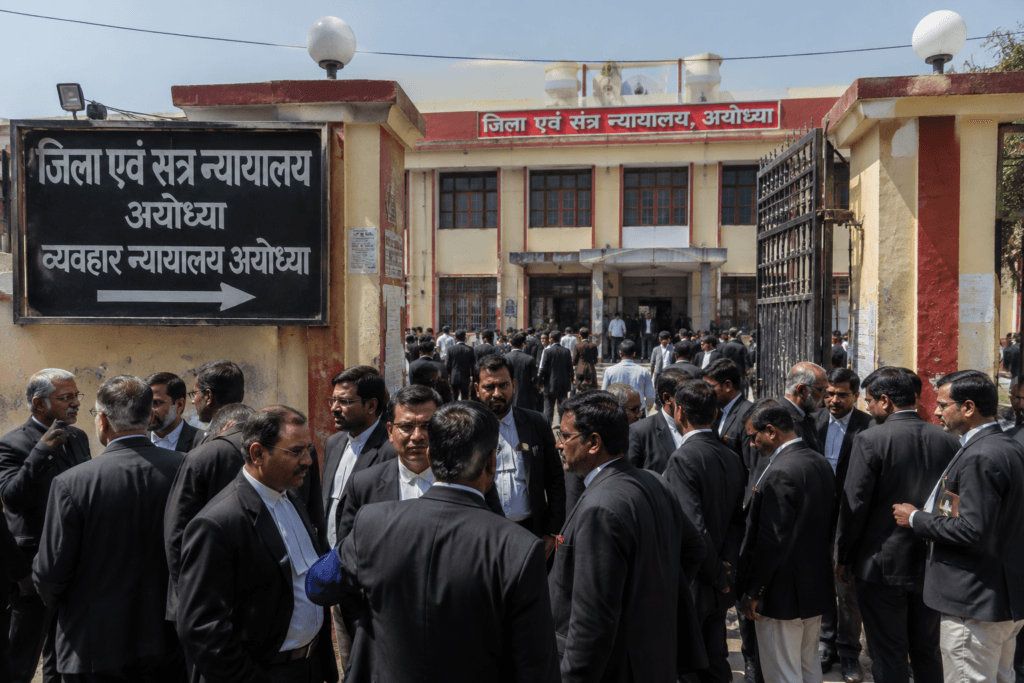
awyers gather outside a court complex in Ayodhya as legal debates intensify over the bar associations’ resolution refusing to represent accused persons in the Ram Mandir donation theft case.
The alleged misappropriation of donations collected for the Ram Mandir in Ayodhya has already become one of the most closely watched legal controversies in the country. But the case has now taken a new turn with reports that local bar associations have passed a resolution that none of their members would represent those arrested in connection with the alleged theft of temple funds. The resolution went a step further and said that any advocate willing to appear for an accused shall first take permission from the association and deposit Rs. 5 lakh per accused in the association’s account.
Legal experts, constitutional scholars and the legal fraternity have severely criticized the move. “While understandable, people’s anger at allegations involving religious institutions, denying an accused person legal representation strikes at the very heart of India’s criminal justice system,” many argue. The controversy has sparked renewed debates about professional ethics, the constitutional right to legal counsel and whether bar associations are legally empowered to impose such restrictions on advocates.
Why and How the Controversy Began
The controversy erupted after some persons were detained in connection with alleged diversion and misappropriation of donations collected for the Ram Mandir Trust. The case drew nationwide attention, as the Ram Mandir is not just a religious structure but a symbol of deep cultural, historical and political significance in India.
Public opinion is turning hostile and two bar associations based in Ayodhya have reportedly passed resolutions refusing to let their members defend the accused in court. The resolution says any advocate who wants to represent an accused would have to get the association’s approval first and also deposit Rs 5 lakh for each accused they want to represent.
The decision was quickly challenged in court, as it effectively disincentivizes advocates for defending the accused. Constitutional experts say such resolutions constitute indirect intimidation and interfere with an advocate’s professional independence.
Under Indian law, every accused person is presumed innocent until he is proved guilty by a court of law. The principle is the cornerstone of criminal jurisprudence and is applicable irrespective of the nature of the allegations or the emotions attached to a case.
Why Legal Experts Say the Resolution Violates the Law
A number of legal experts have pointed out that the resolution seems to violate both constitutional protections and professional conduct rules for advocates.
The Constitution of India, under Article 22(1), specifically provides that any person who is arrested shall have the right to consult and be defended by a legal practitioner of his choice. This constitutional safeguard prevents anyone from being denied legal assistance merely because they are unpopular in the public eye.
The Advocates Act, 1961, and the Rules of the Bar Council of India also stress the independent professional responsibility of the advocates. Their duty is to help the court to administer justice, not to pronounce guilt according to the popular sentiment.
The Supreme Court has always ruled that even people accused of the most serious crimes are entitled to effective legal assistance. The denial of access to lawyers or the erection of barriers to advocates willing to appear for an accused undermines the fairness of criminal trials.
Legal experts warn that financial penalties or pre-approval before representing a client could amount to professional misconduct and even risk disciplinary action.
Constitutional Principles at Stake
The controversy is much wider than a single criminal investigation. It affects fundamental constitutional principles that safeguard all citizens.
India is a country of rule of law, not rule of public opinion. Courts, not associations, political groups, or public emotions, decide whether a person accused of a crime is guilty.
The right to a fair trial includes the right to legal representation, an impartial judiciary and equality before the law. Without these protections, criminal justice is subject to bias and popular opinion.
For a long time the Supreme Court has recognized the essential role of lawyers in the protection of justice. To take the stand for an accused is not to endorse the alleged crime. Rather, it guarantees that the courts hear both sides before reaching a legally valid conclusion.
Many senior lawyers said that if lawyers start refusing cases on the basis of public anger, then the entire justice delivery system will become selective and unpredictable.
Statements from the Legal Community
The announcement of the resolution has caused alarm among a number of legal experts.
According to constitutional experts, bar associations are powerless to stop lawyers from appearing for clients of their choosing. It is said that professional independence is one of the fundamental pillars of the legal practice in a democratic society.
Legal scholars have also observed that the effectiveness of the prosecution and the defense is the determinant of the success or failure of every criminal trial. “Without good defense lawyers, courts cannot properly assess evidence, or ensure justice is served fairly.
Experts have pointed out that advocates are officers of the court, and their job is not to respond to public sentiment but to ensure justice.
Background
The alleged looting of donations for Ram Mandir has been a matter of great public interest due to the national importance of the temple.
Authorities have taken several persons into custody for misappropriation of donations given for temple-related causes. Legal proceedings are in progress and investigators continue to review financial records and other evidence.
It was only after these arrests that the controversy about legal representation arose, changing the public discourse from the alleged financial irregularities to more general constitutional and ethical matters relating to access to justice.
Even as public anger over alleged misuse of religious donations is at a fever pitch, India’s legal framework requires every accused to be given a fair chance to defend themselves before a competent court.
Timeline
The alleged irregularities in Ram Mandir donations were uncovered in a probe after the alleged financial irregularities. “Following this, police registered cases and started investigating the alleged misappropriation of temple funds.
Following the investigation a number of people were taken before the courts and arrested.
Soon afterwards, bar associations in Ayodhya are said to have passed resolutions that their members would not represent the accused. The resolutions also introduced the contentious requirement of prior approval and deposit of Rs. 5 lakh for each accused represented.
The resolutions immediately drew criticism from members of the legal fraternity and constitutional experts who questioned the legality and compatibility of the resolutions with the Advocates Act and constitutional guarantees.
Also read: Ram Temple Donation Scam: Court Orders 14-Day Judicial Custody for Eight Accused
Why This Matters
The controversy is about way more than one criminal case. It raises important questions about how justice works in India.
If lawyers start refusing to represent unpopular clients under public pressure, the fallout could go far beyond Ayodhya. Similar resolutions may be passed tomorrow in cases of terrorism, corruption, financial fraud, communal violence or politically sensitive inquiries.
Such a trend could erode public confidence in the judicial process and set a dangerous precedent where accused persons are unable to secure legal representation.
This is a very important issue because constitutional rights are tested the most when emotions are high. The real strength of a democracy is to protect legal rights even when the accused is facing serious allegations.
The legal profession has a tradition of defending people, regardless of what they are accused of, because justice is administered in the courtroom, not in the court of public opinion.
India Angle
“This case is of very great constitutional importance for the citizens of India. The Ram Mandir has huge religious and emotional significance all over the country and any allegations involving the donations to the Ram Mandir are bound to be sensitive.
But the Indian Constitution was deliberately crafted to make sure emotions would never trump due process. Whether it is religion, politics, national security or financial crime, every accused is entitled to legal defense.
This debate is a reminder to Indians that constitutional protections are not just for the innocent but for all. Jab law bhi equally apply hota tabhi democracy strong rehti hai.
The debate also points up the importance of protecting the legal profession from public or institutional pressure.
Analysis
The controversy shows the delicate balance between public sentiment and the rule of law from a legal and constitutional perspective.
With the allegations surrounding religious institutions, public outrage is not surprising. Of course, the public expects accountability with public donations. Accountability should be through lawful investigation, credible evidence and judicial determination—not restrictions on legal representation.
As a news writer who writes about legal affairs, I think this issue is worth noting, as it exemplifies the way constitutional principles are often challenged in such emotionally charged cases. “The justice system works when the prosecutors, defense lawyers, investigators and judges do their independent jobs without outside interference.
The independence of the legal profession could be under threat if lawyers fear disciplinary proceedings, financial penalties or professional isolation for representing specific clients. Such developments would not only affect this case but could also have an impact on future criminal proceedings involving sensitive issues of public concern.
The controversy underscores a fundamental principle of the law: defending a defendant is not endorsing the alleged crime but helping to guarantee justice is meted out fairly and openly.
What Next
It is still likely the legality of the bar associations’ resolutions will be under scrutiny. Legal experts say that complaints could possibly be filed with the concerned Bar Councils if such resolutions are against professional ethics or the Advocates Act.
The criminal investigation into the alleged misappropriation of Ram Mandir donations will continue independently through the courts meanwhile. The prosecution will present evidence The accused will have the constitutional right to defend himself by way of legal counsel
The findings could have wider implications for bar associations across India should the resolutions be looked into by the judiciary or regulators. The result could help define the boundaries of collective decisions by professional legal bodies and strengthen the norms on the independence of lawyers. The story is covered by multiple news sites
Conclusion
Lawyers in Ayodhya have withdrawn from defending the accused in the Ram Mandir donation theft case, turning a criminal investigation into a major constitutional quandary. Religious donation cases obviously stir public emotions. But our system of justice is based on principles that guard fairness, due process and equal access to law.
Every accused is innocent till proved guilty in a court of law. Every advocate has the professional independence to represent the clients without intimidation or institutional restrictions. This controversy reminds us that constitutional values matter most when the cases are difficult and emotions run high.
As investigations proceed and legal processes take their course, the eye will be on not just the alleged financial wrongdoing but on whether India’s justice system continues to preserve the basic rights that define a democratic society.