In a major development in the alleged Ram Temple donation embezzlement case, a local court on Monday, June 29, 2026, remanded all eight accused to 14 days of judicial custody. The accused were produced before Special Judge (Anti-Corruption Court) Rajat Verma through video conferencing after the expiry of their previous judicial custody.
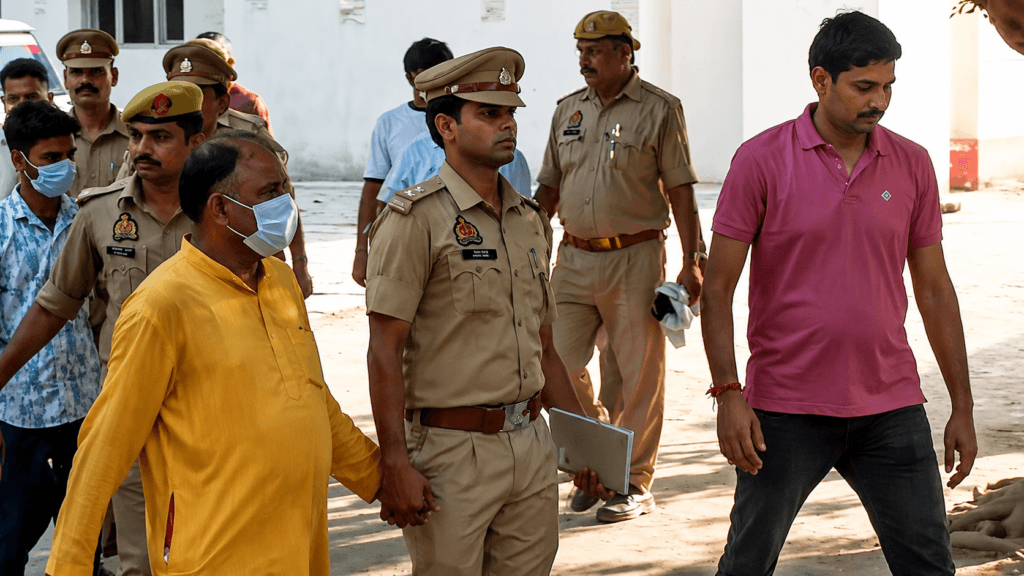
Police officials escorting the accused in the Ram Temple donation embezzlement case as they appear before the Special Anti-Corruption Court through video conferencing.|Image cradit to PTI
The court extended the judicial custody of the eight persons as the investigating agency was still collecting evidence regarding alleged financial irregularities in donations made for the Ram Temple, Special Prosecution Officer Umesh Dubey said.
The case has attracted national attention as it involves public donations made by devotees to one of India’s largest religious institutions. Now the authorities are trying to determine the full scope of the alleged embezzlement and who else might have been involved.
Also read: Ayodhya Temple Donation Case: Eight Arrested Over Alleged Fund Misuse
How the Alleged Scam Came to Light
The case relates to alleged irregularities in the management and accounting of donations collected for the Ram Temple, investigators said. The officials suspect that the money donated by the devotees might have been siphoned off or misappropriated rather than being accounted for through official financial channels in the right manner.
Preliminary investigations are said to have uncovered irregularities in the financial records, transaction details and documentation associated with the donation management process. On these observations, the authorities registered a formal case and started a detailed investigation.
After filing the FIR, the investigators have questioned several persons connected with the handling of donations. So far, eight persons have been arrested in connection with the alleged scam based on the evidence collected.
Bank records, financial documents, digital transactions, accounting registers and other relevant evidence are still being examined by the authorities to determine the exact amount allegedly embezzled and whether there are other suspects.
The officials have made it clear that the allegations are under judicial scrutiny and all accused are presumed innocent until proven guilty in a court of law, though the probe is still on.
Court Proceedings
Special Judge Rajat Verma heard the matter through video conferencing on Monday after the expiry of their earlier judicial custody.
Special Prosecution Officer Umesh Dubey told the court that the investigation is still underway and more evidence is being looked into. As the investigation is on, the court sent all eight accused to judicial custody for 14 days.
The period of judicial custody helps investigators to continue their investigations and keeps the accused available for further legal proceedings. In the meantime, officials can continue to gather documentary evidence, interview witnesses and review financial records.
The court did not delve into the merits of the allegations and merely ruled on the procedural aspect of extending custody as provided by law.
Statements from Officials
Special Prosecution Officer Umesh Dubey said that all eight accused were produced before the Special Anti-Corruption Court through video conferencing after the expiry of their previous custody.
Judicial custody is common in financial crime probes, say legal experts, when authorities need more time to check documents, track financial transactions and sift through evidence gathered from various agencies.
“Cases involving alleged misuse of public or charitable funds often require extensive forensic accounting before charges can be fully made out in court,” said a senior legal analyst.
Background of the Case
The Ram Temple is of great religious and cultural importance to millions of devotees, both in India and abroad. The donations received for the temple are contributions made on a voluntary basis by the individuals who want to support religious activities and temple development.
As they are donations from the public, there is a great need for transparency and accountability in their management. Any allegation of misapplication of such funds is likely to attract wide public attention.
The present case came to light after the investigators allegedly found financial discrepancies, raising questions over the handling of the donated money. Further searches led to the opening of a criminal case and the detention of eight people suspected of involvement in the financial activities under investigation.
Officials have not yet released the full financial details of the alleged embezzlement in public, but more is expected as the investigation moves forward.
Timeline of the Investigation
The probe was launched after suspected financial irregularities were uncovered in the review of records on donations. The investigating agencies registered a formal FIR and started a detailed probe. As evidence was gathered, eight individuals were arrested in connection with the alleged embezzlement. They were then remanded to judicial custody while investigators continued to probe financial records and other documentary evidence. The accused were produced before the Special Anti-Corruption Court through video conferencing on 29th June, 2026 after the expiry of their earlier custody, where the court extended their judicial custody by another 14 days. This also covered by The Hindu
Why This Matters
“This case is important because it is about public trust.
Millions of devotees contribute with the belief that their money will be used for religious, charitable and developmental purposes. If there are accusations of mismanagement or embezzlement of funds, the public’s trust in the institutions entrusted with managing the funds can be seriously compromised.
The case also highlights the need for financial transparency in charitable organizations all across India, beyond the religious angle. Proper accounting systems, independent audits and strict governance are essential to ensure the donated money is used for the intended purpose.
This is an important issue because trust is hard to rebuild once it is gone. Whether the allegations are proven or not, the case underscores the need for greater financial oversight in institutions that handle public donations.
India Angle
This investigation is more than a criminal case for Indian citizens. Every year crores of rupees are donated to religious institutions in the country. These contributions are the faith and good will of common people.
The results of this research may have implications for future debates on financial management, digital accounting systems, auditing standards and transparency mechanisms in the context of religious and charitable trusts.
The move to introduce more robust financial monitoring systems can bolster public confidence and safeguard authentic institutions from accusations of wrongdoing, say many experts.
This is why the case is being keenly followed not only by legal observers but also by devotees, policymakers and governance experts across India.
Analysis
This investigation is a major test of institutional accountability in journalistic terms.
Investigations of financial crime involving public donations are generally document-heavy, requiring a rigorous review of banking records, accounting entries, digital evidence and witness testimony. Generally, the courts are reluctant to make determinations until the investigators have completed their work and evidence has been presented at trial.
I am a news writer and I feel this case should be covered fairly and with facts. Sensationalism may draw readers in the short term, but ethical journalism must adhere to the legal principle that an accused is innocent until proven guilty.
But transparency still matters. Institutions that accept donations must have strong internal controls and periodic independent audits. These measures serve to protect the money people donate but also public confidence.
The inquiry is also a reminder that all institutions that deal with the public purse, whatever it may be or does, are expected to be financially accountable.
What Happens Next
Investigators are likely to continue to scrutinize financial documents, digital records, bank transactions and witness statements during the extended period of judicial custody.
If sufficient evidence is gathered, the authorities may file a detailed chargesheet before the competent court. Depending on the results, more people could also come under investigation if their involvement is established.
Then, the court will examine the evidence presented by the prosecution and determine the next stage of the legal proceeding. During the judicial process the accused will be given the chance to present their defense.
The investigation is still continuing and more developments are expected in the next few weeks.
Conclusion
This is yet another crucial phase in the alleged Ram Temple donation embezzlement case, as all the eight accused have been sent to judicial custody for 14 days. The court order will keep the legal process moving forward uninterrupted while investigators continue to gather evidence.
The case has gained significance not just because of the alleged financial irregularity but also because it bears on the public’s faith in institutions that deal with donations of millions of devotees. In the meantime, hopefully more details will be forthcoming about the nature of the alleged financial irregularities, the extent of the suspected embezzlement and the legal culpability of the accused.
All allegations are subject to proof before the court until the end of the judicial process. The next few weeks are expected to be critical in setting the course of one of the country’s closely watched financial probes.