
The 26ft whale was first spotted at the work site of Bandra-Versova Sea Link at around 6 am. BMC, Mumbai Fire Brigade, the forest department and coastal police teams tried to save it but doctors later declared it dead.
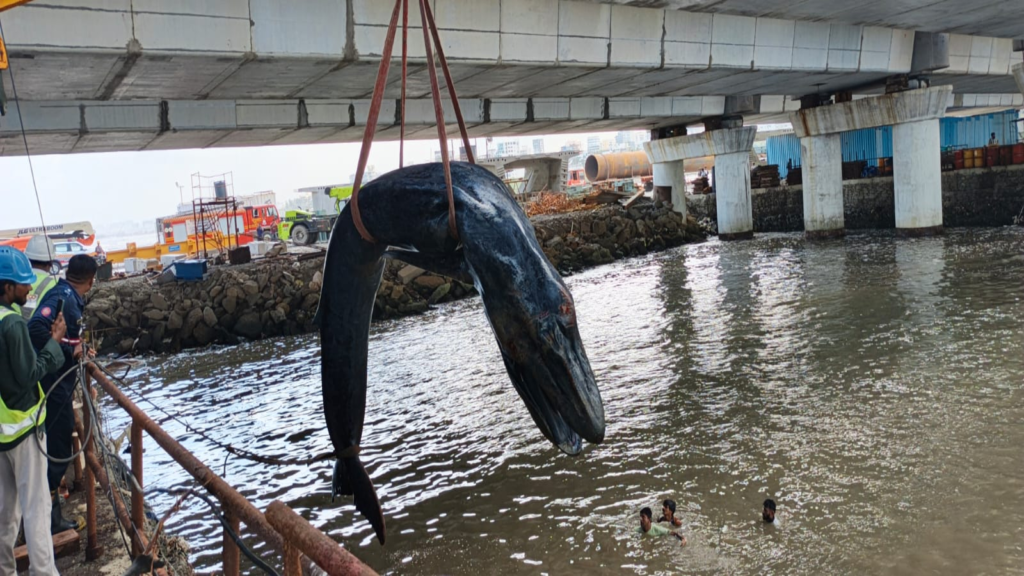
Officials and rescue teams work near Carter Road after a baby humpback whale washed ashore and became stranded on the rocky coastline of Mumbai. Image Credit: Indian Express
Mumbai witnessed a rare and heartbreaking marine incident on Saturday morning when a baby humpback whale was found stranded on the rocky shore near Carter Road, close to Otters Club in Bandra. The whale, estimated to be around 26 feet long, was initially seen alive and writhing between the rocks at about 6 am, but despite a coordinated rescue response from civic and forest authorities, it died later in the day. The carcass was eventually transported to Versova and buried in the sand.
The incident is unusual for Mumbai’s coastline and immediately drew attention because such large marine mammals rarely wash up in the city. It also highlighted the challenges of rescuing stranded sea animals in rough coastal conditions, especially when heavy tides and rocky terrain make intervention difficult. Yeh matter kaafi important hai because it combines wildlife protection, coastal safety and environmental awareness in one tragic event.
What Happened at Carter Road
According to preliminary reports, labourers working on the Bandra-Versova Sea Link project were the first to notice the stranded whale. The animal was reportedly alive at the time and still moving, which prompted workers to raise an alarm. Once the sighting was reported, teams from the Brihanmumbai Municipal Corporation, the Mumbai Fire Brigade and the forest department’s Mangrove North Konkan Cell were dispatched to the site. The India Express has covered the full story.
An official from the mangrove cell’s West Mumbai range said that after workers from the Apco work site flagged the whale sighting, the team reached the spot and found that the baby humpback whale had washed up on the rocks amid heavy tides. Rescue workers initially tried to support the whale and push it back into the water, but the animal was not moving. Later, fishermen and specialized teams inspected its body.
Because the whale appeared immobile, it was eventually lifted out using a crane. Coastal Police personnel supervised the operation. After retrieval, doctors examined the animal and declared it dead. The carcass was then taken to Versova and buried in the sand.
Why the Rescue Failed
The exact reason the whale washed ashore is still not known. Officials have sent samples for postmortem analysis to determine the cause of death. At this stage, the rescue effort appears to have failed mainly because the whale was already badly distressed or possibly injured by the time it was found.
Stranding events can happen for several reasons, including injury, illness, disorientation, or problems caused by rough seas. In this case, heavy tides and the rocky shoreline likely made it even harder for the whale to survive or be moved back safely into deeper water. Once a large mammal like a humpback whale becomes trapped on rocks, its own body weight and dehydration can worsen its condition very quickly.
A forest department official noted that dolphins and whales generally wash up on shorelines when they have sustained injuries. That observation fits with the general understanding that strandings are often a sign that something has already gone wrong before the animal reaches land. In other words, by the time humans see the animal, the crisis may already be advanced.
Background and Context
Mumbai’s coastline is one of the busiest and most heavily used stretches of urban sea frontage in India. It is also home to mangroves, marine life and sensitive coastal ecosystems that are often under pressure from construction, pollution and shipping activity. A whale stranding in such a location is rare, which is why this incident drew so much attention.
Humpback whales are large marine mammals that usually travel through open seas. Their appearance near a city shoreline is unusual and often indicates distress. In India, such sightings are not common, and when they do happen, they become major news because they remind people that the Arabian Sea is not just a backdrop to city life but an active marine habitat.
The fact that this stranding happened near the Bandra-Versova Sea Link work site may also raise questions about coastal activity, though no cause has been established yet. Officials have not suggested any direct link at this stage, and the postmortem report will be key before any conclusions are drawn. Still, the incident has already brought marine conservation back into public conversation.
Timeline
Around 6 am, Saturday: Laborers at the Bandra-Versova Sea Link work site spot the stranded baby humpback whale near Carter Road.
Immediately after sighting: Workers raise an alarm and alert authorities.
Shortly thereafter: BMC, Mumbai Fire Brigade, the forest department and coastal police teams arrive at the scene.
Rescue attempt: Officials and fishermen try to support the whale and push it back into the water, but it does not move.
Later in the day: The whale is lifted using a crane and examined by doctors.
Medical confirmation: Doctors declare the whale dead.
Final step: The carcass is transported to Versova and buried in the sand.
Afterwards: Samples are sent for postmortem to determine the cause of death.
Also Read: Mumbai Muharram Tragedy Averted as Man Allegedly Caught With Toxic Pills in Crowd
Why This Matters
This matters because marine strandings are not just isolated wildlife incidents; they are signals about the health of coastal ecosystems. When a whale washes ashore, it can point to injury, environmental stress or broader changes in the sea. For a city like Mumbai, where urban life and marine life overlap so closely, such events deserve attention. Yeh issue kaafi important hai because it reminds us that the coastline is alive and vulnerable.
It also matters because rescue attempts require quick coordination between multiple agencies. In this case, the response included civic officials, firefighters, forest personnel, fishermen and coastal police. That kind of coordination is essential in wildlife emergencies, especially when time is limited and the animal is large and difficult to move.
There is also an emotional and public awareness dimension. A baby whale stranded on a rocky shoreline is a powerful image, and it can make people think more seriously about ocean conservation, coastal protection and responsible urban development.
India Angle
For Indian readers, this story carries a strong local and environmental angle because Mumbai is one of the country’s most coastal, crowded and development-heavy cities. In Hinglish, seedhi baat yeh hai: jab itne bade marine animals Mumbai shore tak aa jate hain, toh humein samajhna chahiye ki sea life kitni fragile hai.
The incident also matters because India’s coastal cities are expanding fast, and marine habitats often take the impact first. Construction, shipping traffic and pollution can all affect sea life in ways that are not always visible. This makes events like the Carter Road whale stranding especially relevant for Indian environmental discussions.
For schoolchildren, nature enthusiasts and city residents, the story is also a reminder that Mumbai is connected to the ocean in a much deeper way than most people think. A whale on the rocks is not just a sad scene; it is a call to pay more attention to the marine environment around us.
Analysis
My view is that the most important part of this story is not only the whale’s death but also the fact that the response happened quickly and in a coordinated manner. That matters because wildlife emergencies often depend on minutes, not hours. The teams did the right thing by trying to help, and the postmortem will now determine whether the animal was already too weak, injured or disoriented to survive.
The story also shows how urban coastlines need better awareness systems. Laborers at the site were the first to notice the animal, which suggests that local workers and coastal teams can play a huge role in reporting such incidents early. That is a useful lesson for other coastal cities as well.
From a conservation perspective, the incident should prompt more discussion about shoreline monitoring, rescue readiness and marine protection. Even if the whale’s death was unavoidable, the response can still help improve future outcomes. That is how such tragedies can still lead to better preparedness.
What Next
The immediate next step is the postmortem analysis. Once the samples are examined, officials should have a clearer idea of what caused the whale to wash ashore and die. That information will help determine whether there were signs of injury, illness or environmental stress.
Authorities may also review how the rescue operation was handled and whether any improvements are needed in response protocols for future strandings. Given Mumbai’s coastline and heavy coastal activity, a more structured marine emergency response could be valuable.
For the public, the best next step is awareness. People who live or work near the coast should know whom to call if a stranded marine animal is spotted and should avoid crowding or moving the animal without guidance. In cases like this, quick reporting can make all the difference.
Conclusion
The baby humpback whale that washed up near Mumbai’s Carter Road has left behind a mix of sadness and urgency. Despite efforts by civic teams, firefighters, forest officials and fishermen, the animal could not be saved and was later buried at Versova. The cause of death is still being investigated, but the incident has already underscored how fragile marine life can be along a busy urban coastline. For Mumbai, it is both a tragic wildlife story and a reminder that the sea needs as much protection as the city that borders it.
Written By A. Jack