
The accused in the Mumbai local train murder case, Sachin Ramesh Suvarna, during police interrogation confessed that he stabbed Mayank Lohar following a heated argument in a train coach, officials said. Borivali court remands Suvarna in police custody till June 29 as investigators continue to probe how a rain-soaked compartment turned fatal.
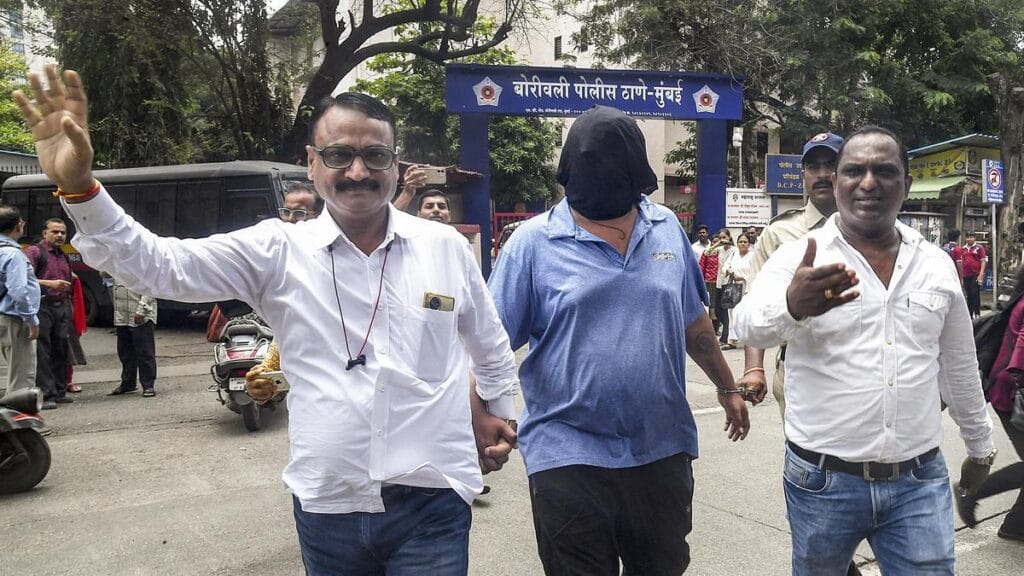
Police escort accused Sachin Ramesh Suvarna after his confession in the Mumbai local train murder case`. Image Credit: The Hindu
A deadly confrontation on a Mumbai local train has taken a grim turn after accused Sachin Ramesh Suvarna reportedly confessed to stabbing Mayank Lohar during an argument in a moving train coach. The incident, which occurred earlier this week, has now led to Suvarna being remanded in police custody until June 29 by a Borivali court. According to police, the dispute started when Lohar asked Suvarna to close the train door because rainwater was entering the compartment, and what followed was a sudden escalation that ended in a fatal stabbing.
This case has shocked commuters because it reflects how a small disagreement in a crowded local train can spiral into violence within seconds. Mumbai locals are the city’s daily lifeline, carrying millions of passengers, and that makes any act of train violence feel deeply unsettling. Yeh case kaafi serious hai because it is not only about one assault but also about public safety inside one of India’s busiest transport systems.
How the Incident Escalated
According to Suvarna’s statement, the argument began after Lohar objected to the open door in the coach. Rainwater was entering the compartment, and Lohar allegedly asked Suvarna to shut it. That request reportedly triggered a verbal altercation, which then turned physical. The Hindu has covered the full story.
Suvarna says Lohar punched him during the argument. He further claimed that other passengers in the coach sided with Lohar and assaulted him as well. Police say that at some point during this chain of events, Suvarna stabbed Lohar. The exact sequence of blows, crowd reactions and the moment the knife was used will likely remain a core part of the investigation.
The most important question for police is not only what happened but also why a dispute that could have ended in a few harsh words turned into murder. Crowded trains, heat, stress, alcohol and group pressure can all turn an ordinary conflict into a dangerous one. In this case, the accused has said he was under the influence of alcohol, which investigators will likely treat as a key aggravating factor.
What the Confession Means
Suvarna’s confession is a major development because it gives investigators a direct account of the incident from the accused himself. He reportedly admitted to stabbing Lohar during interrogation on Thursday, June 25, 2026. A confession does not end the case, but it gives police a clearer starting point for reconstructing the events.
Police still need to verify the statement against witness accounts, forensic evidence and any possible CCTV or passenger testimony. In criminal cases, a confession is only one part of the picture. The court will ultimately look at whether the evidence supports the claim that the stabbing was the result of an escalating fight rather than a premeditated act.
At this stage, the police are expected to examine whether the accused carried a knife onto the train, how the passengers responded, and whether alcohol played a direct role in the violence. Those details will determine how the case is charged and argued in court.
Background and Context
Mumbai local trains are often described as the city’s backbone, but they are also one of its most stressful public spaces. Packed coaches, sudden arguments, open doors, rainwater, delays and overcrowding can create an environment where tempers rise fast. Most commuter disputes end in shouting or minor scuffles, but every now and then a moment of anger turns into a major crime.
This is not the first time public transport has become the setting for a fatal altercation. The city has seen multiple cases where minor disputes escalated because people were packed too closely together and had very little room to step away from the conflict. The current case fits that troubling pattern.
The added element of alcohol makes the situation even more serious. Alcohol can reduce restraint and increase impulsive behaviour, especially in a high-stress environment like a local train. When combined with crowd pressure and an argument, the result can be tragic. That is why this case has drawn strong public attention.
Timeline
Before the incident: Passengers are traveling in a Mumbai local train coach during rainy conditions.
Initial dispute: Mayank Lohar asks Sachin Suvarna to close the train door because rainwater is entering the compartment.
Argument escalates: The two get into a heated exchange.
Physical confrontation: According to Suvarna, Lohar punches him and other passengers also assault him.
Fatal stabbing: Lohar is stabbed during the altercation.
June 25, 2026: Suvarna allegedly confesses during police interrogation.
Court hearing: Borivali court remands the accused to police custody until June 29.
Also Read: Mumbai Local Train Stabbing Over Door Dispute Leaves 21-Year-Old Dead; Accused Arrested
Why This Matters
This matters because the case highlights how vulnerable commuters can be in crowded public transport. A local train should be a place of movement, not a place where one argument can turn deadly. When violence breaks out in such a setting, it puts hundreds of passengers at risk. Yeh issue kaafi important hai because transport safety is not only about trains running on time; it is also about passengers feeling safe inside them.
It also matters because it raises concerns about alcohol-related violence in public spaces. If the accused was intoxicated, as he claims, then the case becomes a reminder of how impaired judgment can have catastrophic consequences. Public transport systems depend on order and shared discipline, and once that breaks down, everyone is exposed.
For Mumbai residents, the emotional impact is especially strong because the local train network is part of everyday life. Millions of people travel by it every day, including office-goers, students and workers. A fatal attack on such a familiar system creates fear and outrage far beyond the immediate scene.
India Angle
For Indian readers, this story is painfully relatable because local train travel is part of daily life in many cities, especially Mumbai. In Hinglish, seedhi baat yeh hai: ek chhota sa jhagda agar control na ho, toh poori situation bigad sakti hai. People often argue over doors, space, luggage or seating, but this case shows how dangerous such disputes can become if anger takes over.
It also underscores the need for better commuter discipline and faster intervention in public transport. Indian railways and local systems already face crowding challenges, so preventing violence in transit should be a priority. More awareness about conflict de-escalation could help, but stronger enforcement and quicker reporting are also needed.
For families and everyday commuters, the incident is a reminder to stay alert and avoid escalating fights in confined spaces. In a packed train, there is usually no good outcome once tempers rise. The safest response is often to create distance, seek help and let authorities handle the matter.
Analysis
My opinion is that the real story here is not just the stabbing itself, but the speed with which a routine commuter disagreement escalated. That is what makes the case so disturbing. Trains are compressed spaces where emotions can rise quickly, and when alcohol is involved, the risk becomes even higher.
The police custody extension suggests investigators are still trying to build the full chain of events. That is smart, because these cases often depend on who hit first, who escalated the argument, and whether the weapon was carried in advance. The legal outcome may turn on those details.
From a broader perspective, the case may also push more conversation around passenger safety, alcohol consumption before travel and the need for stricter monitoring in crowded coaches. One tragic incident can influence public debate for weeks, especially when it happens in a system used by so many people every day.
What Next
The next step will likely be a deeper police investigation into witness statements, forensic evidence and the exact circumstances of the stabbing. Officers may also try to confirm whether Suvarna was carrying the knife before the fight started.
If the evidence matches the confession, the case could move toward a murder charge with added scrutiny over intoxication and intent. The court will also consider the sequence of events and whether the act was spontaneous or planned.
For commuters, the incident may renew calls for better surveillance and conflict management on local trains. More visible policing, emergency reporting mechanisms and awareness campaigns could become part of the conversation if public concern grows.
Conclusion
The Mumbai local train murder case has shocked commuters because it began with what appears to have been a simple request to close a door and ended in a fatal stabbing. Sachin Ramesh Suvarna’s reported confession, along with his claim that he was intoxicated and attacked during the argument, gives police an early version of events, but the investigation is far from over. What is already clear is that a routine train dispute turned into a deadly crime in one of the city’s most crowded public spaces. The case is a grim reminder that in a packed local train, one moment of anger can change everything.
Written By A. Jack