
Acting Chief Justice Ravindra V. Ghuge and Justice Gautam Ankhad said citizens cannot blame BMC alone when public drains, footpaths and pavement spaces are routinely occupied or misused. The court’s comments have reignited the larger discussion about civic responsibility, flooding and urban planning in Mumbai.
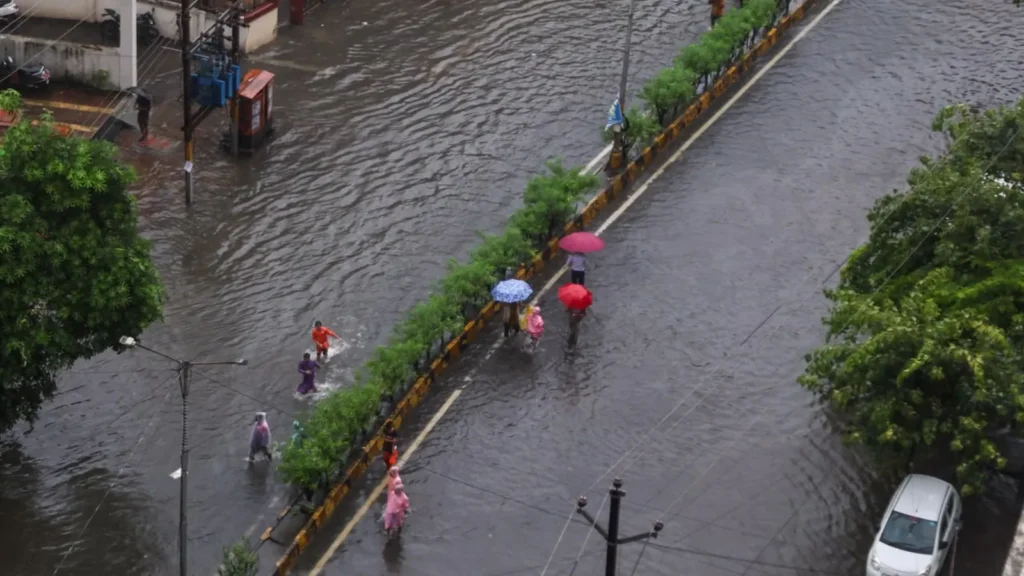
The Bombay High Court during a hearing on Mumbai’s flooding problem and land issues linked to road widening in Mandala village. Image Credit: IndianExpress
The Bombay High Court has once again put Mumbai’s annual monsoon crisis under the spotlight, this time with unusually blunt remarks from the bench. During a hearing on a plea related to road widening in Mandala village on the Sion-Trombay stretch, the court said Mumbai’s flooding problem is not just an administrative failure but “our own creation”, pointing to encroachments, clogged drains and the misuse of shared public spaces as key causes.
Acting Chief Justice Ravindra V. Ghuge and Justice Gautam Ankhad also issued notice to the Department of Atomic Energy after the Brihanmumbai Municipal Corporation said it had cleared encroachments from its own portion of the land but needed the remaining land belonging to DAE for the project. The exchange has turned a routine infrastructure matter into a larger civic conversation. Yeh issue kaafi important hai because it connects daily flooding with everyday behaviour, not just government action.
What the Court Said
The bench did not hold back in its observations. Acting Chief Justice Ghuge said Mumbai is “destined to see rainwater on roads” because of the way the city is built and used. The court’s broader point was clear: the problem is not only a municipal one but also a public habit problem.
Justice Ghuge said people are “good at grabbing lands” and then filling drains with dirt and material. The court also referred to pavement blocks becoming parking lots after being inaugurated by representatives and footpaths being occupied by stalls and other commercial activity. The judge’s remarks suggested that the city’s flooding is aggravated not merely by heavy rain but by the repeated human misuse of drainage lines, footpaths and open public spaces. This story is also covered by the IndianExpress.
The bench also pointed to footpaths outside the Bombay High Court on the east side, saying they were occupied by photocopy shops, tea stalls and juice vendors. That example mattered because it showed how the court sees the issue as systemic rather than limited to one locality. The message was simple: if public spaces are continuously encroached upon, the city loses its ability to absorb or move water efficiently.
Why the Remarks Matter
These comments matter because they shift the conversation from blame alone to accountability. In Mumbai, the BMC is often the first institution blamed whenever roads flood during the monsoon. But the court’s remarks suggest that civic problems become worse when citizens, businesses and even informal operators treat public infrastructure as private space.
That is a powerful point. A drainage line does not fail only because it is poorly designed; it also fails when it is blocked. A footpath does not stop being a pedestrian space because it is inconvenient; it becomes unusable when it is occupied by stalls, parked vehicles and temporary structures. The court’s language was sharp because it wanted to show that flooding is not created overnight by rain alone. It is built up over time through neglect and misuse.
From a legal and civic standpoint, the bench is also reminding everyone that urban governance is shared responsibility. The BMC may build drains, but if those drains are clogged or covered, the system breaks down. The court’s message is not anti-citizen; it is pro-accountability.
The Road Widening Dispute
The case before the court also involved a more specific infrastructure issue: the BMC’s plea for land required to widen a road in Mandala village on the Sion-Trombay stretch. According to the civic body, encroachments on its own portion had already been removed, but the remaining land belonged to the Department of Atomic Energy. Because of that, the court issued notice to DAE so the issue could move forward.
This part of the hearing is important because it shows how land ownership and clearances can delay road improvement projects in Mumbai. Road widening is often necessary to improve traffic flow, drainage and emergency access. But if the land is split between agencies, or if one portion is under another department, even basic improvements can get stuck in procedural delays.
The fact that the court chose to intervene suggests it is monitoring both the flooding issue and the infrastructure bottlenecks behind it. The hearing was not just about an abstract civic principle. It had immediate consequences for how a road project in a flood-prone city might proceed.
Background and Context
Mumbai’s monsoon flooding is one of the city’s most persistent annual problems. Every year, even moderate rainfall can cause waterlogging on key roads, slow traffic and disrupt daily life. Residents have grown used to checking weather alerts, avoiding underpasses and dealing with delayed commutes whenever heavy rain arrives.
But the problem has never been just about rainfall intensity. Mumbai’s geography, density and infrastructure load all contribute to flooding risk. At the same time, improper disposal of waste, illegal encroachments and blocked drains make the situation much worse. That is why the court’s remarks landed so sharply: they echoed what many citizens already know from experience.
The city has also seen repeated public investment in flood-control and drainage projects. Yet each monsoon brings new complaints, suggesting that engineering solutions alone are not enough. Maintenance, enforcement and public discipline matter just as much. Without them, even expensive civic projects can fall short.
Timeline
Earlier hearing: The Bombay High Court takes up a plea related to road widening in Mandala village on the Sion-Trombay stretch.
BMC submission: The civic body says it has cleared encroachments from its portion of the land and seeks remaining land from DAE.
Tuesday hearing: The bench makes strong oral observations about Mumbai’s flooding and public misuse of space.
Court action: Notice is issued to the Department of Atomic Energy.
Related development: Last month, the court said it would decide whether contempt proceedings should be initiated against the BMC after considering the commissioner’s reply.
Also Read: Mumbai Chawl Collapse Kills 6, Including 5 Children, in Mankhurd Heavy Rain Tragedy
Why This Matters
This matters because Mumbai’s flooding affects lakhs of people every monsoon season. Commuters miss trains, buses slow down, delivery systems get disrupted and emergency services face delays. Yeh issue kaafi important hai because the cost of waterlogging is not just inconvenience — it is lost time, lost money and, in some cases, real danger.
It also matters because the court is touching on a deeper civic truth. Cities cannot function well if public spaces are treated casually. If drains are blocked, if footpaths are occupied and if parking spills into every available space, then even a strong municipal system will struggle. The court’s comments are a reminder that urban life depends on discipline as much as design.
For Mumbai residents, this is also an emotional issue. Monsoon flooding has become a yearly frustration, and many people feel the city keeps repeating the same mistakes. The court’s remarks may not fix the problem immediately, but they do validate the idea that the crisis is not inevitable. It is partly a result of choices.
India Angle
For Indian readers, Mumbai’s flooding is not just a city story; it is a broader urban India story. Many Indian cities are now facing similar challenges — encroachments, poor drainage, traffic stress and weak coordination between agencies. In Hinglish, seedhi baat yeh hai: agar public space ko public space ki tarah treat nahi karenge, toh problem baar-baar repeat hogi.
Mumbai is especially important because it is one of India’s busiest economic hubs. When its roads flood, the effect is felt far beyond the city. Businesses, workers, logistics and services all take a hit. That is why the court’s comments matter nationally, not just locally.
There is also a lesson here for other metro cities. Drainage systems cannot work if waste is dumped into them. Footpaths cannot function if they become commercial parking zones. Urban planning only works when citizens and authorities both respect the system.
Analysis
My opinion is that the court has chosen a very human and accessible way to make a serious point. By mentioning footpaths, stalls, parking and clogged drains, the judges made the issue relatable to ordinary residents. That is smart judicial communication because it moves the debate away from technical jargon and into daily lived experience.
I also think the remarks reflect a frustration shared by many Mumbaikars. Every year, the same areas flood, the same photographs circulate and the same questions are asked. At some point, a city has to move from complaining about rainfall to cleaning its own systems. That is the heart of what the court is saying.
At the same time, the civic body’s role cannot be dismissed. The BMC still has a major responsibility to maintain drainage, remove encroachments and enforce rules consistently. The challenge is not only that citizens misuse spaces but also that enforcement often arrives late or unevenly. So the lesson is shared accountability, not shared excuses.
What Next
The immediate next step is the Department of Atomic Energy’s response to the court notice on the land issue in Mandala village. That will determine how quickly the road-widening matter can move forward. If the land is cleared or handed over, the BMC may be able to continue work on the stretch.
On the flooding side, the larger question is whether the court’s remarks will push stronger enforcement before the next heavy rain spells. That could mean more aggressive removal of encroachments, better drain cleaning and tighter parking controls near vulnerable roads and footpaths.
The contempt matter involving the BMC may also return to the court after the commissioner’s reply is considered. That means the civic body remains under close judicial scrutiny. If the court feels progress is inadequate, it may push harder for compliance.
Conclusion
The Bombay High Court’s remarks on Mumbai flooding cut to the heart of a problem that residents experience every monsoon. By saying the city’s waterlogging is “our own creation”, the bench highlighted how encroachments, blocked drains and misuse of public spaces have turned a natural event into a recurring urban crisis. The hearing also moved forward a road-widening issue in Mandala village, showing how land disputes and civic delays can slow down improvements. Ultimately, the court’s message is clear: Mumbai’s flooding is not just about rain — it is about responsibility, planning and respect for shared public space.
Written By A. Jack