
The incident happened around 8.30 pm when part of a G3 chawl collapsed trapping some residents under the debris. Chief Minister Devendra Fadnavis announced compensation of Rs 5 lakh to each family of the deceased victims.
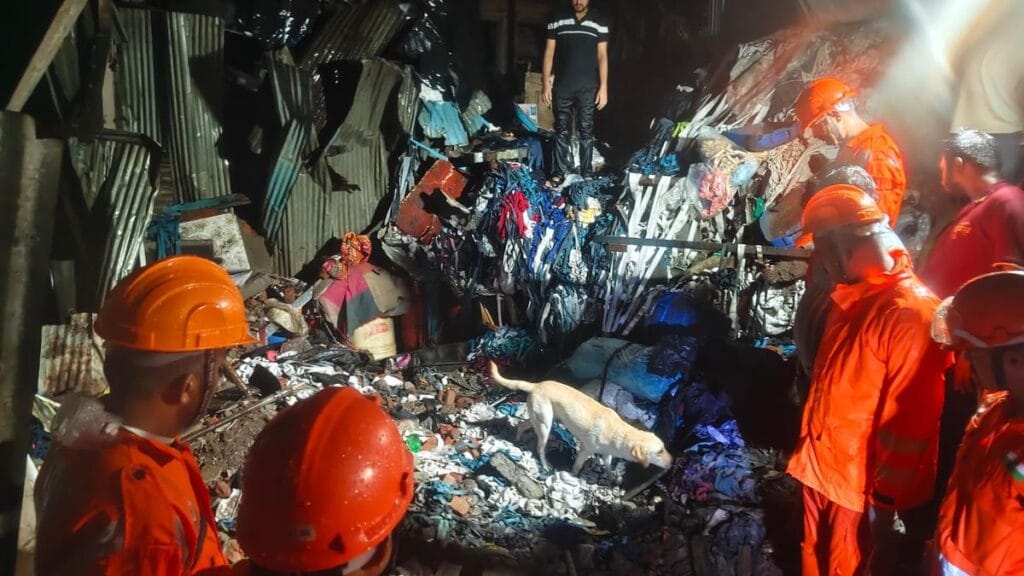
Rescue workers search through debris after a three-storey chawl collapsed in Mumbai’s Mankhurd area during heavy rain. Image Credit: The Hindu
A devastating structural collapse in Mumbai’s Mankhurd area claimed at least six lives, including five children, on Saturday night after a section of a three-storey chawl caved in during heavy rainfall. The tragedy unfolded around 8.30 pm in Janta Nagar, where a part of a G3 chawl in Chawl No. 5 gave way, trapping multiple residents beneath the rubble.
According to the Brihanmumbai Municipal Corporation, two to three houses collapsed in the incident, forcing emergency teams into a rescue operation that continued late into the night. The victims have been identified as Nabiya, 2; Nihal, 6; Aliya, 7; Munaf, 7; Muskan, 14; and Soni, 32. Rehan Alli, 24, was injured and admitted to hospital, where his condition was later said to be stable. The exact cause of the collapse remains under investigation. Yeh tragedy kaafi heartbreaking hai because it shows how dangerous monsoon conditions can become for people living in older and crowded housing.
What Happened
The collapse took place in a dense residential area where multiple families were living inside a three-storey chawl structure. Officials said a section of the building suddenly gave way, causing two to three houses in the chawl to collapse in on themselves. Because the incident happened at night, many residents were likely inside their homes, which increased the risk of casualties.
Once the structure failed, several people were trapped under the debris. Rescue teams arrived quickly and began pulling out survivors and bodies from the collapsed section. In such incidents, response time is critical because trapped victims may survive only if rescue work starts immediately. The fact that one injured person survived and was stabilised in hospital shows that the rescue effort reached the site fast, but the loss of young lives makes the event especially tragic. NDTV has covered the full story.
Heavy rain is believed to have played a role, but officials have said the exact cause is still not known. That means investigators will likely examine whether the building was already weakened, whether water seepage had compromised the structure or whether the collapse was triggered by a combination of old construction and monsoon pressure. In Mumbai, that combination is unfortunately a recurring risk.
The Human Loss
The victims’ ages tell the emotional story behind the numbers. Nabiya was just 2 years old. Nihal and Munaf were 6 and 7. Aliya was 7. Muskan was 14. Only one adult among the identified dead, Soni, was 32. That means five children lost their lives in a single structural failure.
This is what makes the collapse so devastating. It is not just an infrastructure issue or a monsoon accident. It is a family tragedy on a very deep level. Entire households may have been affected, and the emotional trauma will extend far beyond the immediate rescue operation. When children are among the dead, the loss feels even more severe because it speaks to the vulnerability of families living in risky structures.
Rehan Alli, the injured survivor, has been admitted with serious injuries but is now said to be stable. That is one small piece of relief in a very grim situation. Still, the broader picture remains tragic and deeply unsettling.
Rescue and Official Response
Emergency teams and civic officials rushed to the site soon after the collapse. Rescue operations were launched to pull out people trapped under the debris, and clearance work was still underway as officials assessed whether adjoining structures were also at risk. That kind of assessment is important because once one part of a chawl collapses, nearby sections may also be unstable.
Chief Minister Devendra Fadnavis expressed grief over the deaths and announced financial assistance of Rs 5 lakh to the family of each deceased victim. The announcement provides immediate support, though no amount can truly compensate for the loss of life, especially children. In such disasters, compensation is a necessary step, but prevention is always the bigger issue.
The BMC is also expected to examine the building condition and surrounding area. In many Mumbai chawl collapses, ageing structures, poor drainage and monsoon damage become part of the larger conversation. This incident will likely renew questions about how many vulnerable buildings are still standing in dense neighbourhoods across the city.
Why the Collapse Matters
This collapse matters because it highlights the fragile relationship between monsoon rain and old urban housing. Mumbai has many ageing residential structures, especially in areas where families live in tightly packed chawls. When heavy rain hits, those buildings are often under enormous strain.
The timing is also significant. Monsoon-related incidents frequently expose weaknesses that may have been ignored during drier months. A wall can crack, a floor can weaken, or water can seep into support structures for weeks before a disaster happens. When the final collapse comes, it seems sudden, but the warning signs may have been there.
For urban India, this is a reminder that housing safety is not only about construction quality at the time a building is erected. It is also about regular maintenance, drainage systems, structural checks and timely evacuation when a building becomes unsafe. Yeh issue kaafi important hai because old housing stock is still home to millions of people in Indian cities.
Background and Context
Mumbai’s monsoon often brings stories of waterlogging, landslides, wall collapses and building failures. The city’s dense population, high rainfall and many old structures make it especially vulnerable. Chawls, in particular, are part of Mumbai’s social and housing history, but many of them were built decades ago and are now under strain.
When such buildings age without enough repair or redevelopment, rain can worsen existing damage. Waterproofing fails, cracks deepen, and weak sections can eventually collapse. In areas like Mankhurd, where many families live in compact spaces, a single structural failure can affect multiple homes at once.
This tragedy also fits into a broader pattern of monsoon danger in Indian metros. Every year, cities face similar incidents, and every year the same questions return: which buildings are safe, which need evacuation, and whether enough is being done before the rains arrive. The answers are often incomplete, and the consequences are often paid for by ordinary residents.
Timeline
Saturday night, around 8.30 pm: A section of a three-storey chawl collapses in Janta Nagar, Mankhurd.
Immediately after collapse: Two to three houses in Chawl No. 5 are brought down, trapping residents under debris.
Late Saturday night: Rescue teams launch an operation to pull out trapped people.
After the rescue: Six deaths are confirmed, including five children and one adult woman.
Hospital update: Rehan Alli, 24, is admitted with serious injuries but later stabilises.
Later response: Chief Minister Devendra Fadnavis announces Rs 5 lakh compensation for each deceased victim’s family.
Ongoing: Officials continue clearance work and assess risks to nearby structures.
Also Read: Pune Heavy Rain Damage: Compound Wall Collapse in Katraj Damages 14 Vehicles
Why This Matters
This matters because it is a fatal reminder of how dangerous housing vulnerability can become during heavy rain. The loss of six lives, including five children, is not just a local tragedy — it is a warning for every city with ageing buildings and poor drainage. The human cost is immense, and the social cost is even broader because families in such structures often have few alternatives.
It also matters because incidents like this test civic preparedness. Rescue teams can respond after a collapse, but the real challenge is preventing the next one. That means identifying unsafe buildings, improving monsoon inspections and moving people out of danger before disaster strikes.
For residents of Mumbai and other Indian cities, the story underlines a simple truth: safety in the monsoon is not optional. When rain is heavy and structures are old, risk rises fast. The tragedy in Mankhurd is proof of that.
India Angle
For Indian readers, this incident hits close to home because it reflects a common urban reality: many families still live in ageing, overcrowded housing that becomes risky during the rains. In Hinglish, seedhi baat yeh hai — jab monsoon aata hai, tab sirf roads hi nahi, ghar bhi test hote hain. If the structure is weak, the danger is immediate.
The story also matters because it is happening in Mumbai, a city that often sets the tone for how India experiences the monsoon. When such a major city sees a deadly chawl collapse, it raises concern for similar structures in other metros and smaller cities too. This is not a one-city problem.
Families living in older buildings across India will read this and think about their own homes. That is why the news has such wide resonance. It is about public safety, housing quality and the need for stronger urban planning.
Analysis
My opinion is that the most painful aspect of this tragedy is the age of the victims. Five children dead in one collapse is an unbearable loss and changes the tone of the story completely. It moves the issue beyond civic failure and into a deeply human catastrophe.
From an infrastructure perspective, this also raises questions about monitoring and evacuation. If a chawl is structurally weak, residents should not be waiting for a collapse to find out. Regular inspections, visible warning systems and faster relocation support are essential, especially before the monsoon peaks.
I also think the compensation announcement, while necessary, should be seen as only the beginning of the response. Financial help matters, but the bigger issue is whether similar buildings are being checked before another tragedy occurs. That is where real accountability lies.
What Next
The next steps will likely include a detailed structural assessment of the collapsed chawl and nearby buildings, as well as a review of whether the area had known vulnerability before the incident. Rescue and clearance teams may continue working until officials are certain there is no further danger.
The affected families will also need immediate support, both financial and emotional. Compensation can help with urgent needs, but the trauma of losing children and relatives will take much longer to heal.
The wider civic response may involve checking other chawls and ageing buildings in Mumbai that could be at risk during the ongoing rains. If that happens quickly, it could help prevent more fatalities. If not, the city may face more such tragedies.
Conclusion
The Mankhurd chawl collapse is a devastating reminder of how deadly monsoon vulnerability can be in crowded urban housing. Six people, including five children, died after a section of a three-storey chawl caved in during heavy rain, while one injured survivor is now stable. The rescue operation may have ended the immediate crisis, but the larger questions remain: how many similar buildings are still at risk, and whether enough is being done to protect residents before the next storm arrives. In a city like Mumbai, prevention must come before condolences.
Written By A. Jack