The accident occurred at a THDC hydroelectric project near Pipalkoti after a landslide or sudden water surge sent mud and debris into the tunnel. NDRF, SDRF, police and local administration teams led the rescue operation.
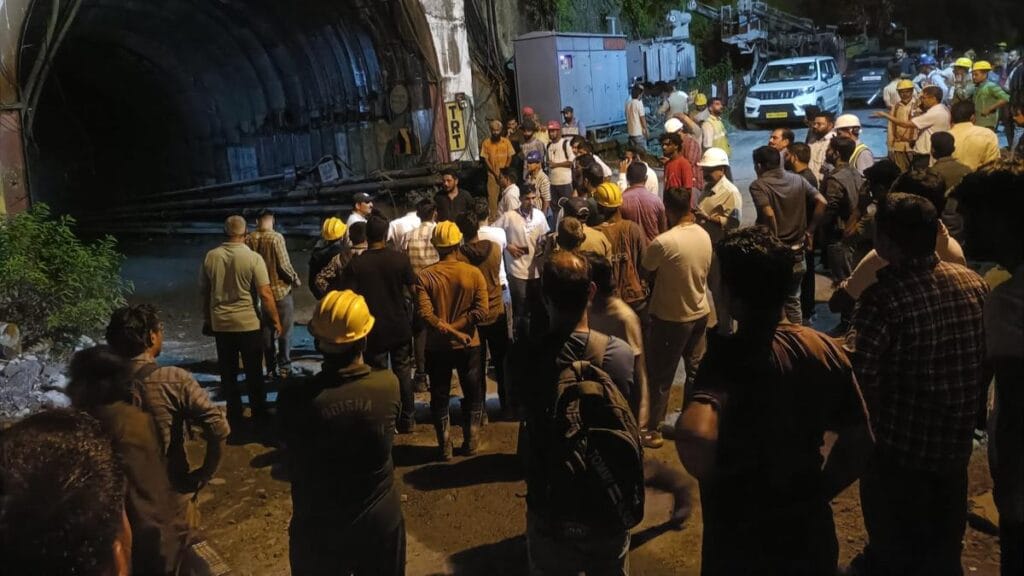
Rescue workers conduct operations at an under-construction hydroelectric tunnel in Chamoli after water and debris trapped workers inside the structure. Image Credit: The Hindu
Chamoli Tunnel Accident: According to preliminary official information, 22 workers were inside the tunnel when the surge occurred. Rescue teams brought several workers out, but seven were later declared dead and 14 were admitted for treatment. Information about the remaining workers was initially unclear as rescue personnel continued searching through the affected section.
The tunnel forms part of the Vishnugad-Pipalkoti hydroelectric project being developed by Tehri Hydro Development Corporation Limited. The project site lies in a mountainous region where heavy monsoon rain, landslides and sudden water movement can create severe risks for underground construction.
The accident triggered a large-scale response involving the National Disaster Response Force, State Disaster Response Force, district administration, police, Indo-Tibetan Border Police and project personnel.
What happened inside the tunnel?
The workers were reportedly carrying out construction activity inside a tunnel when a sudden rush of water and debris entered the passage.
Initial accounts described a large volume of water, slush and mud entering the tunnel after a landslide or cavity formed above the tunnel alignment. The material blocked sections of the passage and trapped workers who were on duty during the afternoon-to-night shift.
The incident was reported at approximately 6:30 p.m. to 7:05 p.m. on Thursday, according to officials and project sources. The workers were believed to be part of the shift scheduled from 2 p.m. to 10 p.m. This story was also covered by TheHindu.
A tunnel under construction can contain narrow access points, equipment, cables, ventilation systems and uneven surfaces. When water and debris enter suddenly, workers may have very little time to move towards the exit.
The force of the inflow can also block access roads and create additional hazards for rescuers. Water levels may continue rising, while loose rock and soil can fall from the roof or sidewalls.
Rescue operation in difficult conditions
The rescue effort was launched immediately after officials received information about the trapped workers.
NDRF and SDRF personnel were deployed with excavators, cutting equipment, lighting systems and other machinery. Police, district officials and project workers assisted in clearing debris and identifying safe access routes. Rescuers worked to remove mud and stones from the tunnel while checking for workers who could be alive in pockets beyond the blockage.
The operation became more difficult because the tunnel was still vulnerable to water inflow and further debris movement. Teams had to ensure that machinery could operate without causing another collapse.
Some workers were taken to nearby hospitals after being brought out. Doctors treated them for injuries and monitored their condition. The deaths were confirmed after the rescued workers were assessed at the hospital. The rescue agencies also had to reconcile changing figures as workers were evacuated, injured people were shifted and the identities of those missing were verified.
Death toll and injured workers
At least seven workers were declared dead following the incident. Fourteen others sustained injuries and were undergoing treatment at a nearby hospital.
Officials initially reported six deaths, but subsequent updates raised the toll to seven. This reflects the evolving nature of disaster reporting, especially when several injured people are transported from a remote site to different medical facilities.
The names and home districts of all the deceased and injured workers were not immediately released. Authorities are expected to inform families and complete identification and post-mortem procedures.
For relatives, the lack of immediate information can be extremely distressing. The administration will need to establish a help desk, maintain a verified list of workers and provide regular updates.
The medical condition of the injured workers will also be monitored. Some may have suffered trauma from falling debris, while others may face complications from drowning, suffocation, fractures or exposure to contaminated water.
Possible cause of the accident
Officials believe the incident was linked to a sudden surge of water and debris inside the tunnel. A landslide above the tunnel alignment may have created a cavity or opened a path for water and loose material to enter the construction area.
Chamoli has experienced intense monsoon rain, and the Himalayan terrain is vulnerable to slope failures. Rainwater can seep into cracks in rock formations, weaken soil and trigger landslides.
A tunnel project may encounter underground water channels, fractured rock zones and unstable geological formations. Construction teams generally use geological surveys, drainage systems, support structures and monitoring equipment to manage such risks.
The exact cause, however, will require a technical investigation. Authorities will need to examine the tunnel design, construction methods, water-management system, safety warnings, shift records and emergency evacuation procedures.
It would be premature to conclude that the accident resulted from negligence before the investigation is complete. At the same time, the loss of seven lives requires a detailed review of whether all required safety precautions were in place.
Statements from officials
Chamoli District Magistrate Gaurav Kumar said a large volume of debris and water surged into the tunnel around 6:30 p.m. to 6:45 p.m. Workers on duty became trapped, after which NDRF, SDRF and other teams started rescue operations.
A senior THDC official said 22 people were inside the tunnel when a mixture of slush and water entered. The official said workers were rescued within a few hours, while efforts continued to evacuate those still trapped.
The statements indicate that the authorities responded quickly, but the situation remained critical because of rising water levels and the unstable tunnel environment. Officials are expected to provide more detailed information about the project, the tunnel section affected and the safety measures that were active at the time of the incident.
Vishnugad-Pipalkoti project
The accident occurred at the Vishnugad-Pipalkoti hydroelectric project near Pipalkoti in Chamoli district. The project is being developed by THDC India Limited and involves underground construction in a geologically complex Himalayan region.
Hydroelectric projects in Uttarakhand are important for power generation and regional development, but they also involve tunnels, dams, roads and underground works in areas vulnerable to landslides, earthquakes and flash floods.
Tunnel construction requires workers to operate deep inside the mountain, sometimes far from the main entrance. Safety planning must account for sudden water inflow, rockfall, equipment failure, ventilation problems and evacuation difficulties.
The Himalayas are among the world’s youngest mountain systems and remain geologically active. Slopes can be unstable, especially during prolonged monsoon rainfall.
The disaster has renewed attention on the safety of workers building large infrastructure projects in mountain states.
Also Read: Uttarakhand Flash Flood: Bailey Bridge Washed Away in Chamoli, BRO Driver Missing
Timeline
On Thursday evening, workers were engaged inside an under-construction tunnel at the THDC hydroelectric project near Mayapur and Pipalkoti.
At approximately 6:30 p.m. to 7:05 p.m., water, slush and debris suddenly entered the tunnel.
Twenty-two workers were initially reported trapped inside.
NDRF, SDRF, police, district administration and project teams launched rescue operations.
Several workers were brought out and shifted for medical attention.
Fourteen injured workers were admitted for treatment, while at least seven were declared dead.
Officials continued searching and verifying information about workers who were not immediately accounted for.
A technical assessment of the tunnel and the surrounding slope is expected after the immediate rescue operation.
Why This Matters
This matters because the incident has caused multiple deaths at an infrastructure project that relies on hazardous underground construction work.
Every worker inside a tunnel depends on warning systems, safe access routes, emergency communication, ventilation and a reliable evacuation plan. If water and debris enter suddenly, even a well-trained workforce may face overwhelming conditions.
The accident also matters because hydroelectric projects are often located in remote mountain areas where medical facilities and roads are limited. Injured workers may need to be transported quickly over difficult terrain.
The incident raises questions about how construction companies monitor underground water movement and landslide risks during the monsoon.
It also highlights the need for accurate worker records. When authorities initially cannot confirm how many people remain trapped, families may be left waiting for information.
Yeh incident kaafi important hai because development projects cannot be considered successful if worker safety is treated as an afterthought.
India angle
For India, the Chamoli tunnel accident highlights the risks faced by workers building roads, railways, hydropower projects and other infrastructure in the Himalayas.
Uttarakhand has witnessed several major disasters linked to heavy rain, flash floods, landslides and unstable slopes. The region’s difficult terrain makes it attractive for hydropower development but also increases construction risks.
The government and project companies must ensure that tunnel workers receive proper safety training, protective equipment and emergency drills. Every site should have clearly marked evacuation routes, communication systems and rescue equipment.
Monitoring instruments can help detect water pressure, rock movement and structural changes. Weather warnings should be linked to work-shift decisions, particularly during periods of intense rain.
Simple Hinglish mein, project jaldi complete karna important hai, lekin workers ki jaan sabse pehle aati hai.
The incident also has implications for labour rights. Workers in hazardous construction projects should have insurance, medical support, compensation mechanisms and clear information about emergency procedures.
Analysis
The first priority is to locate every worker and provide medical care. Rescue teams should not stop after bringing out the majority of workers; they must verify each person’s identity against the project attendance register and shift roster.
The changing figures show why disaster communication must be carefully managed. Early updates referred to six deaths, while later reports put the toll at seven. Such changes are understandable during an ongoing operation, but authorities should issue regular verified bulletins.
The second priority is to determine how water and debris entered the tunnel. Investigators should examine whether a natural cavity, landslide, drainage failure or construction activity created the passage.
The third priority is safety reform. If the project is allowed to resume, authorities must first confirm that the tunnel is stable and that an improved emergency plan is in place. A detailed inquiry should look at weather conditions, geological surveys, hazard warnings, worker training, safety equipment, supervisory arrangements and response time. The objective should not be to assign blame quickly. It should be to establish facts and prevent another tragedy.
What Next
Rescue teams will continue searching for workers who remain unaccounted for. Officials will cross-check the list of workers present inside the tunnel against hospital, deceased and rescued records.
The injured workers will receive treatment at nearby hospitals. Authorities will inform families and arrange support for those who have lost relatives. The tunnel and surrounding slope will undergo a safety assessment. Work may remain suspended until engineers determine that water levels, debris and structural conditions are safe.
The State government and project authorities may announce compensation for the families of deceased workers and financial assistance for the injured. A technical committee could be formed to investigate the cause of the water and debris inflow. The committee may recommend improvements in drainage, tunnel support, monitoring equipment, evacuation procedures and monsoon work protocols.
Long term, similar hydroelectric and tunnel projects in Uttarakhand may face fresh safety inspections. Regulators may require developers to strengthen emergency preparedness before allowing construction to continue during periods of heavy rainfall.
Conclusion
At least seven workers have died and 14 were injured after water and debris entered an under-construction hydroelectric tunnel near Pipalkoti in Chamoli district. Twenty-two workers were initially trapped, and rescue teams brought many of them out while continuing to search for those not immediately accounted for.
The accident occurred at a THDC project in a fragile Himalayan environment during the monsoon. The sudden inflow of water and debris created a life-threatening situation inside the tunnel and exposed the dangers faced by construction workers in remote mountain areas.
The immediate focus must remain on rescue, medical care and support for the families of the deceased. After the operation ends, authorities must conduct a transparent technical investigation.
Uttarakhand’s infrastructure needs are real, but development must go hand in hand with worker safety, geological monitoring and strong emergency planning. The lives lost in Chamoli should lead to concrete improvements, not merely another temporary response.
Written By A. Jack