Ranchi police register case against “troublemakers” who allegedly disrupted law and order during Monday’s Vidhan Sabha gherao; say genuine students not targeted as protest enters Day 20.
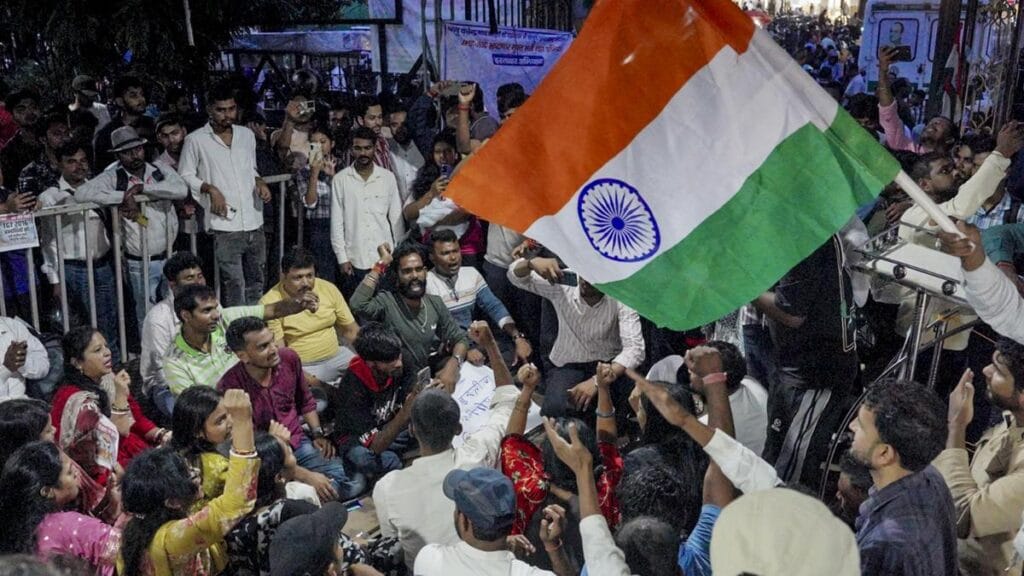
Students and job aspirants gather during the ongoing Jharkhand recruitment exam protest in Ranchi. Image Credit: The Hindu
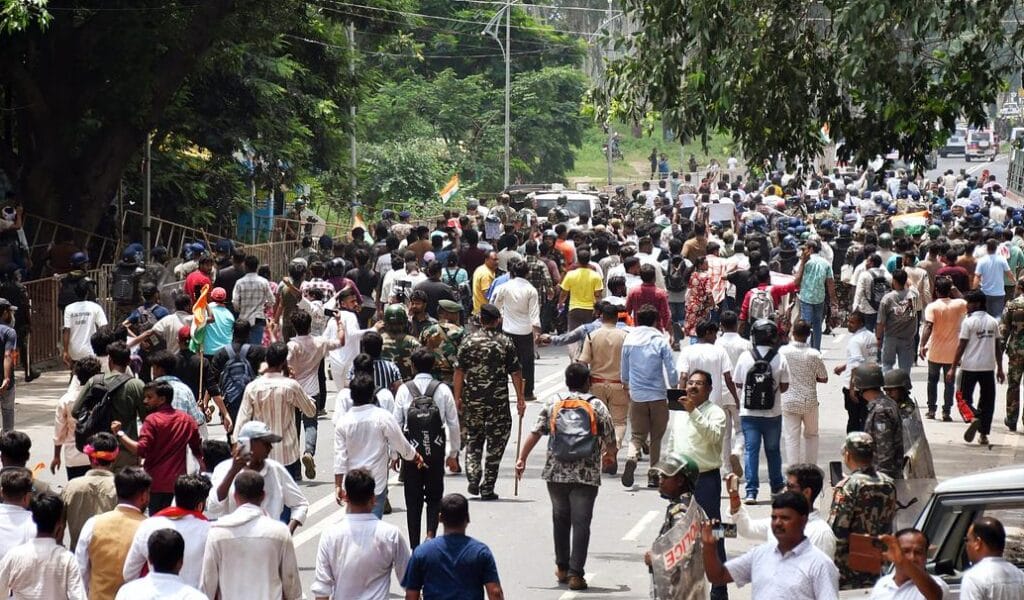
As the students’ protest over alleged irregularities in Jharkhand’s recruitment examinations entered its 20th day on Thursday (August 13, 2026), Ranchi police registered FIRs against more than 500 unidentified protesters who took part in a march towards the Jharkhand Assembly on Monday (August 10, 2026).
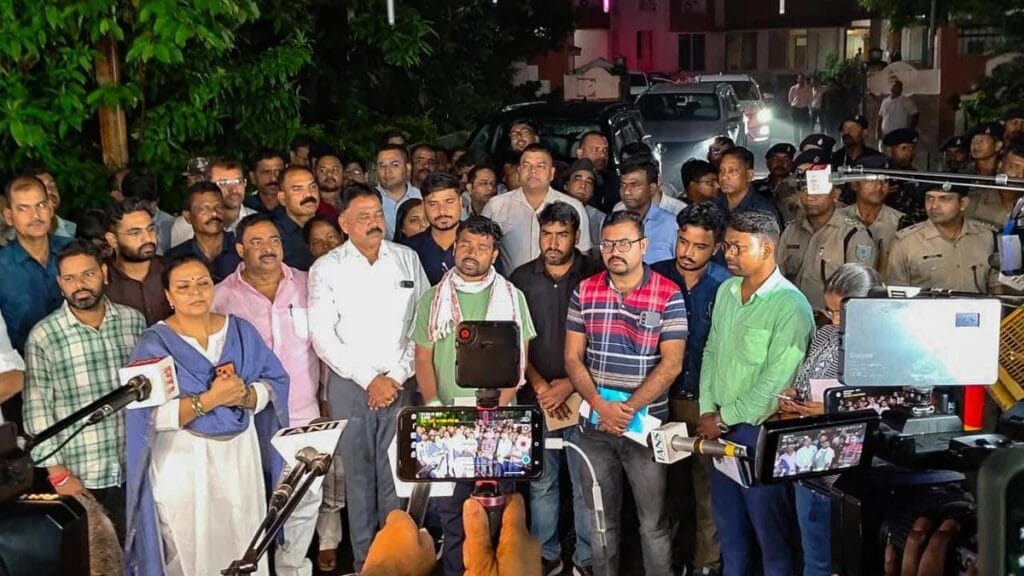
Ranchi Senior Superintendent of Police (SSP) Rakesh Ranjan said those booked were “troublemakers” and “anti-social elements” who tried to disturb law and order during the Vidhan Sabha gherao. He clarified that genuine students need not worry because no FIR has been filed against them by name, and action will focus only on those found involved in violence and disruption after video analysis.
Why and How the FIRs Were Filed
According to police, the case was lodged at Vidhan Sabha police station for violating prohibitory orders, damaging government property, and attacking police personnel during the August 10 march.
SSP Ranjan told reporters that while students were engaged in a largely peaceful protest, some disruptive elements allegedly infiltrated the gathering and created disturbances at multiple points, prompting police to register an FIR against 500-plus unnamed people. This story was also covered by TheHindu.
He added that video footage from the march is being scrutinised to identify individuals involved in violence, stone-pelting, or assault on police, and that appropriate legal action will follow once identities are confirmed.
Reports also indicate that at least 14 police personnel were injured during the clash, with allegations of obstruction in government work, misbehaviour, and assault included in the FIRs.
Statements From Police and Protest Leaders
Police stance:
“We have collected comprehensive details regarding the Vidhan Sabha March, during which the students encircled the Assembly. While students were engaged in a peaceful protest, we learned that some disruptive individuals infiltrated the gathering,” SSP Rakesh Ranjan said. “These troublemakers attempted to create disturbances at various locations, prompting the police to file FIRs against more than 500 unidentified individuals. No students’ names appear in the FIRs, so they should not be alarmed.
He further said around 500 people had been potentially identified for scrutiny so far, but the number was not final and could change after detailed analysis of the footage.
Protesters’ position:
The JPSC–JSSC Reforms Manch has been protesting at Jaipal Singh Munda Stadium in Ranchi, demanding greater transparency in recruitment exams, cancellation of several tests, and an independent probe by the CBI or a panel of retired judges from outside Jharkhand. Despite the government’s claim of meeting many demands, students have refused to end the stir until core issues—especially a credible, outside investigation—are addressed.
The 2026 Jharkhand Exam Protest
The 2026 Jharkhand student protests began over alleged irregularities in recruitment examinations conducted by the Jharkhand Public Service Commission (JPSC) and Jharkhand Staff Selection Commission (JSSC). Key demands include:
Cancellation of the 14th JPSC Preliminary Examination and certain backlog exams
A CBI probe or an independent judicial panel into exam anomalies
Systemic reforms in JPSC and JSSC functioning
Transparency in question paper setting, evaluation and result declaration
The agitation started on July 25, 2026, and quickly turned into a state-wide movement, with thousands of job aspirants camping in Ranchi. On August 9, the Jharkhand government agreed to cancel the 14th JPSC preliminary exam and certain backlog examinations after nearly six hours of talks with student groups. However, protesters say this does not fully address their demand for an external, high-level inquiry into the entire process.
Tensions escalated on August 10 when a large march towards the Assembly turned confrontational. Security personnel used batons, water cannons, and tear gas to disperse demonstrators, leading to injuries on both sides and widespread criticism of the police action.
Key Developments So Far
July 25, 2026: Students begin protest in Ranchi over alleged JPSC–JSSC irregularities.
Early August: Agitation enters the second week; hunger strikes and large rallies intensify pressure on the Hemant Soren government.
August 9: The Government agrees to cancel the 14th JPSC prelims and some backlog exams after talks; claims “98% demands met,” but protesters remain unconvinced.
August 10: Thousands march towards the Assembly; clash with police; water cannons and lathi charges are used.
August 11–12: BJP calls bandh in parts of Jharkhand; ED launches money-laundering probe into exam-related financial irregularities; former JPSC chairperson arrested by CID.
August 13 (Day 20): Police register FIRs against 500+ unnamed protesters linked to the August 10 march; say genuine students not targeted.
Why This Matters
Yeh issue kaafi important hai kyunki seedha asar pad raha hai hazaron youth ke career par.wikipedia+1
Career uncertainty: Thousands of aspirants have invested years preparing for JPSC/JSSC exams. Alleged paper leaks and irregularities shake their faith in the system and delay their entry into government jobs.
Credibility of recruitment: If exam processes are not seen as fair, it undermines the legitimacy of future recruitments and fuels cynicism among educated youth.
Law-and-order challenge: Prolonged protests, combined with police action and FIRs, risk turning a legitimate demand for fairness into a polarised law-and-order situation.
Political fallout: With ED probes, arrests of exam officials, and opposition parties jumping in, the controversy has become a major political flashpoint in Jharkhand.
India Angle
Jharkhand’s exam stir is not an isolated case. It fits into a larger, pan-India pattern where recruitment exam controversies—paper leaks, answer key disputes, and alleged manipulation—have triggered massive protests in multiple states.
For India, yeh ek warning signal hai ki agar recruitment system transparent nahi hoga, toh youth ka trust tootega aur unrest badhega. States are increasingly under pressure to:
Adopt third-party monitoring for high-stakes exams
Ensure real-time grievance redressal
Bring in external agencies like CBI or judicial panels when serious allegations arise
Jharkhand’s protest is now being watched as a test case: can the state balance student demands, investigative integrity, and administrative stability without long-term damage to its recruitment ecosystem?
Analysis
The government’s move to cancel some exams and order an ED probe shows responsiveness, yet students’ insistence on a CBI or external judicial panel indicates that partial measures are not enough to restore confidence.
The police decision to file FIRs against 500+ unnamed protesters is a double-edged sword. On one hand, it signals that violence and property damage will not be tolerated. On the other, if not handled with extreme care—clear communication, transparent video evidence, and strict focus on actual wrongdoers—it could be perceived as intimidation, further hardening student sentiment.
For sustainable resolution, the state needs a two-track approach: firm action against genuine lawbreakers and a credible, time-bound roadmap for exam reforms and independent investigation. Anything less may keep the protest cycle alive.
Possible Scenarios
More talks, still no breakthrough: Second-round talks have already failed to end the deadlock; further rounds may follow, but without a clear commitment to an external probe, students are unlikely to withdraw.
Escalation or partial withdrawal: If the government announces a high-level external inquiry (CBI or retired judges’ panel), a section of protesters may scale down agitation. If not, the stir could enter a new, more intense phase.
Legal and investigative pressure: With ED probing financial angles and CID arresting former exam officials, more indictments could emerge, strengthening the protesters’ demand for systemic overhaul.
Political ripple effects: Opposition parties are already using the issue to attack the ruling dispensation. How the CM handles the next few weeks could shape Jharkhand’s political narrative heading into future electoral battles.
Conclusion
The Jharkhand exam stir has moved from a demand for transparency to a broader test of governance, trust, and rule of law. Police FIRs against 500+ unnamed protesters mark a new, more confrontational phase, but authorities insist that genuine students are not the target.
At the heart of the matter remains a simple question: how does the state ensure that recruitment exams are beyond doubt while also maintaining public order? The answer will decide not just the fate of this protest but also the credibility of Jharkhand’s entire recruitment system in the eyes of its youth.
Written By A. Jack