Abhijeet Dipke and his supporters stayed at Jantar Mantar overnight, mounting pressure on the Centre over the NEET leak row. Climate activist Sonam Wangchuk who joined the protest on June 20 has also warned of a hunger strike on June 27 if action is not taken.
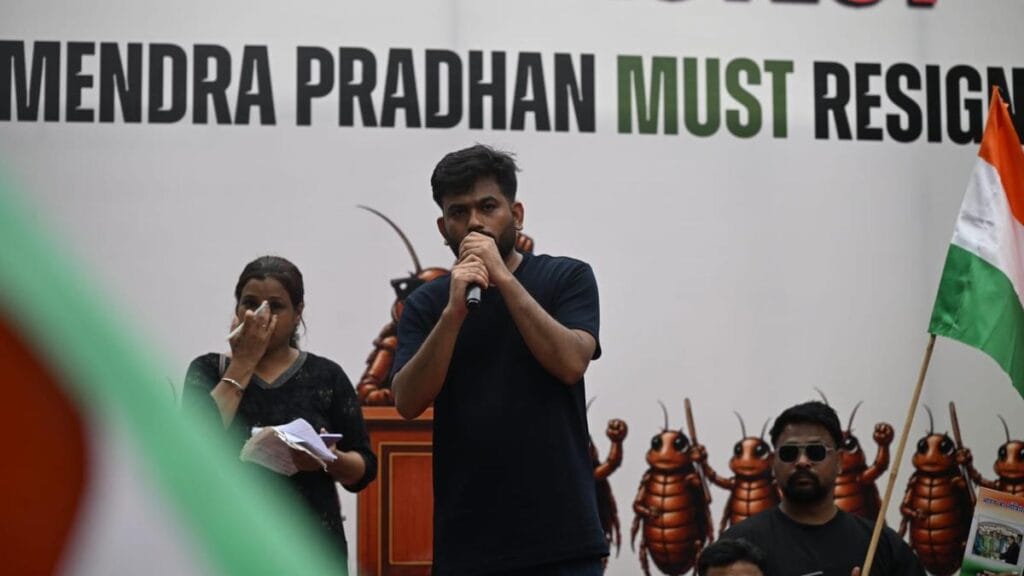
Abhijeet Dipke and supporters continue their sit-in protest at Jantar Mantar in Delhi. Image Credit: The Hindu
CJP Protest in Delhi
The protest at Jantar Mantar in Delhi continued overnight as Cockroach Janta Party founder Abhijeet Dipke, along with supporters, stayed put at the sit-in demanding the resignation of Union Education Minister Dharmendra Pradhan over the NEET paper leak controversy. The demonstration entered its second day on Sunday, June 21, 2026, and the protestors urged more people to join them at Jantar Mantar. Dipke also appealed to NEET aspirants to take part in the agitation after completing their re-examination, turning the protest into a broader show of anger over exam integrity and accountability.
Why the Protest Continues
The protest is continuing because the NEET paper leak issue has become much bigger than a single exam controversy. For many students and families, the case represents a breakdown of trust in the system, especially when a competitive exam as important as NEET is seen as vulnerable to malpractice. That is why the sit-in is not just symbolic — it is being used as a pressure tactic to demand political accountability at the highest level. The Hindu has covered the full story.
Abhijeet Dipke and his supporters are pushing for Dharmendra Pradhan’s resignation, arguing that the education system needs accountability after such a serious breach. The call for a minister’s resignation is often a way for protestors to signal that they see the issue as systemic, not accidental. In this case, the ongoing sit-in shows that the group wants to keep the issue visible until it gets a formal response.
The protest also gained additional visibility because climate activist Sonam Wangchuk joined the demonstration on June 20. His presence has broadened the protest’s profile beyond one political group and made it more likely to attract public attention. Wangchuk has now said he would go on a hunger strike on June 27 if the Union Education Minister does not step down, adding more urgency to the situation.
What the Protestors Are Saying
Dipke’s messaging has been simple and direct: join the protest, keep the pressure up, and do not let the issue fade away. By asking people to reach Jantar Mantar and calling on NEET aspirants to join after their re-examination, he is trying to turn student frustration into a larger public movement. That strategy is designed to keep the protest visible and emotionally resonant.
A natural reading of Wangchuk’s warning is that the protestors are preparing for a longer confrontation if the government does not respond. His hunger strike threat on June 27 is especially significant because hunger strikes traditionally carry moral and emotional weight in Indian public life. They are often used to demonstrate seriousness and sacrifice, and they tend to generate wider public sympathy when linked to a cause seen as important.
A protest organiser said the sit-in would continue as long as needed until the issue receives a meaningful response. That is the central logic of the movement: if the state does not answer politically, the protest continues physically. In Delhi, where symbolic protests often play out at Jantar Mantar, this type of sustained presence is a familiar but powerful tactic.
Background and Context
The NEET paper leak controversy has already triggered national concern because it affects one of India’s most competitive and high-stakes entrance examinations. NEET is not just another test; for lakhs of students, it is the gateway to medical education and professional futures. When a paper leak or related scandal happens, it shakes confidence far beyond the immediate exam cycle.
This is why the protest has gained traction at Jantar Mantar. The location itself is a familiar stage for public demonstrations, especially around governance, transparency and student issues. In this case, the protest combines two potent themes: exam fairness and ministerial responsibility. That makes it more than a local sit-in; it becomes part of a wider national conversation about trust in institutions.
The mention of a re-examination also adds to the tension. Students who have already been through one disruption now face another layer of uncertainty, and that can create frustration, stress and a feeling of unfairness. Protestors are tapping into that emotion, which is one reason the demonstration has remained active overnight.
Timeline
June 20, 2026: Climate activist Sonam Wangchuk joins the protest at Jantar Mantar.
June 21, 2026: The protest enters its second day, with Abhijeet Dipke and supporters continuing the sit-in overnight.
Sunday: Dipke urges people to join the protest and asks NEET aspirants to participate after their re-examination.
June 27, 2026: Wangchuk says he will begin a hunger strike if Union Education Minister Dharmendra Pradhan does not step down.
Ongoing: The protest continues as pressure builds over the NEET paper leak controversy.
Why This Matters
This matters because the NEET issue affects thousands of students and families who depend on a fair and transparent examination process. When exam credibility is questioned, the impact is not limited to one academic year; it affects the long-term faith people place in public institutions. Yeh issue kaafi important hai because if students stop believing that hard work matters, the damage goes far beyond one paper leak.
It also matters politically because protests like this can shape the public narrative around accountability. Calls for a minister’s resignation are not made lightly, and even if the government does not act immediately, the pressure can force a stronger public response. In a democracy, such protests play a role in keeping institutions answerable.
For India’s education system, this is a reminder that exam security is not just about logistics. It is about fairness, confidence and merit. If that chain breaks, the consequences are serious for students, coaching families and the broader education ecosystem.
India Angle
From an India-focused perspective, this protest is deeply relatable because competitive exams are part of the life story of millions of Indian students. Families invest time, money and emotional energy into exams like NEET, so any allegation of a paper leak hits a nerve. In Hinglish, seedhi baat yeh hai: jab exam ka trust toot-ta hai, toh students ka confidence bhi hilta hai.
Jantar Mantar protests often become a national signal, and this one is no different. Delhi is where policy pressure, media coverage and political symbolism converge. So when Dipke and supporters sit overnight in the capital, the message travels quickly across India, especially among students who are already anxious about exam fairness.
Sonam Wangchuk’s involvement also adds a broader public-interest layer. He is widely seen as a voice for youth and education-linked causes, so his participation gives the protest a stronger moral dimension. That makes this issue relevant not just in Delhi, but in coaching hubs and student communities across the country.
Analysis
My opinion is that the protest’s overnight continuation is a smart move if the goal is to keep public attention alive. In media cycles, one-day protests can disappear quickly, but overnight sit-ins tend to signal seriousness and commitment. The addition of a hunger strike threat makes the story more emotionally charged and more likely to stay in the headlines.
At the same time, the protest will only have long-term impact if it connects public anger to a clear policy demand. A resignation call gets attention, but students and parents will also want to know what concrete steps will prevent the next paper leak. That is the real challenge for both protestors and the government.
What Next
The next few days are likely to decide whether the protest grows or stays symbolic. If more people join at Jantar Mantar, the demonstration could gain momentum and attract wider media coverage. If not, it may remain a concentrated but still visible sit-in.
Sonam Wangchuk’s warning of a hunger strike on June 27 is the biggest immediate development to watch. If that goes ahead, the issue will almost certainly intensify and may force a sharper response from authorities. The government, meanwhile, may try to de-escalate the situation through statements, reviews or assurances around exam integrity.
For NEET aspirants, the coming days will be about waiting for clarity after the re-examination and watching whether the political pressure leads to any systemic changes. The broader outcome will depend on whether the protest translates into policy action or remains a strong but limited show of dissent.
Conclusion
The overnight sit-in at Jantar Mantar led by Abhijeet Dipke and supporters has turned the NEET paper leak controversy into a live political and student rights issue. With calls for Dharmendra Pradhan’s resignation, Sonam Wangchuk’s hunger strike threat, and growing public frustration over exam fairness, the protest is now part of a much larger debate about accountability in India’s education system. What happens next will depend on whether the government responds meaningfully or whether the protest movement grows further in the days ahead.
Written By A. Jack