The Cockroach Janta Party (CJP) will continue its protest at Jantar Mantar on Tuesday, a day after dramatic clashes erupted near Parliament and stage and tents were removed from the site. By early morning, police and RAF presence was still heavy as protesters started to filter back into the protest zone.
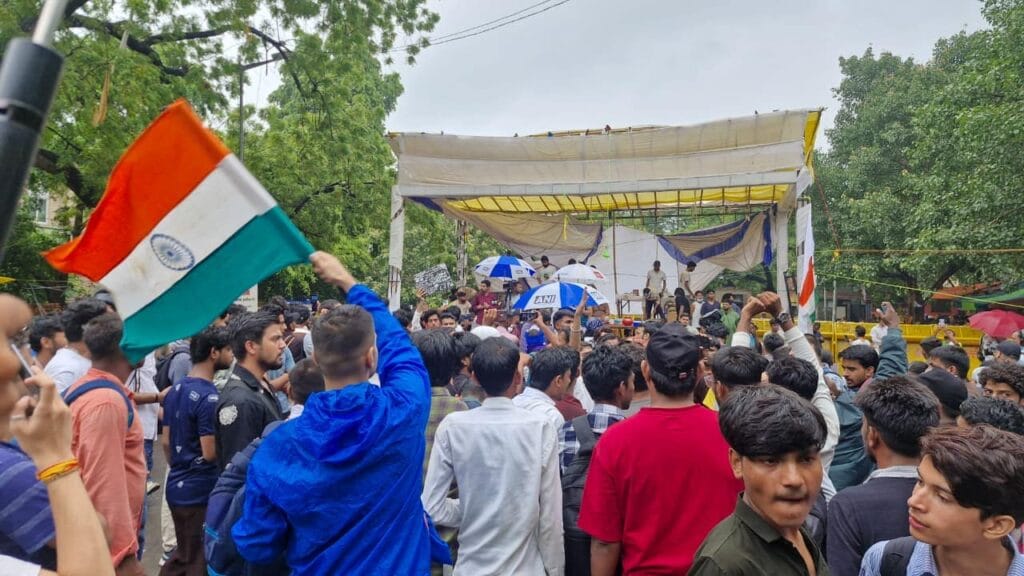
Protesters gather again at Jantar Mantar in New Delhi as police maintain a heavy security presence after Monday’s clashes near Parliament. Image Credit: NDTV
Jantar Mantar once again became the centre of protest politics in New Delhi on Tuesday as the Cockroach Janta Party announced that its demonstration would continue despite Monday’s violence, detentions and police action. Protesters began returning to the site early in the morning after police had removed the stage and tents from the area following the previous day’s confrontation.
The police response remained strong, with heavy deployment of Delhi Police and RAF personnel still visible at the site. Monday’s march to Parliament had already created unprecedented scenes in the national capital, with thousands of students pushing toward the heart of power and police responding with force. Yeh issue kaafi important hai because it is no longer just about one march; it has turned into a larger battle over protest rights, state response and political accountability.
What Happened at Jantar Mantar
The immediate trigger for the renewed gathering was CJP’s call for the protest to continue. Despite the police removal of the stage and tents, protesters began streaming into Jantar Mantar again on Tuesday morning. That move signalled that the movement was not backing down after Monday’s confrontation.
What makes this significant is that Jantar Mantar has long served as a designated protest space in Delhi. When the stage and tents were removed after the clashes, it seemed like an attempt to reset the ground and limit the protest’s momentum. But the return of demonstrators showed that symbolism still matters. In protest politics, returning to the same site can be a statement in itself. Seedhi baat yeh hai: the protesters were telling the authorities that clearing the stage does not clear the cause. This story was also covered by NDTV.
Police remained on alert because the crowd had already demonstrated its willingness to move beyond the usual boundaries. After Monday’s march came within metres of Parliament, the security challenge was no longer theoretical. That is why Tuesday’s developments were watched closely. A gathering at Jantar Mantar can quickly shift from a sit-in to a march if the crowd mood changes again.
Monday’s Clash Set the Tone
The renewed protest cannot be understood without Monday’s violence. The earlier march saw extraordinary scenes in central Delhi as thousands of protesters reached close to Parliament. According to police, around 70 protesters were detained and an FIR was filed against unidentified persons for violence and vandalism. More than 100 policemen and over 60 protesters were injured after lathicharge and tear gas were used to disperse the crowd.
Delhi Police described the protesters as “unruly, aggressive and violent”, saying they had ignored repeated warnings and violated prohibitory orders. The protesters, on the other hand, accused the police of using excessive force during the “Sansad Chalo” march and said several students were injured. That split in narratives is crucial because it shapes how the public interprets the whole event.
In situations like this, the official response and the protester response often become competing stories. One side sees a security breach; the other sees suppression of dissent. Both frames can travel quickly, especially when the issue is already emotionally charged. Yeh bhi important hai because once violence enters the picture, the protest becomes harder to resolve and easier to politicise.
Talks Opened With Government
Amid the chaos, the government did open a line of communication. Union Health Minister JP Nadda met CJP spokespersons Saurav Das and Ashutosh Ranka at his residence on Monday afternoon and heard their demands. According to the statement after the meeting, the CJP team placed three key demands before him.
Those demands were the release of Sonam Wangchuk without any restriction on his movement, the resignation of Education Minister Dharmendra Pradhan, and compensation of Rs 1 crore for all NEET aspirants who died by suicide following the NEET 2026 paper leaks. Nadda later posted on X that the CJP leaders had submitted a written petition around 4 pm and that the discussion had begun after the CJP approached the government for talks.
After the meeting, Saurav Das said the minister had assured them that he would discuss the matter at the appropriate level, but no commitments had been made yet. He also said the peaceful protesters would not rest until the demand was met. That is a classic protest dynamic: once the movement gets formal contact with the government, it may either de-escalate or become more determined depending on whether the response feels meaningful. Right now, it appears to be the latter.
Sonam Wangchuk’s Role
Sonam Wangchuk remains at the centre of the political and emotional energy around this movement. Wangchuk has said he will continue his fast until youth leaders are allowed to meet MPs in Parliament or are allowed to meet him at the hospital in Delhi where he is admitted. His handwritten note, shared by his wife Gitanjali Angmo, added moral weight to the protest.
In that note, Wangchuk said he had decided to continue fasting after seeing the brutality with which peacefully protesting youth were being dealt with. He wrote that he would remain on fast until the youth leaders were allowed to meet parliamentarians at Sansad Bhavan or were allowed to meet him at the hospital. That message matters because it transforms the protest from an on-the-ground rally into a broader moral appeal.
When a respected activist aligns himself so visibly with students, the movement gains legitimacy among supporters and scrutiny from the state. It also makes the issue harder to dismiss as a short-term outburst. In a country like India, where symbolism can be as powerful as slogans, Wangchuk’s continuing fast is likely to keep this story alive. Yeh issue kaafi important hai because it links student anger, medical protest and parliamentary accountability into one narrative.
Background and Context
The CJP protest has been building for some time around allegations of paper leaks and exam irregularities, especially concerning NEET 2026. The group has repeatedly framed the issue as one of justice for students and accountability in education. That helped the protest grow beyond a single organisation and attract students from multiple states.
Jantar Mantar had already become the movement’s base. In previous days, the site saw sit-ins, speeches and growing crowds. The confrontation on Monday changed the scale of the protest, moving it from a demonstration to a national security and political issue. Once the crowd reached near Parliament, the state’s response became more forceful, and the protest entered a new phase.
Delhi Police had also taken preventive steps before Monday’s march, including heavy security deployment and restrictions around the New Delhi district. But the sheer turnout still created pressure. That is why Tuesday’s return to Jantar Mantar matters so much: it shows the protest structure survived the crackdown and remains active.
Timeline
Before Monday: CJP maintains its protest at Jantar Mantar over NEET paper leak allegations.
Monday morning: Thousands join the “Sansad Chalo” march toward Parliament.
Monday afternoon: Police use lathicharge and tear gas; injuries and detentions follow.
Monday later: JP Nadda meets CJP spokespersons and hears their demands.
Late Monday / early Tuesday: Police remove the stage and tents from Jantar Mantar.
Tuesday morning: Protesters stream back into Jantar Mantar after CJP says the protest will continue.
Tuesday onwards: Heavy police and RAF deployment remains in place.
Also Read: Mobile Internet Shutdown in Central Delhi Delays Protest Visuals as Crackdown Unfolds
Why This Matters
This matters because the protest has moved beyond a campus-style grievance into a national conversation about state response, student anger and the handling of education-related crises. When students believe that exam leaks or irregularities threaten their future, the emotional stakes are enormous. That kind of pressure can turn into sustained mobilisation very quickly. Yeh issue kaafi important hai because it affects not just protest management but trust in the education system itself.
It also matters because Delhi is the symbolic centre of Indian politics. A protest at Jantar Mantar is one thing; a march that reaches Parliament is another. The fact that the movement has returned after police action means the authorities cannot assume the issue has been contained. They will have to deal with both security concerns and the underlying demands.
There is also a democratic angle. Peaceful protest is a constitutional right, but once violence, tear gas and baton charges enter the picture, public debate usually hardens. The question becomes whether the government is listening enough and whether protesters are willing to stay within permitted boundaries. This is why the aftermath of Monday’s clash is so significant for India’s political culture.
India Angle
For Indian readers, this story has a strong national relevance because NEET affects millions of students and families across the country. In Hinglish, seedhi baat yeh hai: jab exam leak aur protest ek saath headline bante hain, toh har ghar mein tension feel hoti hai. The issue is not limited to Delhi; it touches aspirants in almost every state.
The CJP protest also reflects how youth movements are changing in India. Students are no longer just demanding answers at colleges or coaching centres. They are taking their concerns to Parliament and connecting them to broader questions of justice and accountability. That shift matters because it shows a more assertive generation entering public life.
And then there is the emotional layer. Wangchuk’s fast, the injured students, and the demands for ministerial resignation and compensation — all of it feeds into a national mood of frustration. For many families, the NEET issue has become a question of whether the system can be trusted at all. That makes this protest far more than a temporary demonstration.
Analysis
My opinion is that Tuesday’s return to Jantar Mantar shows the protest has not lost momentum despite police action. Clearing the stage and tents may have signalled control, but it did not stop the crowd from coming back. In protest terms, that is important because it shows organisational resilience. A protest that survives a crackdown often becomes more symbolically powerful.
I also think the government’s decision to open a dialogue is a double-edged move. It can calm tensions if protesters feel heard, but it can also validate the movement and encourage more demands. At this stage, the protest appears to be in a delicate middle phase where neither side wants to fully back down. That makes the next 24 to 48 hours especially important.
From an editorial standpoint, this is a strong story because it includes conflict, quotes, official responses and a continuing protest site. It has all the ingredients of a developing national news event. The challenge is not just to report what happened but to explain what the protest stands for and why it is still alive after such a dramatic confrontation.
What Next
The next step will likely depend on how the police manage Jantar Mantar through the day and whether the protesters remain peaceful. If the crowd stays put, the site may continue as a sit-in. If the protesters attempt another march, Delhi Police will almost certainly respond with even tighter security.
The government may also decide whether to continue talks with CJP leaders. That could influence whether the movement cools down or escalates. If no concrete response comes to the demands, especially around Wangchuk’s movement, the resignation call and compensation issue, the protest may intensify further.
For now, the main thing to watch is whether the movement remains concentrated at Jantar Mantar or spreads to other cities. Given the emotional charge around NEET and student accountability, more solidarity actions cannot be ruled out.
Conclusion
CJP’s decision to reclaim Jantar Mantar and continue its protest shows that the movement remains active despite Monday’s clashes near Parliament. Heavy police presence has not stopped protesters from regrouping, while talks with the government have opened but produced no final resolution. With Sonam Wangchuk continuing his fast and student anger still high, the issue is far from settled. What happens next will depend on whether authorities address the demands seriously or the protest enters an even more confrontational phase. For now, Delhi’s protest season is not over — it has simply entered a new and more charged chapter.
Written By A. Jack