A hospital case sheet from Safdarjung has given fresh weight to allegations of use of pellet guns in the July 20 CJP protest at Jantar Mantar, amidst denial of the claim by Delhi Police. The medical record describes “darkened skin around wounds, pellet shards stuck to skin and tenderness on impact sites”, raising serious questions over what exactly happened during the crackdown.
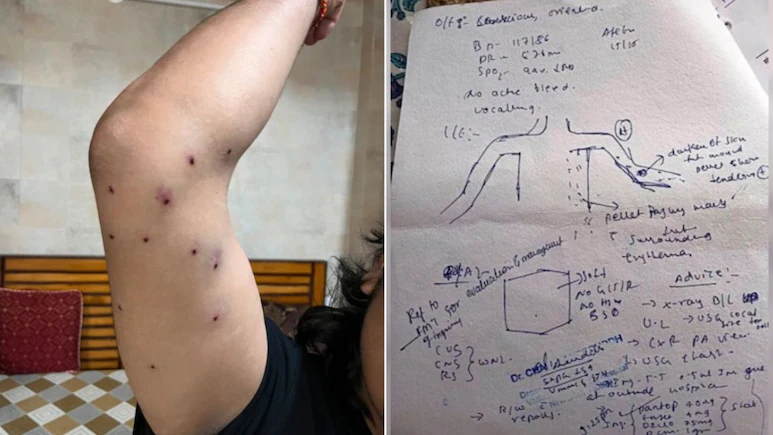
A medical report from Safdarjung Hospital describing pellet wounds and shards stuck to the skin has intensified the controversy over police action during the CJP protest in Delhi. Image Credit: NDTV
CJP Protest: A fresh controversy has erupted over the police action during the July 20 Jantar Mantar protest in Delhi after a government hospital report documented pellet injuries on a demonstrator. The case sheet from Safdarjung Hospital says the 28-year-old patient suffered “pellet wounds” on his right elbow and back, with “darkened skin around wounds, pellet shards stuck to skin and tenderness on impact sites”.
This comes at a time when Delhi Police has firmly denied using pellet guns against the student demonstrators who were marching as part of the ongoing agitation over the NEET paper leak and the demand for Union Education Minister Dharmendra Pradhan’s resignation.
The contradiction between the hospital record and the police denial has turned the incident into a much bigger issue. For protesters, it is evidence that excessive force was used. For the police, it remains an unverified allegation. In such situations, the medical documentation becomes crucial because it is one of the few objective records that can help reconstruct what happened on the ground.
What the report says
The patient was brought to Safdarjung Hospital at around 4 pm on July 20, the same day as the march. According to the case sheet, the injuries were not limited to superficial bruising. The document specifically mentions pellets and pellet fragments embedded in the skin, along with tenderness at the impact sites. That kind of description is medically significant because it suggests direct contact with high-speed fragments rather than a vague or indirect injury. This story was also covered by NDTV.
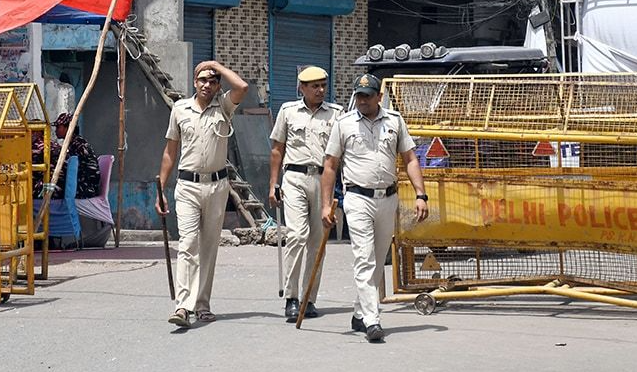
The patient, who chose not to be named, was part of the group marching with the protesters. Reports say he was injured during the crowd-control operation near Jantar Mantar, where the Rapid Action Force and Delhi Police were stationed to prevent the demonstrators from reaching Parliament. The incident has now become one of the most closely watched aspects of the larger protest story.
Why the issue escalated
The reason this has become such a major story is simple: the police and the hospital record point in opposite directions. Delhi Police has said that pellet guns were not used and that claims about them are false and misleading. But the hospital’s documentation appears to indicate that a patient did, in fact, sustain pellet wounds. That mismatch has created a credibility gap that is hard to ignore.
Pellet guns are a controversial crowd-control weapon. They are especially associated in public memory with Kashmir, where they were used to control unrest. Their alleged use in central Delhi, during a student protest near Parliament, would therefore be highly unusual and politically explosive. If the injuries were caused by pellet fire, that would raise serious questions about crowd-control protocol, accountability and proportionality.
The CJP, which is leading the agitation, has accused the police of excessive force to stop protesters from reaching Parliament. Supporters of the movement say the medical report supports their claim that the action was harsher than what was publicly admitted. The police, meanwhile, have continued to stand by their denial.
The medical evidence
The Safdarjung case sheet matters because it gives the controversy a documentary base. The entry describing “darkened skin around wounds, pellet shards stuck to skin and tenderness on impact sites” is not the kind of language that usually appears in a routine injury report unless there was some form of penetrating or fragmenting impact. That makes the document particularly important in the public debate.
At the same time, a medical note alone does not automatically identify who fired the weapon. It confirms the nature of the injury, not the actor responsible. That is why the broader investigation, including eyewitness accounts, video evidence and official logs from the deployed forces, becomes so important. Even so, the hospital record makes it much harder to dismiss the allegations outright.
In practical terms, this is the kind of case where one document can shift the entire conversation. A protester’s injury may be dismissed as vague until a hospital sheet describes embedded pellet shards. Then the question changes from “Did anyone get hurt?” to “What weapon was used?” That is exactly why this report has attracted so much attention.
Quotes and statements
The hospital record itself is the strongest factual statement in the material now public. It states that the patient had “darkened skin around wounds, pellet shards stuck to skin and tenderness on impact sites”. Those words are now being quoted widely because they are specific, clinical and difficult to spin.
Congress president Mallikarjun Kharge used the issue to attack the government, saying Prime Minister Narendra Modi should first apologise to students and take action against those “who ordered the use of pellet guns” against them. He also demanded that Education Minister Dharmendra Pradhan be dismissed before Parliament begins a detailed discussion on education reform. Kharge’s comments show how quickly the medical report has turned into a political weapon in its own right.
Delhi Police, however, continues to deny the allegation and says the force does not use pellet guns in the ongoing protest response. That denial remains central to the official position, even as the hospital record creates discomfort for the authorities. The CRPF, whose Rapid Action Force was also present, has so far remained silent on the specific pellet-gun allegation.
Background and context
The July 20 march was part of the continuing protests over alleged irregularities in competitive examinations and the demand for Dharmendra Pradhan’s resignation. Protesters had gathered at Jantar Mantar and attempted to march toward Parliament, where they were stopped by police and anti-riot units. The CJP has repeatedly accused the police of using force to suppress the protest movement.
Pellet guns are not new in India’s law-and-order debates. They were first introduced in Kashmir in 2010 as a crowd-control measure after unrest, and their use sparked widespread criticism because of the risk of eye injuries and permanent disability. Their reappearance in any other context immediately raises red flags, especially when the target group is students rather than violent rioters.
That history is why this report matters beyond the protest itself. It connects student unrest in Delhi to a much larger conversation about crowd-control tactics in India. When a weapon associated with conflict zones is allegedly used during a student march in the national capital, public concern naturally deepens.
Timeline
July 20, 2026: CJP-led protesters march toward Parliament from Jantar Mantar.
Same day: Police and the Rapid Action Force are deployed at the site.
Around 4 pm: A 28-year-old protester is brought to Safdarjung Hospital with injuries.
July 20 to 23: Delhi Police denies using pellet guns and calls the allegations false.
July 23 onwards: Medical details from the hospital report circulate, including pellet shards stuck to the skin.
July 24–25: Political pressure grows, with opposition leaders demanding accountability.
Also Read: UP Police Raid Jantar Mantar Volunteer Mohd Junaid’s Home, Family Members Reportedly Detained
Why This Matters
This matters because it is not just a protest injury story; it is a test of institutional credibility. If the hospital report is accurate and the police did use pellet guns, then the official denial becomes a major trust issue. If the injuries came from some other source, then the authorities need to explain clearly and quickly to stop misinformation from spreading. Either way, the public deserves a straight answer.
It also matters because protest policing in India affects everyone, not just those on the ground that day. If a peaceful or student-led march can end with pellet injuries, people start wondering how safe dissent really is. Yeh issue kaafi important hai because it goes to the heart of civil liberties, public safety and state power.
For the families of protesters, the issue is deeply personal. A 28-year-old who goes to a march and returns with embedded pellet shards is not an abstract statistic. It is a real person with a real injury, and that makes the debate far more serious than a routine political clash.
India angle
For Indian readers, this story lands at the intersection of education, protest and policing. The protests are already emotionally charged because they involve exam irregularities and student futures, and now the injury report has added a safety angle. In simple Hinglish, seedhi baat yeh hai: jab student apni demands lekar nikalta hai aur hospital report mein pellet shards milte hain, toh sawal aur bhi serious ho jaata hai.
The larger Indian context is that protests are increasingly being judged not only by the demands they make but also by the state response they trigger. If the response includes weapons that can cause long-term injury, public concern will naturally rise. That is why the medical report is getting attention far beyond Delhi.
It also speaks to how fast protest narratives spread in India. One hospital case sheet, one denial from police and one opposition statement can quickly become a national debate. That makes clarity and transparency absolutely essential.
Analysis
My reading is that this is one of those stories where the evidence gap matters more than the political noise. The hospital report is specific, and specificity is powerful in journalism. It does not settle every question, but it gives the allegations enough weight that the police cannot simply brush them aside.
At the same time, the public should be careful not to jump to conclusions without a fuller investigation. The presence of pellet wounds does not by itself identify the exact weapon operator, the force unit involved or the circumstances of firing. What it does do is raise the pressure on authorities to provide a detailed and credible explanation.
What Next
The next step should be a formal clarification from the Delhi Police and, ideally, the CRPF on what crowd-control equipment was actually used at Jantar Mantar on July 20. If a written deployment log or medical inquiry is opened, that could help resolve the contradiction. Without that, the debate will continue to rely on competing claims.
If the hospital report is corroborated by additional medical or video evidence, pressure will mount on the government to explain whether the use of force violated protocol. If not, the police will likely use the gap to reinforce their denial. In either case, the issue is now too public to disappear quietly.
There is also a political next step. Opposition leaders are already using the report to demand accountability and to target the government over its handling of the protest. That means this story is likely to remain alive in both news and parliamentary spaces for some time.
Conclusion
The Safdarjung Hospital report has given the pellet-gun controversy a new and troubling dimension. With a case sheet describing “darkened skin around wounds, pellet shards stuck to skin and tenderness on impact sites”, the denial by Delhi Police now faces serious public scrutiny. Even as the police maintain that no pellet guns were used, the medical record has made the incident harder to dismiss.
This is no longer just about one protester’s injuries. It is about whether the state used force proportionate to the situation, whether the official version matches the medical evidence and how India handles dissent in the age of high-stakes protest politics. For students, families and ordinary citizens watching from afar, yeh issue kaafi important hai because it asks a basic question: when people protest, how much force is too much?
Written By A. Jack