
The earthquake struck near San José del Palmar in the Chocó region at 7:34 a.m. local time, damaging more than 1,500 homes and leaving emergency workers searching through rubble across several departments.
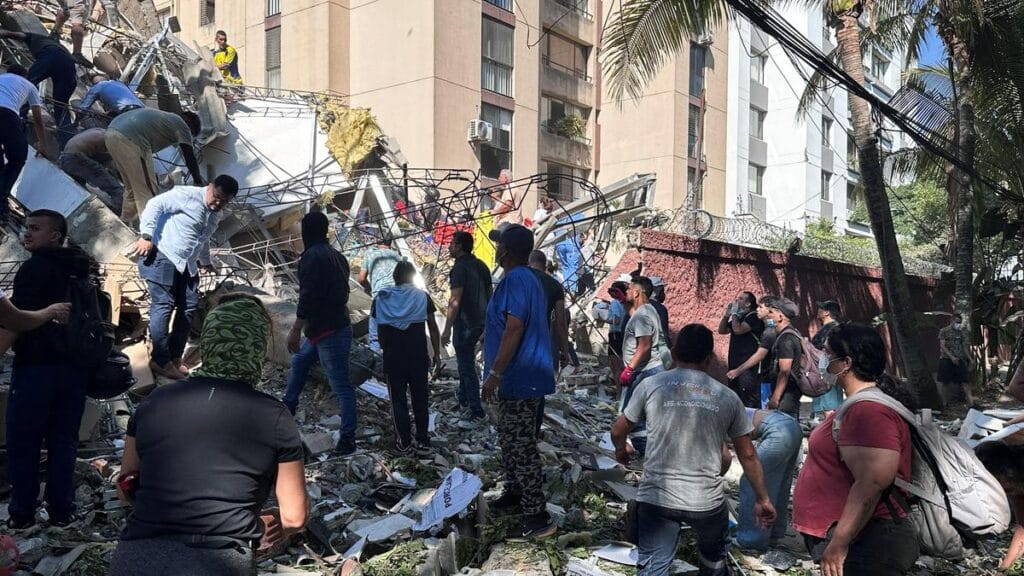
Rescue workers and local residents search through rubble after a magnitude-7.4 earthquake struck western Colombia. Image Credit: The Hindu
Colombia has declared a national emergency after one of the most powerful earthquakes to hit the country in decades caused widespread destruction across the western region. The magnitude-7.4 earthquake struck at 7:34 a.m. local time on Monday, with the epicenter near San José del Palmar in the department of Chocó, according to Colombian and international geological agencies.
President Abelardo de la Espriella said at least 111 people had died and 87 others were injured. Rescue teams were deployed to several cities and towns, where buildings had collapsed and residents were feared trapped beneath the rubble.
Authorities reported that 1,575 homes, 61 buildings, 18 health centers, and 52 schools had been damaged. Several structures were completely destroyed, while emergency teams struggled to reach remote communities in the affected region.
“The national government has all of its capabilities deployed to protect lives, assist affected communities and deliver aid wherever it is needed,” President de la Espriella said while announcing the emergency measures.
Where the earthquake struck
The epicenter was near San Jose del Palmar, a community in the Choco region approximately 400 kilometers west of Bogotá. The earthquake occurred at a depth of roughly 96 to 103 kilometers, according to geological agencies. This story was also covered by TheHindu.
The depth and location of the quake meant that shaking was felt across a wide area. Reports indicated damage not only in Chocó but also in Valle del Cauca, Caldas, Antioquia and other western departments.
Major cities, including Cali, Pereira, Quibdo and Manizales, reported shaking and damage. In some places, residents rushed out of homes and offices as buildings moved violently.
Authorities said the quake was the strongest to affect Colombia in the current century. The country’s Pacific and western regions are particularly vulnerable because of their location near active tectonic boundaries.
Rescue operations after the quake
Emergency workers began rescue operations immediately after the earthquake. Local residents used their hands, buckets and basic tools to remove rubble from collapsed structures while professional teams were mobilized.
The first hours after an earthquake are critical because survivors may remain trapped in air pockets beneath collapsed buildings. Rescue personnel therefore prioritized areas where witnesses reported hearing voices or detecting movement.
The operation has faced several challenges. Roads in parts of the Chocó region are difficult to access even under normal conditions, while landslides, damaged bridges and blocked routes have slowed the movement of emergency equipment.
Hospitals and health centers have also been affected. Some medical facilities suffered structural damage, while others faced a sudden increase in injured people.
Rescue authorities are likely to use sniffer dogs, thermal imaging equipment, drones and specialized urban-search teams as the operation continues. Medical teams are also setting up temporary treatment areas for people who cannot reach functioning hospitals.
Scale of damage
President de la Espriella said 1,575 homes had been damaged, with dozens completely destroyed. At least 61 buildings collapsed, while 18 health centers and 52 schools were affected.
The destruction has left thousands of people without safe shelter. Many residents have refused to return to their homes because of aftershocks and fears that weakened buildings could collapse.
Damage to schools may disrupt education for weeks or months. Health center damage is even more concerning because the earthquake has increased the need for emergency treatment while reducing medical capacity.
Authorities are assessing roads, bridges, electricity lines, water systems and telecommunications networks. Disruption to these services could make rescue and relief operations more difficult.
The emergency declaration is expected to speed up the release of funds, allow the government to coordinate resources more efficiently and support temporary housing and medical aid.
Presidential response
President Abelardo de la Espriella, who had taken office only a few days earlier, cancelled his scheduled agenda to coordinate the national response.
He called on government departments, local authorities, the military, police and emergency agencies to work together. The administration is also expected to organize food, water, medicine, tents and sanitation facilities for displaced families.
The President’s emergency declaration allows the government to redirect resources to affected areas. It may also help simplify procurement and logistical procedures during the rescue and recovery phase.
The focus remains on saving lives, but officials will soon face a second challenge: ensuring that survivors receive shelter and basic services while damaged communities begin rebuilding.
Why the earthquake caused so much damage
Earthquake damage depends on several factors, including magnitude, depth, distance from populated areas, building quality, soil conditions and the duration of shaking.
A magnitude-7.4 earthquake releases enormous energy. Even when the epicenter is not directly below a major city, the resulting waves can travel across a broad region. Older buildings constructed without modern earthquake-resistant standards are especially vulnerable. Informal settlements, poorly reinforced homes and structures built on unstable slopes face greater risks.
Chocó is one of Colombia’s poorer regions and includes remote communities with limited infrastructure. Emergency services may take longer to reach these locations, increasing the risk to people trapped under debris. The earthquake’s effects were also felt in larger cities, where residents evacuated buildings and authorities carried out safety checks.
Yeh issue kaafi important hai because earthquake preparedness is not only about predicting tremors; it is also about building safer homes and ensuring rapid emergency access.
Aftershocks and public warnings
Residents across the affected region have been warned to remain alert for aftershocks. Smaller tremors can damage buildings already weakened by the main earthquake and create fresh risks for rescuers and survivors.
Authorities have advised people not to re-enter homes with visible cracks, leaning walls, broken staircases or damaged roofs. Residents should wait for official safety inspections before returning.
Emergency officials are also checking for gas leaks, electrical faults, broken water lines and hazardous materials. These secondary dangers can cause fires, contamination and further injuries.
Temporary shelters will need to be located away from damaged buildings and possible landslide zones. Authorities must also ensure that displaced families receive reliable information to prevent rumors and confusion.
Background and context
Colombia is located in a seismically active part of the world, where several tectonic plates interact. The country has experienced major earthquakes in the past, including events that caused extensive damage and loss of life.
The Chocó region is particularly exposed because it lies near Colombia’s Pacific seismic zone. The area also faces heavy rainfall, flooding and landslides, which can complicate disaster response.
This earthquake struck during a period when Colombia was already dealing with difficult access conditions in several rural areas. Roads damaged by rain or landslides can become impassable after an earthquake, isolating communities from emergency aid.
The disaster has therefore created a combined challenge involving collapsed buildings, damaged infrastructure, difficult terrain and possible continuing tremors.
Timeline
7:34 a.m., August 10: A Magnitude-7.4 earthquake strikes western Colombia.
Immediately afterwards: Residents leave buildings as emergency calls begin arriving from affected regions.
Morning: Rescue teams and local volunteers begin searching damaged structures.
Later Monday: President Abelardo de la Espriella declares a national emergency.
Monday afternoon: Authorities report at least 111 deaths, 87 injuries and widespread structural damage.
Ongoing: Search operations continue in Chocó, Valle del Cauca, Caldas and Antioquia as authorities assess roads, hospitals and schools.
Why This Matters
This matters because the disaster has affected homes, schools and medical facilities at the same time. The loss of 111 lives is expected to increase if rescuers find more victims beneath collapsed structures.
It also matters because the emergency is concentrated in a region where communities may already face limited access to healthcare, transport and public services. A major earthquake can deepen existing inequality by making remote areas even harder to reach.
For families, the immediate priorities are finding missing relatives, receiving medical care and securing temporary shelter. Many survivors may also require psychological support after losing homes or witnessing deaths.
The disaster will have long-term economic consequences. Businesses may be damaged, roads may remain closed and local employment may be disrupted. Reconstruction will require significant funding and coordination.
In simple Hinglish, rescue sabse pehla step hai, lekin affected families ko long-term rehabilitation bhi chahiye.
India’s angle
For Indian readers, the Colombia earthquake offers important lessons about disaster preparedness. India is also vulnerable to earthquakes, particularly in the Himalayan region, the Northeast, parts of Gujarat and other seismically active zones.
Cities such as Delhi, Guwahati, Srinagar and parts of Uttarakhand face earthquake risks. Older buildings, unauthorized construction, and narrow roads can make rescue operations difficult.
The Colombian disaster highlights the importance of enforcing building codes, conducting structural audits and training local communities in emergency response.
India also needs stronger coordination between disaster-management authorities, local governments, hospitals, police, fire services and the armed forces. Rescue operations are most effective when agencies already have clear responsibilities and communication systems.
The situation in Colombia also demonstrates why hospitals and schools should have emergency plans. Medical facilities must be able to continue functioning during a disaster, while schools need evacuation and reunification procedures for children.
Analysis
The national emergency declaration is necessary, but its success will depend on how quickly resources reach remote communities. Bogotá may announce aid, but transport and communication problems can delay delivery to the people who need it most.
The reconstruction phase will require more than rebuilding homes. Authorities must examine why buildings collapsed, identify unsafe structures and ensure that new construction meets earthquake-resistant standards.
The earthquake also raises the importance of public communication. False rumors about tsunamis, aftershocks or missing people can create panic. Officials should provide frequent and clear updates through television, radio, mobile alerts and local leaders.
What Next
The immediate next step will be the continuation of search-and-rescue operations in collapsed buildings and damaged communities. Authorities will also establish temporary shelters and medical facilities for displaced residents.
Engineers will inspect buildings, bridges, roads, schools and hospitals to determine which structures are safe to use. Families may be prevented from returning to homes that have suffered serious damage.
The government is expected to announce financial assistance, food distribution, medical support and temporary accommodation. International agencies and neighboring countries may also offer support.
In the coming weeks, authorities will begin clearing roads, restoring electricity and water supplies and reopening essential services. Schools may remain closed in badly affected areas until buildings are inspected.
In the long term, Colombia will need a major reconstruction programme. The government may revise building standards, improve earthquake early-warning systems and strengthen disaster-response training in vulnerable regions.
Conclusion
The magnitude-7.4 earthquake that struck western Colombia has killed at least 111 people, injured 87, and damaged more than 1,500 homes, along with schools, health centers, and other buildings. President Abelardo de la Espriella has declared a national emergency as rescuers continue searching for survivors.
The disaster has exposed the vulnerabilities of remote and economically disadvantaged communities, where difficult terrain and damaged infrastructure can delay assistance. The immediate focus remains on rescue and medical care, but the country will soon face the enormous task of rebuilding homes, hospitals, schools and public services.
For Colombia, the earthquake is a national tragedy. For countries such as India, it is a reminder that earthquake safety depends on building standards, emergency planning and fast coordination.
The coming days will be crucial. Every hour may bring new survivors, new casualties and new information about the scale of the damage. The government’s response will be judged not only by its emergency action but also by how effectively it supports affected families through the long recovery ahead.
Written By A. Jack