Students are demanding an independent probe into alleged irregularities in JPSC and JSSC recruitment examinations. Mahto has been on hunger strike for nine days and has reportedly lost 10.5 kilograms.
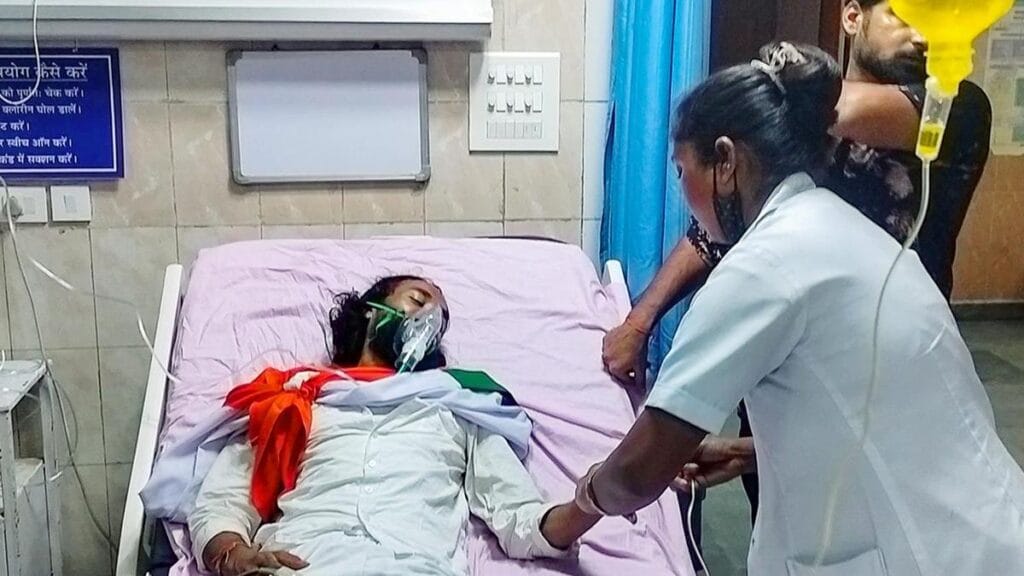
JLKM leader Devendra Nath Mahto was hospitalized. Image Credit: The Hindu
The Jharkhand student protest movement entered a more serious phase on Monday, August 10, when police used force to stop job aspirants from reaching the State Assembly in Ranchi. Protesters broke through barricades during the march, prompting the police to deploy water cannons, fire tear gas shells and carry out a lathi charge.
JLKM leader Devendra Nath Mahto, who had been on an indefinite hunger strike for nine days over alleged irregularities in Jharkhand recruitment examinations, joined the march despite his deteriorating health. He was later admitted to a hospital in Ranchi after his condition worsened.
The political reaction was immediate. Jharkhand BJP president Aditya Sahu and Leader of Opposition Babulal Marandi announced a statewide Jharkhand bandh for Tuesday, August 11, beginning at 8 a.m., to protest what they described as police excesses against student protesters. Essential services were expected to remain operational during the shutdown.
The protest is linked to demands for transparency in recruitment examinations, including the JSSC Combined Graduate Level examination and the 14th JPSC Preliminary Examination.
What happened outside the assembly?
Thousands of job aspirants gathered in Ranchi to hold a “Vidhan Sabha Gherao” march. They wanted to submit their demands directly to the government and press for an independent investigation into alleged irregularities in recruitment examinations.
Security forces had placed barricades on routes leading towards the Assembly. When groups of protesters attempted to cross the barricades, police used water cannons and tear gas to disperse them.
The situation became tense as protesters continued moving towards the restricted area. Police then carried out a lathi-charge. Several protesters and at least four policemen were reportedly injured during the confrontation. This story was also covered by The Hindu.
The use of force triggered anger among student leaders and opposition parties. Protesters alleged that the government was attempting to suppress their demands instead of addressing the questions raised about examination procedures.
The administration, however, faced the challenge of preventing a large crowd from entering a high-security zone near the Assembly. Any assessment of the incident will need to consider both the protesters’ right to demonstrate and the police responsibility to maintain security around the legislature.
Devendra Nath Mahto’s health deteriorates
Devendra Nath Mahto has been on hunger strike for nine days, demanding action over alleged irregularities in state recruitment examinations. He joined the student march even after experiencing significant weight loss.
Reports said Mahto had lost approximately 10.5 kilograms during the fast. His condition became worse after he participated in the protest, and he was taken to a hospital in Ranchi for treatment.
Doctors had earlier raised concerns about his declining health. During a previous deterioration, his blood glucose level was reportedly recorded at 53, a dangerously low level requiring medical attention. A medical officer at Ranchi Sadar Hospital said Mahto was being treated in the emergency ward.
The hospitalization has added urgency to the dispute. Hunger strikes can cause dehydration, low blood sugar, electrolyte imbalance and damage to vital organs, particularly when they continue for several days.
Mahto’s supporters say his fast reflects the frustration of thousands of candidates who have spent years preparing for government jobs. Authorities, on the other hand, have a responsibility to ensure that his medical condition is addressed immediately.
What are students demanding?
The protesting students have raised allegations about irregularities in several recruitment examinations conducted in Jharkhand. Their demands include cancellation or review of disputed examinations, an independent probe by the Central Bureau of Investigation and reforms in the functioning of the Jharkhand Public Service Commission and Jharkhand Staff Selection Commission.
The movement has focused particularly on the JSSC-CGL examination and the 14th JPSC Preliminary Examination. Protesters want the government to clarify how examination centers were selected, how question papers were handled, whether any unfair advantage was given to candidates and how complaints were investigated.
They are also seeking greater transparency in the recruitment process. This includes timely publication of answer keys, an accessible grievance mechanism, clear examination calendars and strict action if wrongdoing is established. The students say the issue is not limited to one examination. They want an investigation into recruitment tests held over several years.
The government has held talks with sections of the protesters, but the movement has continued because student groups say discussions have not produced a concrete written commitment.
BJP announces statewide bandh
After the police action, Babulal Marandi and Aditya Sahu announced a statewide bandh for Tuesday, August 11. The announcement was made at a press conference at the BJP state office in Ranchi.
The BJP accused the Hemant Soren-led government of using excessive force against students and said a shutdown was necessary to protest the lathi-charge, tear gas and water-cannon action.
Aditya Sahu said the party would oppose what it described as “injustice and atrocities” against the aspirants. BJP leaders claimed that a large number of protesters were injured, although official figures may take time to confirm.
The bandh was announced for August 11, not August 10. Monday, August 10, was the day of the Assembly march and police action; Tuesday, August 11, is the date announced for the statewide shutdown. The BJP said essential services would remain operational. Even so, a bandh may affect public transport, schools, shops, offices and daily wage workers across the State.
Background to the recruitment controversy
Government recruitment examinations carry enormous importance in Jharkhand, where thousands of young people depend on public-sector jobs for stable employment. Candidates often spend years preparing for a limited number of vacancies.
When an examination is delayed, cancelled or questioned, the impact goes beyond the candidates who took the test. It affects age limits, preparation costs, family finances and future career opportunities.
Jharkhand has witnessed student protests over recruitment examinations for several weeks. The current agitation reportedly began around July 25 and has continued through sit-ins, hunger strikes and public demonstrations.
Mahto began his hunger strike after student groups concluded that earlier protests had not resulted in a satisfactory response. His fast gave the agitation a more visible face and attracted political attention.
The government has attempted dialogue, but the protesters have continued to demand an independent investigation. The central point of disagreement is whether the State should handle the allegations internally or invite an outside agency such as the CBI or appoint a judicial panel.
Also Read: Jharkhand Government Cancels 14th JPSC Exam, but Students Continue Protest for CBI Probe
Timeline
On July 25, student groups began intensifying protests over alleged irregularities in Jharkhand’s recruitment examinations.
In early August, JLKM leader Devendra Nath Mahto began an indefinite hunger strike in Ranchi after weeks of demonstrations failed to produce a concrete response.
By August 9, the protest had entered its 16th day. The State government held fresh talks with student groups, while the protesters warned that they would march to the Assembly if their demands were not addressed.
On August 10, students held a “Vidhan Sabha Gherao” march in Ranchi. Police used barricades, water cannons, tear gas and lathi charges after protesters attempted to move towards the Assembly.
Mahto joined the march despite being on hunger strike and was later hospitalized after his health deteriorated.
On the evening of August 10, Babulal Marandi and Aditya Sahu announced a BJP-sponsored Jharkhand bandh for August 11 to protest the police action.
Why This Matters
This protest matters because recruitment examinations determine the future of thousands of young people. Any allegation of cheating, paper leaks, procedural manipulation or unfair evaluation can damage trust in the entire public hiring system.
For candidates, an examination is not simply a test. It involves months of preparation, coaching fees, travel costs and emotional pressure. If an exam is cancelled or disputed, many candidates may have to start again while facing age-related limitations.
The dispute also raises questions about accountability. If the allegations are unfounded, a transparent investigation can clear the recruitment agencies. If irregularities are proven, the government must act quickly to protect honest candidates.
The police response has made the issue more sensitive. A lathi charge and tear gas during a student protest can deepen public anger, especially when demonstrators are demanding transparency rather than opposing a public policy.
At the same time, protesters must ensure that their demonstrations remain peaceful. Clashes, damage to public property or attempts to forcibly enter restricted areas could weaken public support for their demands.
India’s angle
The Jharkhand agitation reflects a wider concern among young Indians about government recruitment examinations. Across the country, students regularly protest over delayed results, alleged paper leaks, changing eligibility rules, examination cancellations and long recruitment cycles.
Competitive examinations are particularly important in smaller cities and rural areas, where government jobs are seen as a route to economic security. For many families, a candidate’s preparation may represent a major financial and emotional investment.
The Jharkhand situation shows why recruitment bodies need strong digital security, independent oversight and time-bound grievance redressal. Exam authorities must communicate clearly whenever allegations arise.
Simple baat hai: students ko fair opportunity chahiye, aur government ko transparent process dikhana hoga. Without public trust, even a legally conducted examination can face prolonged controversy.
The bandh will also test how political parties use student issues. Opposition support may bring attention to the demands, but a prolonged shutdown could affect workers, businesses and ordinary citizens.
Analysis
A credible inquiry should be independent enough to satisfy candidates but fast enough to prevent further uncertainty. A lengthy investigation without interim safeguards could increase frustration.
The police action is also likely to become a political turning point. Authorities may argue that force was used after protesters breached barricades, while student groups and opposition parties will focus on injuries and alleged excessive force.
Both sides must avoid allowing the issue to become only a confrontation between the government and the BJP. The interests of the candidates should remain central. The government should first ensure Mahto receives proper medical treatment. It should then invite representatives of all major student groups for a recorded, formal meeting and provide written responses to each demand.
The BJP bandh may increase pressure on the government, but political mobilization cannot replace an investigation. The only durable solution is an examination process that candidates believe is fair.
What Next
The immediate focus will be Devendra Nath Mahto’s medical condition and the possible continuation of the student agitation. Supporters are likely to demand that the government send representatives to the hospital and hold direct talks.
The BJP’s statewide bandh on August 11 may disrupt normal life across Jharkhand. Police and district administrations are expected to increase security near government offices, educational institutions and transport hubs.
The government may announce a committee, judicial inquiry or independent investigation into the recruitment allegations. It may also release a timeline for reviewing the JSSC-CGL and JPSC examinations.
Student leaders are likely to insist on a CBI probe or another external investigation. If the government refuses, protests could continue or expand to other districts.
The authorities must also investigate the Assembly clash and establish whether the force used was proportionate. A transparent review of injuries, detentions and police conduct could help reduce tension.
Long term, Jharkhand needs reforms in recruitment examinations, including secure paper handling, reliable technology, prompt result publication and a permanent grievance system.
Conclusion
Jharkhand’s recruitment examination controversy has escalated after police used water cannons, tear gas and lathi-charge during a student march towards the State Assembly. JLKM leader Devendra Nath Mahto, who had been on hunger strike for nine days, was hospitalized after his health deteriorated during the protest.
The BJP has announced a statewide bandh for August 11 to protest the police action and support the students’ demands. The government now faces pressure on two fronts: it must manage public order while addressing allegations that have shaken confidence in recruitment examinations.
The immediate priority is Mahto’s health and the safety of the protesting students. The long-term solution will require an independent, time-bound inquiry and meaningful reforms.
Written By A. Jack