Clashes that started in Sunsari over loudspeakers and a religious procession have spread to Siraha, Saptari and Dhanusha, prompting indefinite curfew and a government vow of stern action against those responsible.
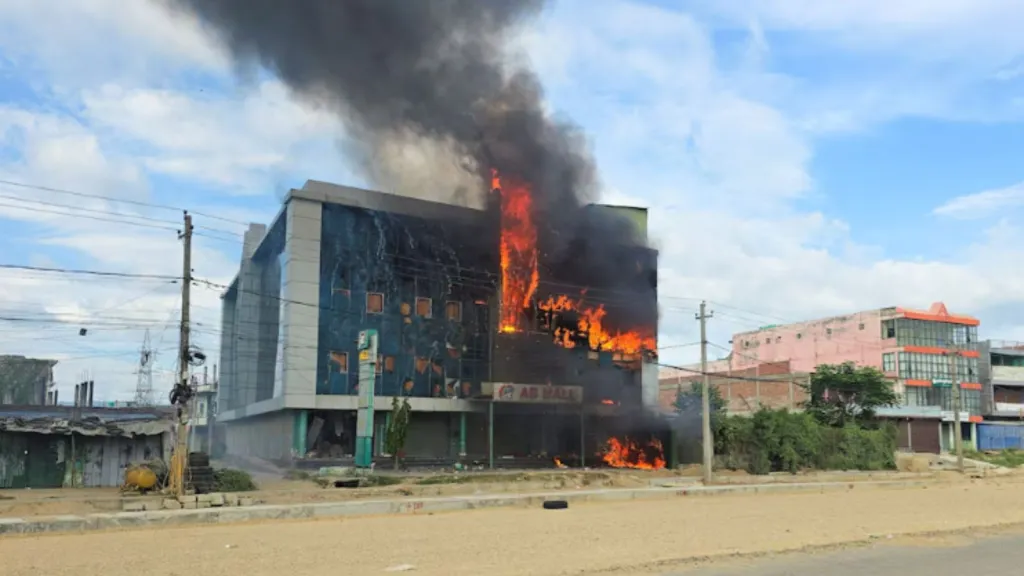
Security personnel patrol a town in southern Nepal’s Terai region as curfew remains in place following communal violence between Hindu and Muslim communities. Image Credit: IndianExpress
Southern Nepal’s Terai belt has been rocked by communal violence between Hindu and Muslim communities, with at least three people killed and dozens injured in clashes that began in Sunsari district and quickly spread to neighbouring areas. The unrest, which started on the night of July 26 in Kaptanganj, a market area in Dewanganj Rural Municipality of Sunsari, has led to indefinite curfew in several towns and a strong appeal for calm from Prime Minister Balendra Shah.
According to police, the clash broke out after a flag associated with the local Muslim community, mounted on an electricity pole, was replaced with a Hindu flag. Tensions escalated after the other side objected to loud music being played during a religious procession, leading to an argument that quickly turned violent.
How the violence broke out
The violence began on the night of July 26 in Kaptanganj, a bustling market area in Dewanganj Rural Municipality of Sunsari district, just a few kilometres from the Bihar border. The initial trigger was a dispute over loudspeakers and a religious procession. Tensions escalated after one side objected to loud music being played, which led to an argument. A group of people resorted to stone-pelting, escalating the violence.
Police first fired warning shots before opening fire to disperse the crowd. Two men were killed in Sunsari during the initial clashes. A third man died on July 30 during fresh clashes in Siraha’s Golbazar despite a curfew being in place. At least 25 people were injured in the initial violence, Reuters reported. This story was also covered by The IndianExpress.
Authorities imposed an indefinite curfew in several towns to prevent further violence. No fresh clashes were reported on Friday, but the situation remains tense, with heavy police presence in affected areas and restrictions on movement and assembly.
Spread to other districts
The violence quickly spread from Sunsari to neighbouring Siraha district, triggering protests and restrictions in Saptari and Dhanusha as well. Two districts in southeastern Nepal, neighbouring India, remained under curfew this week after communal clashes between the two communities left at least three people dead.
The spread of violence highlights how quickly local disputes can escalate into wider communal unrest in the Terai region, where Hindu and Muslim communities often live in close proximity. In several districts, including Sunsari, Dhanusha, Parsa and Sarlahi, the Muslim population share is significantly higher than the national average of around 5 per cent, making inter-community relations a sensitive issue.
Political and administrative response
Prime Minister Balendra Shah appealed for calm in a televised address on July 30, saying the government would conduct an impartial investigation and bring those responsible to justice. His statement was aimed at reassuring both communities that the state would act firmly against violence while avoiding any appearance of taking sides.
Local administrators have been tasked with enforcing curfew, preventing rumour-mongering and ensuring that essential services remain functional. Police have been deployed in large numbers in affected towns, with additional forces sent from other regions to maintain order.
Yeh issue kaafi important hai because in multi-religious societies, even small incidents can spiral into large-scale violence if not contained quickly.
Background and context
The violence between the two religious communities in Sunsari and Siraha districts is the latest the region has seen over the years. However, the roots of the violence have traditionally been ethnic and political rather than purely religious, according to Nepal News.
The report said that the Gaur massacre in 2007 left 26 people, mostly Maoist-linked cadres, dead in clashes with Madhesi activists. Kapilvastu, another district neighbouring India, saw days of rioting in 2007 between Madhesi and hill-origin Pahadi communities, killing 18 people.
The latest violence, however, involves the minority Muslim community, which accounts for around 5 per cent of the country’s population. The share of the community is significantly higher in several Terai districts, including Sunsari, Dhanusha, Parsa and Sarlahi, where Hindu and Muslim communities often live in proximity.
Nepal became a secular republic under the 2015 Constitution, ending its status as the world’s only Hindu kingdom. However, the issue remains politically contentious. The Rastriya Prajatantra Party continues to campaign for restoring Nepal as a Hindu state, keeping the debate over national identity alive.
Timeline
July 26 night: Violence begins in Kaptanganj, Sunsari, over loudspeakers and a religious procession; a flag dispute escalates tensions.
July 27–29: Clashes spread to Siraha, Saptari and Dhanusha; curfew imposed in multiple towns; at least 25 injured.
July 30: Third person dies in fresh clashes in Siraha’s Golbazar despite curfew; PM Balendra Shah appeals for calm.
Friday: No fresh clashes reported, but curfew remains in place in several areas.
Coming days: Government promises impartial investigation and stern action against those responsible.
Also Read: Kulgam Terror Attack: Second Worker Dies, L-G Orders SOP Review for Migrant Labourers
Why This Matters
This matters because communal violence undermines social cohesion and economic stability in an already vulnerable region. The Terai belt is Nepal’s agricultural and industrial heartland, and prolonged unrest can disrupt trade, daily wages and cross-border movement with India.
It also matters because it tests Nepal’s secular framework. The 2015 Constitution declared Nepal a secular state, but the debate over Hindu versus secular identity remains politically charged. Every communal incident becomes a flashpoint for larger questions about national identity, minority rights and political mobilisation.
For the Muslim community, the violence reinforces fears of vulnerability and marginalisation. For the Hindu community, there are concerns about being painted as aggressors in a diverse society. In simple Hinglish, jab do communities ke beech danga hota hai, toh poora ilaaka affect hota hai.
India angle
For Indian readers, this story is directly relevant because the affected districts share a porous border with Bihar and other Indian states. Communal tensions in southern Nepal often have echoes across the border, where similar demographic and political dynamics exist.
The India angle also includes the cross-border movement of people and goods. Many workers from the Terai region travel to India for employment, and any escalation of violence can disrupt livelihoods and family connections on both sides.
There is also the security dimension. Past communal riots in Nepal have sometimes drawn in actors with cross-border links, raising concerns about external influence. Indian authorities closely monitor such situations to prevent spill-over effects into bordering states.
Analysis
My opinion is that while the immediate trigger was a flag and loudspeaker dispute, the underlying causes are deeper. They include historical grievances, political mobilisation along identity lines and economic competition in a resource-constrained region.
I also think the government’s response will be closely watched. If the investigation is perceived as biased or if arrests are seen as one-sided, it could fuel further resentment. A credible, transparent process is essential to prevent recurrence.
What Next
The immediate next step will be the enforcement of curfew and the prevention of rumour-mongering through social media and local networks. Authorities will likely increase patrols, restrict large gatherings and monitor sensitive spots to prevent fresh outbreaks.
The promised impartial investigation will be critical. If those responsible for inciting violence are identified and prosecuted, it could send a strong deterrent message. If not, it could embolden hardline elements on both sides.
Longer term, the government may need to invest in community dialogue, local peace committees and economic development to reduce the appeal of identity-based mobilisation. Without addressing root causes, such incidents are likely to recur.
Conclusion
Communal violence between Hindu and Muslim communities in southern Nepal has left at least three people dead and several towns under curfew, with the unrest beginning in Sunsari over a dispute involving flags, loudspeakers and a religious procession. The spread of violence to Siraha, Saptari and Dhanusha highlights the fragility of inter-community relations in the Terai region.
Prime Minister Balendra Shah has appealed for calm and promised an impartial investigation, but the real test will be whether the state can deliver justice and rebuild trust. For Nepal, the incident is a reminder that secularism on paper must be matched by peace on the ground.
Written By A. Jack