Political leaders are engaged in a blame game over the killings and the safety of migrant workers in the Valley, but security agencies have been asked to carry out a “comprehensive review of SOPs” to safeguard labourers from outside in J&K.
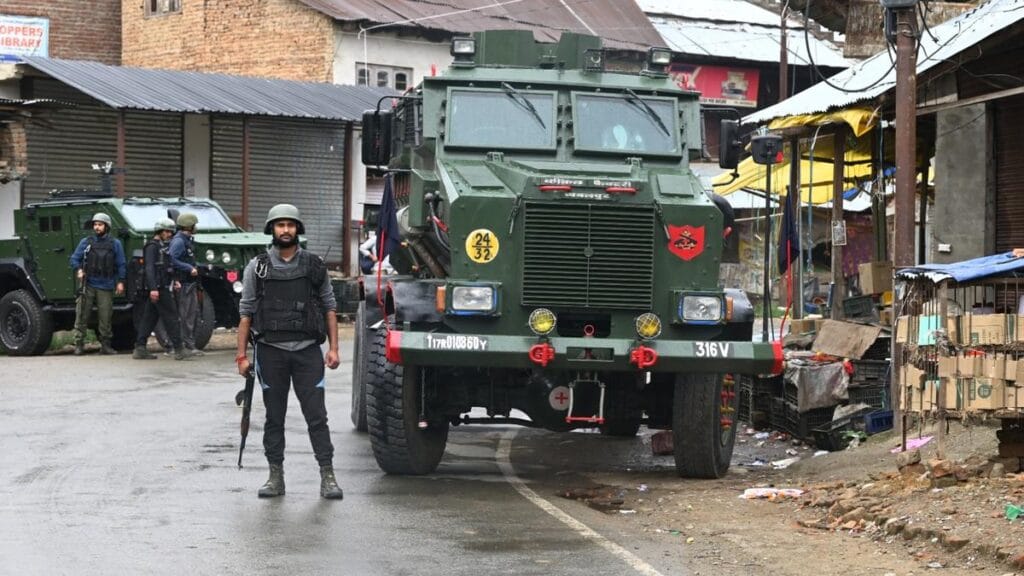
Security personnel and officials at the site of the Kulgam terror attack, where two migrant workers were killed. Image Credit: The Hindu
A fresh terror attack in Jammu and Kashmir’s Kulgam district has claimed a second life, reigniting debate over the safety of migrant labourers working in the Valley. On Friday, militants opened fire on a group of outside workers in Kulgam, killing one labourer on the spot and injuring several others. The second injured worker died in hospital on Saturday, taking the death toll to two.
In response, Jammu and Kashmir Lieutenant-Governor Manoj Sinha directed security agencies to conduct a “comprehensive review of the Standard Operating Procedures (SoPs) established to protect labourers from outside in J&K”. Meanwhile, Deputy Chief Minister Surinder Choudhary targeted the Centre over its “failure to contain terrorism”, demanding a high-level probe into the killings and questioning the Centre’s narrative on peace in the region.
What happened in Kulgam?
The attack took place on Friday in Kulgam district, a region that has seen sporadic militant activity in recent years. According to initial reports, a group of migrant labourers from outside J&K was targeted by militants. One worker was killed on the spot, while others sustained injuries in the firing.
The injured were rushed to nearby hospitals, but one of them succumbed to his injuries on Saturday, raising the death toll to two. Security forces launched a cordon-and-search operation in the area following the attack, while local administration tightened security around work sites employing outside labourers. This story was also covered by TheHindu.
The identities of the victims and the exact location of the attack within Kulgam are being finalised as part of the ongoing investigation. Authorities have classified the incident as a targeted terror attack on migrant workers, a pattern that has been seen in previous years in parts of the Valley.
Why and how the attack happened
While the exact motive and planning behind the attack are still under investigation, such incidents are typically aimed at creating fear among migrant workers and disrupting economic activity in the region. Over the years, militants in Kashmir have targeted outside labourers, shopkeepers and truck drivers in an attempt to send a message and destabilise normalcy.
The timing of the attack is significant. It comes at a time when the administration has been pushing for increased development work and infrastructure projects in J&K, many of which rely on labour from outside the Union Territory. Targeting these workers can slow down projects, create labour shortages and fuel political controversy over security arrangements.
Security agencies will now examine whether existing SoPs for the protection of migrant labourers were followed, whether there were intelligence gaps, and whether additional measures are needed to prevent similar attacks in future.
Statements from top leaders
Lieutenant-Governor Manoj Sinha’s order for a “comprehensive review of SOPs” signals that the administration sees this as a systemic issue, not just an isolated incident. The review is expected to cover:
How work sites are identified and registered
Whether security cover is provided based on threat perception
How information about attacks is shared between police, intelligence and local administration
Whether labourers are adequately briefed on safety protocols
Deputy CM Surinder Choudhary, however, used the incident to target the Centre. He demanded a high-level probe into the killings and questioned the Centre’s peace narrative, accusing it of “failure to contain terrorism” in J&K. His remarks reflect the growing political friction between the elected government in J&K and the Centre-appointed administration over security and governance issues.
Yeh issue kaafi important hai because it shows how terror attacks can quickly become political flashpoints, with each side blaming the other for lapses.
Background and context
Attacks on migrant labourers in Jammu and Kashmir are not new. In previous years, there have been multiple incidents where workers from outside the Valley were targeted, leading to a large-scale exodus of labourers and disruption of development work.
Following such attacks, administrations have often introduced or tightened SoPs for the protection of migrant workers. These have included measures such as:
Registration of work sites employing outside labour
Provision of security cover in high-risk areas
Coordination between contractors, police and district administration
Emergency evacuation plans in case of threats
However, implementation has been uneven. In remote or high-risk districts, security cover is often limited, and contractors may not always follow registration or reporting requirements. That creates gaps that militants can exploit.
Kulgam itself has seen militancy-related incidents in the past, though the frequency has varied over the years. The district’s proximity to other sensitive areas makes it a potential route for militant movement and a location where targeted attacks can be carried out with relative ease.
Timeline
Previous years: Multiple attacks on migrant labourers in different parts of J&K; several SoPs introduced over time.
Friday: Militants open fire on outside workers in Kulgam; one labourer killed, others injured.
Saturday: The Second injured worker dies in hospital; the death toll rises to two.
Saturday: L-G Manoj Sinha orders a comprehensive review of SoPs for migrant labourer safety.
Saturday: Deputy CM Surinder Choudhary demands a high-level probe and questions the Centre’s peace narrative.
Why This Matters
This matters because migrant labourers are a critical part of J&K’s development ecosystem. From road construction to housing projects to infrastructure upgrades, much of the work depends on skilled and semi-skilled workers from outside the Valley. When they are targeted, it not only costs lives but also slows down development and creates fear among other potential workers.
It also matters because such attacks test the credibility of the security apparatus and the political narrative on normalcy. If the administration claims that the situation is improving but workers are still being killed, it raises questions about the ground reality and the effectiveness of existing protection measures.
For families of the victims, the impact is immediate and devastating. They lose a breadwinner, often in a distant location, and must navigate legal, financial and logistical challenges to bring the body home and claim compensation. In simple Hinglish, jab ek worker ki maut hoti hai, toh poora parivaar hil jaata hai.
India angle
For Indian readers, this story is directly relevant because migrant labour is a pan-India phenomenon. Workers from states like Bihar, Uttar Pradesh, Jharkhand and West Bengal regularly travel to other regions, including J&K, for employment. Their safety is a national concern, not just a local one.
The India angle also includes the security dimension. J&K remains a sensitive region where terror groups can use targeted attacks to influence politics and public opinion. Every such incident is closely watched across the country, especially by communities that send large numbers of migrant workers.
There is also the policy angle. If SoPs are found to be inadequate, it could lead to a national debate on how to protect migrant workers in high-risk zones, not just in J&K but in other conflict-prone areas as well.
Analysis
My opinion is that the L-G’s order for a comprehensive SOP review is a necessary but insufficient step. Reviews are important, but they must lead to concrete changes: better intelligence sharing, more visible security presence at work sites, and stricter enforcement of registration norms for contractors.
I also think the political rhetoric, while understandable, can be counterproductive if it distracts from the core issue: how to prevent the next attack. Blame games may score political points, but they do not bring back the dead or protect the living.
What Next
The immediate next step will be the security review ordered by the L-G. Agencies will examine existing SoPs, identify gaps and propose changes. This could include tighter registration of work sites, more frequent patrols in vulnerable areas and better communication channels between contractors and police.
A high-level probe, if ordered, will look into the specific lapses that allowed the attack to happen, including intelligence failures, response delays and possible collusion. The findings could lead to disciplinary action or policy changes.
Longer term, the administration may push for a more structured framework for migrant labourer safety, possibly involving central agencies, state governments and contractors. If such attacks continue, there could be pressure to create dedicated protection units or insurance schemes for workers in high-risk zones.
Conclusion
The Kulgam terror attack that claimed two lives has once again highlighted the vulnerability of migrant labourers working in Jammu and Kashmir. The Lieutenant-Governor’s order for a comprehensive review of SoPs is a recognition that existing measures are not enough, while the Deputy CM’s demand for a high-level probe reflects the political sensitivity of the issue.
For J&K, the challenge is to balance development needs with security realities. Migrant workers are essential for infrastructure growth, but they cannot be expected to work in fear. The real test will be whether the SOP review leads to tangible improvements that prevent the next attack and restore confidence among workers and their families.
Written By A. Jack