The new fleet includes 195 nine-metre DEVi buses and 105 standard 12-metre buses, all of which are low-floor accessible, air-conditioned and equipped with smart safety features. The officials said the buses would enhance last-mile mobility, especially for women, senior citizens and persons with disabilities.
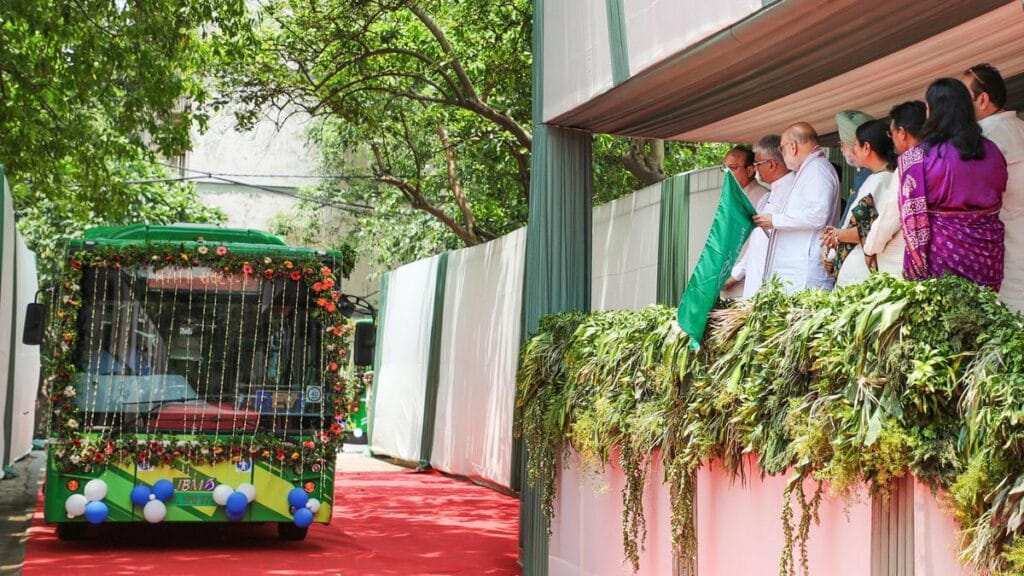
Union Home Minister Amit Shah and Chief Minister Rekha Gupta during the flag-off of 300 new electric buses in Delhi. Image Credit: TheHindu
Delhi’s public transport network received a major boost on Tuesday with the flag-off of 300 new electric buses, a move aimed at improving urban mobility and reducing pollution in the capital. Union Home Minister Amit Shah launched the fleet in the presence of Chief Minister Rekha Gupta while also laying the foundation stone for a high-security prison in Narela. The new buses include 195 nine-metre DEVi buses and 105 regular 12-metre buses, expanding the city’s electric bus presence at a time when demand for cleaner and more reliable transport is rising.
The announcement is important not just because of the number of buses but because it reflects a broader shift in how Delhi is trying to move its people. The buses are low-floor, air-conditioned and equipped with CCTV cameras, panic buttons, GPS tracking and passenger information systems. That combination of accessibility and technology makes the rollout more than just a transport update. It is part of a larger urban planning story, one that matters for daily commuters across the city. Yeh development kaafi important hai because Delhi’s transport system needs both capacity and trust.
What Happened
According to officials, 300 electric buses were inducted into Delhi’s public transport system on Tuesday. The fleet is divided into two categories: 195 smaller nine-metre DEVi buses and 105 standard 12-metre buses. The DEVi buses are designed to handle urban routes where tighter roads, shorter distances and more frequent stops make smaller vehicles useful. The larger buses, meanwhile, are expected to serve higher-capacity corridors. This story is also covered by The Hindu.
Chief Minister Rekha Gupta said the newly inducted buses are low-floor, air-conditioned vehicles built to provide safe, comfortable and accessible travel, including for persons with disabilities. She added that each bus comes with CCTV cameras, panic buttons, real-time GPS tracking, a passenger information system and other smart features. In practical terms, that means commuters should have better visibility of routes, better safety support and a more predictable travel experience.
The use of electric buses also reflects Delhi’s ongoing push to reduce tailpipe emissions and modernise its public transport fleet. Electric mobility is increasingly being treated as a core urban necessity rather than just a green experiment. With air pollution remaining one of Delhi’s biggest civic concerns, the addition of zero-emission buses is both symbolic and practical.
Why Electric Buses Matter
Electric buses are more than a technological upgrade. They are a response to three major urban problems at once: pollution, congestion and commuter discomfort. Delhi has long struggled with poor air quality, and public transport fleets are a key part of the city’s emissions profile. Every electric bus that replaces a diesel one can help reduce exhaust pollution, which is a major public health issue.
They also matter because they improve the passenger experience. Low-floor access is especially important for elderly people, children, women with strollers and passengers with disabilities. Air-conditioning also makes public transport more usable in Delhi’s extreme weather, where summer heat can be punishing and long waiting times can make buses feel inaccessible. Smart features such as GPS and passenger information systems also make travel easier to plan and less stressful.
From an operational point of view, electric buses can also help the city modernise its fleet management. Real-time tracking makes routes easier to monitor, panic buttons improve security response, and CCTV can deter misconduct. This is the kind of practical upgrade that commuters notice every day, not just in policy speeches.
The Wider Infrastructure Push
The bus rollout was not the only major announcement of the day. Amit Shah also laid the foundation stone for a high-security prison in Narela. While the prison project is a separate part of the day’s agenda, its inclusion highlights the government’s larger infrastructure focus. Delhi is being shaped through a combination of mobility upgrades, public service additions and institutional construction.
That broader context matters because cities do not improve through one project alone. They improve when transport, safety, housing, policing and public institutions all move forward at the same time. A new bus fleet may ease commuting, but it works best when supported by better depots, charging infrastructure, route planning and maintenance. Similarly, a prison project may not directly affect commuters, but it reflects the government’s attention to civic administration and security infrastructure.
The mention of three new bus depots also suggests that Delhi is preparing for a larger electric transport network, not just a one-time fleet expansion. Depots are crucial because buses need space for charging, repair, washing and overnight parking. Without depots, electric buses cannot operate efficiently. So the infrastructure side of this story is just as important as the buses themselves.
Background and Context
Delhi has spent years trying to improve its public transport system while dealing with rising population pressure, traffic congestion and dangerous air pollution. Bus fleets have often played a key role in that effort, but the challenge has always been scale and reliability. Commuters want buses that are frequent, safe, clean and predictable. When public transport fails on any of those counts, people move to private vehicles, which makes congestion and pollution worse.
Electric buses have become a central part of the solution in many cities around the world, and Delhi is now pushing harder in that direction. The transition is also politically significant because it shows a commitment to cleaner mobility without waiting for long-term environmental fixes alone. In cities like Delhi, public transport is not just a convenience; it is a necessity for millions.
The introduction of DEVi buses, especially the smaller nine-metre type, also points to a more route-sensitive approach. Not all roads in Delhi can handle the same vehicle size, and some local routes need agile buses that can move through dense neighbourhoods more easily. That is a practical adaptation to the city’s road reality.
Timeline
Tuesday: Amit Shah flags off 300 new electric buses in Delhi.
Same event: Chief Minister Rekha Gupta highlights the buses’ accessibility and safety features.
Same day: Foundation stone is laid for a high-security prison in Narela.
In parallel: Plans are unveiled for three new bus depots to support the expanding fleet.
Next phase: The buses are expected to enter service across Delhi routes as operations are scaled up.
Also Read: Uganda National Killed in Suspected Hit-and-Run in Delhi’s Lajpat Nagar
Why This Matters
This matters because public transport is one of the biggest determinants of daily life in a city like Delhi. When buses improve, the impact reaches office-goers, students, shopkeepers, senior citizens and low-income commuters. Yeh issue kaafi important hai because better buses mean better access, lower travel stress and potentially fewer private vehicles on the road.
It also matters because Delhi’s air pollution crisis cannot be solved by policy alone; it needs better vehicle choices on the road every day. Electric buses are a visible and measurable step in that direction. They show that clean mobility is not just a future promise but something that can be deployed now.
From a social perspective, safer and more accessible buses also mean more inclusive travel. If a city wants public transport to truly work, it has to serve everyone, not just the able-bodied or the tech-savvy. These buses appear designed with that principle in mind.
India Angle
For Indian readers, this story is especially relevant because Delhi often becomes a model for urban transport trends in the country. In Hinglish, seedhi baat yeh hai: agar Delhi mein electric buses chalengi aur logon ko fayda hoga, toh doosre metro cities bhi us model ko seriously dekhenge. That makes this rollout important beyond the capital.
It also fits into India’s broader move toward cleaner mobility. Cities like Mumbai, Bengaluru, Hyderabad and others are also trying to expand electric public transport, but Delhi’s scale makes it a headline-grabbing case. If this fleet runs smoothly, it can become an example for how urban transport can be cleaner and more comfortable at the same time.
There is also a commuter angle that every Indian city can relate to. People want buses that show up on time, are not overcrowded, and feel safe to board even after dark. Features like GPS tracking, panic buttons and CCTV address exactly those concerns. That is a real-world benefit, not just a policy buzzword.
Analysis
My opinion is that the most important part of this rollout is not the headline number of 300 buses, but the ecosystem behind them. A fleet alone does not transform public transport unless depots, charging systems, route management and maintenance are built properly. The mention of three new bus depots is therefore a big part of the story, even if it gets less attention than the bus flag-off.
I also think the safety features deserve emphasis. In Indian public transport, security and accessibility are often treated as secondary concerns, but they matter deeply to daily users. A bus with GPS, CCTV and panic buttons sends a message that public transport should feel modern and trustworthy. That could help rebuild confidence among commuters who may otherwise rely on private vehicles or app-based alternatives.
From a long-term perspective, the shift to electric buses is wise. Delhi needs cleaner air, better commuting options and a more efficient public mobility system. But the success of the plan will depend on consistency, route coverage and service quality. A launch is easy; reliable operation is the real test.
What Next
The next step will be the integration of these buses into Delhi’s existing routes and the operational rollout of the new depots. Commuters will watch closely to see whether the buses are frequent, well-maintained and actually useful on the routes they need most. If the fleet performs well, more electric bus additions are likely to follow.
The authorities will also need to ensure charger availability, driver training and maintenance discipline. These are the behind-the-scenes factors that decide whether an electric fleet succeeds or struggles. If service quality stays high, Delhi could set a stronger benchmark for other Indian cities.
There may also be further announcements on route expansion, depot development and electric mobility planning in the coming months. The real goal will be to make the buses a normal part of city life rather than a one-day political event.
Conclusion
Delhi’s addition of 300 electric buses is a meaningful step toward cleaner, safer and more accessible public transport. With low-floor design, air-conditioning and smart safety features, the new fleet is meant to improve the daily commute while also supporting the city’s broader environmental goals. The three new bus depots underline that this is not just a fleet update but a larger transport infrastructure push. If implemented well, this move could improve mobility for millions of Delhi residents and offer a useful model for other Indian cities.
Written By A. Jack