Local mattress shop owner and his son are unlikely heroes in deadly Malviya Nagar fire. They spread mattresses outside burning building to help trapped guests jump to safety. Their prompt action, at the cost of stock worth nearly Rs 2 lakh, saved lives in one of the worst fire tragedies in Delhi in recent times.
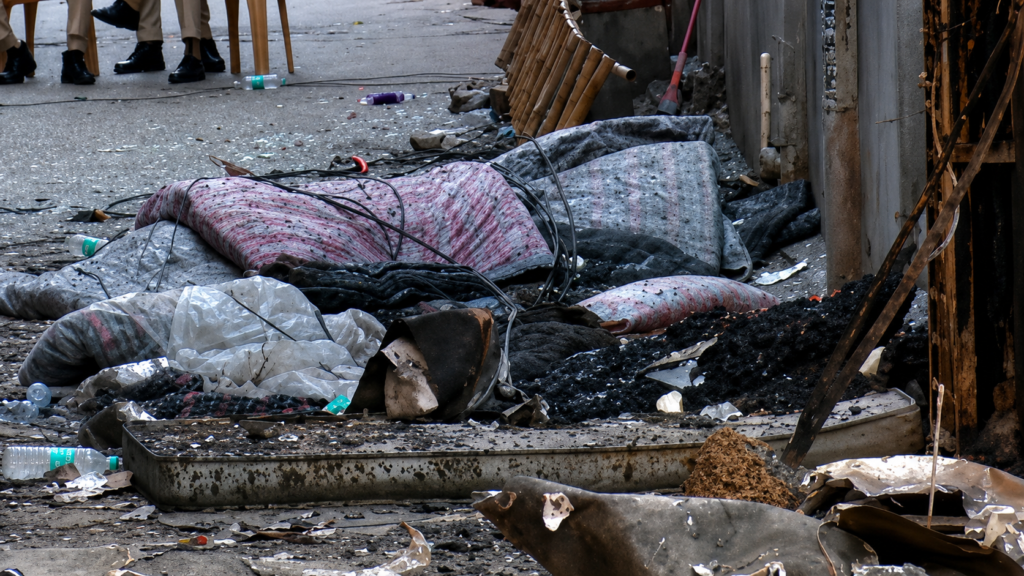
Riyazuddin Mansuri and his son Armaan placed mattresses outside the burning Flourish Stays building in Malviya Nagar to help trapped guests jump to safety.
Delhi Heroes Save Fire Victims
In the middle of a tragic fire that killed 21 people at Flourish Stays in South Delhi’s Hauz Rani area, a local shop owner and his son stepped in with extraordinary courage. Riyazuddin Mansuri and Armaan, who run a mattress shop opposite the burning bed-and-breakfast, brought out new mattresses and quilts and spread them on the road so that trapped occupants could jump down safely from the building.
The fire broke out in the early hours of Wednesday, June 3, in the congested Malviya Nagar area and quickly turned deadly. But according to reports, the timely action of the father-son duo helped save numerous lives by creating a makeshift cushion below the upper floors. Their response stands out as one of the few moments of humanity in an otherwise heartbreaking disaster. Yeh incident kaafi emotional hai because it shows how ordinary people can become heroes in moments of crisis.
What Happened
As the blaze spread through Flourish Stays, people trapped on the upper floors were reportedly shouting for help and asking whether they should jump. Armaan said he reached the spot after a neighbor alerted him about the fire around 8:30 am. By then, the ground floor was already on fire, and no one could safely enter the building. NDTV has covered the full story.
Seeing the urgency of the situation, he brought out around 20 to 25 quilts and mattresses from the shop and laid them outside the building. The family said they stacked around 20 to 22 mattresses on top of each other to soften the impact of anyone jumping from above. In effect, they created a low-cost but life-saving safety net using the materials they sold every day.
The gesture came at a real cost. The family said they lost nearly Rs 2 lakh worth of new mattresses and also gave away bedsheets and quilt covers that were later used to bring out the dead bodies and help the injured. That loss is significant for any small business, but the family said they considered human life more important than the merchandise.
The Human Response
Riyazuddin’s statement captured the spirit of the moment. He said that on the grounds of humanity, everyone is the same, whether Hindu or Muslim, and that helping the victims was his duty as an Indian. That sentiment has resonated widely because it cuts through the chaos and reminds people what community action looks like in a crisis.
Armaan’s account also reflects how quickly he had to act. There was no time for planning, no official rescue instruction, and no certainty about how many people would jump. He simply responded to what he saw. In a fire emergency, especially in a densely built area, such immediate local action can make a major difference before full rescue teams take control.
The rescue effort in this case was not only about fire tenders and police. It was also about neighbors, shopkeepers, and bystanders who did what they could in a terrifying situation. That local response matters because disasters often unfold faster than formal systems can fully react.
Why the Mattresses Mattered
A fall from an upper floor in a fire can be fatal or cause serious injuries. In this case, mattresses and quilts helped absorb the force of the jump and likely prevented multiple additional deaths or major injuries. Even though the exact number of lives saved is not officially specified, the rescue cushion clearly gave trapped people a better chance of survival.
This is also a reminder that urban fire rescue often depends on improvisation. In crowded neighborhoods like Hauz Rani and Malviya Nagar, access can be narrow and smoke can spread fast. If people are trapped on the upper floors and the fire blocks the exit, the window may become the only escape. A mattress stack, though simple, can be the difference between survival and tragedy.
The family’s sacrifice is even more striking because the mattresses were not damaged goods or old stock. They were new items, worth real money, taken out at a moment’s notice to serve a life-saving purpose. That is the kind of action people remember long after the fire is over.
Background
The fire at Flourish Stays was one of Delhi’s deadliest recent fire incidents, with 21 lives lost, including Indian and foreign nationals. The building was already under intense scrutiny because preliminary reports suggested multiple safety and licensing violations. In that larger story of neglect and regulatory failure, the mattress shop owner’s action became a rare and powerful example of public compassion.
Delhi’s congested neighborhoods are often filled with mixed-use buildings, guest houses, small restaurants, and shops packed close together. In such areas, a fire can spread quickly, and emergency access can be difficult. That means local people, not just official responders, often become the first line of help. The Malviya Nagar tragedy shows both sides of urban life in India: the danger of weak safety enforcement and the strength of community response.
This is not the first time residents have played a crucial role in a disaster response. Across Indian cities, shopkeepers, rickshaw drivers, neighbors, and passersby have often helped in crises before formal rescue systems arrive. The difference here is that the family’s action was especially visible, costly, and directly linked to saving lives.
Timeline
Early morning, June 3: Fire breaks out at Flourish Stays in Hauz Rani, Malviya Nagar.
Around 8:30 am: Armaan is alerted by a neighbor and rushes to the scene.
Immediately after: He and his father bring out mattresses and quilts from their shop.
During the rescue: The mattresses are spread outside so trapped guests can jump to safety.
Later: The fire claims 21 lives, and the family’s act of courage begins drawing public attention.
Also Read: Delhi Hotel Fire Exposes Old Pattern of Lapses, Buck-Passing, and Weak Enforcement
Why This Matters
This matters because it shows that in disasters, courage often comes from ordinary people rather than uniforms alone. While the fire investigation will focus on safety lapses, legal responsibility, and administrative failure, the human story here is about empathy under pressure. Yeh issue kaafi important hai because it reminds us that communities can save lives when every second counts.
It also matters because the family absorbed a personal financial loss to help strangers. In a time when people often fear getting involved, this act sends a different message: that helping others can come before calculating profit. For many readers, that is both inspiring and deeply moving.
The story also highlights a larger social point. In India, we often talk about governance after tragedy, but community action in the moment can be just as powerful. The mattresses may look simple, but the decision to use them in that way was life-saving. That is the kind of public spirit that deserves recognition.
India Angle
The India angle here is especially strong because this is a very Indian kind of heroism. A shopkeeper, his son, and their neighbors saw a crisis and acted without waiting for permission. In a country where dense urban spaces and narrow lanes can make rescue difficult, such local initiative is invaluable.
In Hinglish, seedhi baat yeh hai: jab system slow ho, tab insaaniyat fast honi chahiye. That is exactly what happened here. The father-son duo did not ask who the victims were, where they came from or what religion they followed. They just helped. Their words about being Hindu, Muslim, and Hindustani also struck a chord because they showed unity in the middle of tragedy.
This story will resonate across India because it reflects both the fragility of urban safety and the strength of ordinary people. In many towns and cities, shopkeepers are the first responders before official help arrives. Their role often goes unnoticed, but this time, it should not.
Analysis
My opinion is that this kind of story matters because it changes the tone of a tragedy. The fire itself is about loss, negligence, and systemic failure, but the response from Riyazuddin and Armaan adds courage and dignity to the narrative. Their action does not erase the tragedy, but it does show what community responsibility looks like in real life. It also puts pressure on authorities in a subtle way: if ordinary citizens can improvise a rescue cushion in minutes, then the official safety systems should have been far more prepared. The public will rightly ask why a building needed a mattress stack from a nearby shop in the first place. Still, beyond that question, the family’s response is a reminder that the human instinct to help can be stronger than fear. That is why this story will stay with people.
What Next
The next step is likely public recognition for Riyazuddin Mansuri and Armaan, as social media users have already begun demanding compensation or a reward from the government. Given the scale of their loss and the apparent impact of their action, such calls may grow louder.
There may also be broader attention on whether local businesses and residents should be formally integrated into emergency response planning in crowded neighborhoods. Their role in first-response situations is often unofficial but crucial. If Delhi authorities take this seriously, it could lead to better local disaster coordination in the future.
At the same time, the main investigation into the Malviya Nagar fire will continue, and the tragedy will remain a reminder of how badly safety checks failed. The heroism of the mattress shop owner does not reduce the need for accountability; it simply shows that humanity stepped in where systems fell short.
Conclusion
The Malviya Nagar fire is remembered for its terrible death toll, but it should also be remembered for the courage of a local mattress shop owner and his son who gave up nearly Rs 2 lakh worth of stock to help strangers escape. Their mattresses became a rescue tool, their shop became a source of hope, and their quick thinking likely saved lives.
In a tragedy shaped by failure, their action stands out as a moment of courage, compassion, and community spirit. Yeh incident kaafi powerful hai because it proves that even in the darkest moments, ordinary people can do extraordinary things.
Written By A. Jack