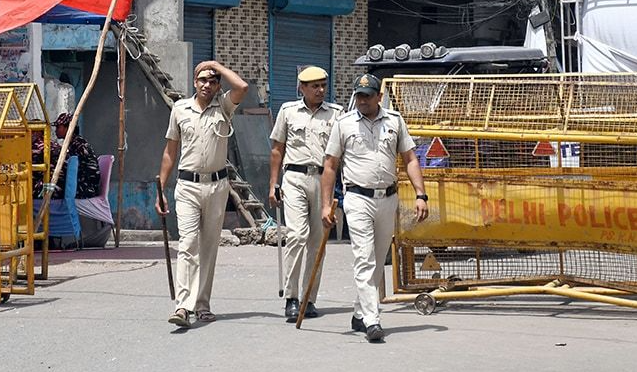
A deadly blaze at Delhi’s Flourish Stay hotel has revealed a series of safety lapses that could have turned a routine morning into a mass-casualty tragedy. Officials addressing the media said the property lacked a valid fire NOC, had a single entry-exit point and was operating far more rooms than allowed, leaving guests with very little chance of escape.
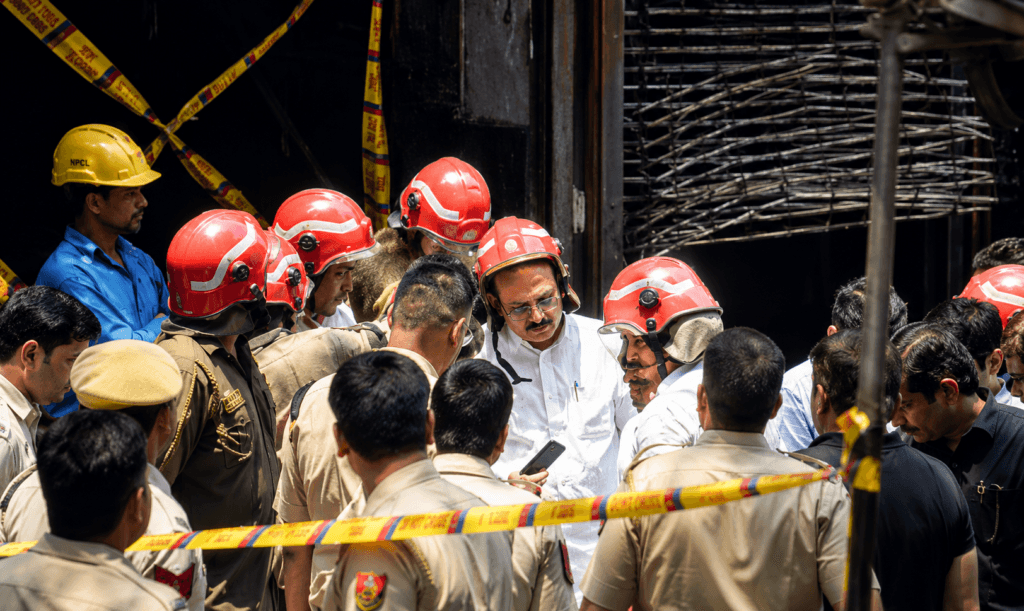
Rescue teams inspect the charred remains of the Flourish Stay hotel in Delhi’s Malviya Nagar after a fire killed 21 people.
The fire at Delhi’s Flourish Stay hotel in Malviya Nagar did not become deadly by accident; according to preliminary findings, the building had multiple red flags long before the blaze broke out. What began as a fire in the restaurant area quickly spread to another hotel, Micasa Inn, trapping guests inside a structure that investigators now say had one entry-exit point, unapproved room additions, and no valid fire clearance.
At least 21 people lost their lives in the tragedy, including foreign nationals and members of a Gurugram family visiting a relative in the hospital. Rescue teams found cramped basement rooms, sealed windows, and a layout that made escape extremely difficult once the fire spread. The case has now become a grim example of how negligence, weak enforcement, and profit-driven expansion can combine into a fatal disaster. Yeh incident kaafi important hai because it shows how safety rules matter long before an emergency begins.
What the Probe Revealed
The preliminary investigation has painted a disturbing picture of the hotel’s operation. According to officials, the building was more than 15 meters high and therefore required a fire safety clearance under law. Yet the hotel reportedly did not have a valid Fire NOC, which should have been mandatory.
Investigators also found that the property had only one entry and exit point. In a fire emergency, that is a critical flaw because it leaves guests with a single route to safety. Once that path was blocked by flames, people inside were effectively trapped. Some guests reportedly jumped from windows to save themselves, with mattresses placed below to cushion the fall. NDTV has covered the full story.
Another serious concern is that four rooms were reportedly crammed into the basement. When rescue teams rushed to evacuate people, they found foreign nationals staying in those basement rooms. Some of them are believed to have died from toxic smoke inhalation rather than direct burns, which underlines how fast smoke can become lethal in a confined space.
The hotel was reportedly operating 25 rooms, far beyond the limits of the original homestay concept under which such properties were first allowed to function. At least 40 guests were believed to be staying there at the time, and 21 of them died. That occupancy mismatch is one of the most alarming parts of the case.
How the Problem Built Up
The roots of the tragedy go back years. Before the 2010 Commonwealth Games, the government introduced a homestay scheme to promote guest accommodation in residential areas. Under the scheme, homeowners were allowed to rent out a limited number of rooms and beds, with the idea that the properties would remain small, safe, and residential in character.
But over time, many such homestays gradually evolved into full-fledged hotels. As medical tourism grew in Delhi and other metro cities, demand rose and some operators expanded beyond the original rules. What started as a modest home-based stay often became a commercial lodging business with 20 to 30 rooms and a much higher guest load.
That appears to be the broader pattern behind Flourish Stay as well. The hotel was described by local residents as one of several semi-illegal facilities in the congested Malviya Nagar area. A local named Faheem reportedly said the owner, Luvkesh Bajaj, owns three such hotels in the area, all of which allegedly ignore safety norms. That claim, if verified, would suggest this was not an isolated lapse but part of a larger operating pattern.
Why Fire Safety Failed
Fire safety depends on layers of protection working together: legal approval, building design, clear exits, ventilation, occupancy control, and active compliance. In this case, several of those layers appear to have failed at once.
First, the lack of a valid Fire NOC is a major issue. A property above 15 meters requires specific safety clearance, and without it, the building should not be operating as guest accommodation in the same way. Second, the single-entry layout created a bottleneck. Third, the sealed windows and basement rooms reduced the chance of natural escape or rescue. Fourth, the suspected unauthorized extra floors and room additions may have altered the building’s safety profile without any proper review.
In practical terms, the guests were staying in a place that had the appearance of a functioning hotel but may not have had the structural safety of one. That mismatch is exactly what turns an ordinary fire into a mass fatality event. Even a small blaze can become deadly when people cannot get out quickly or when smoke gets trapped inside.
What the Fire Dept Found
According to the preliminary probe, the hotel owner had later applied for a trade license, but the complete building plan was not submitted to the authorities. The owner was asked to provide the plans to the Building Department, which was then required to share them with the Fire Department. However, the authorities reportedly never received the full details or a proper response from the owner.
That detail matters because it suggests the regulatory process was incomplete or stalled. If the building’s additional floors were constructed without informing authorities, then the safety evaluation would have been based on partial information. In a city as dense as Delhi, that kind of gap can be dangerous.
Authorities will now need to determine whether the hotel operated in violation of licensing conditions, whether inspections were skipped or ignored, and whether the property’s expansion was ever formally approved. If the answers point to repeated non-compliance, then the tragedy becomes not just a fire incident but a case study in enforcement failure.
The Human Cost
Beyond the technical lapses, the human cost is devastating. Some guests were asleep when the fire broke out. Others were inside basement rooms with smoke rapidly filling the space. Videos from the scene showed people jumping from the burning building while others were trying to help with mattresses below.
The dead included foreign nationals and an eight-member family from Gurugram who had come to Delhi to visit an ailing relative at Max Hospital. That family had booked two rooms and was having breakfast at the time of the fire. Their loss has made the tragedy even more heartbreaking because it involved not only strangers staying at a hotel but also relatives who were there for a hospital visit.
This is the part that stays with people. Fire tragedies are often discussed in terms of buildings, rules, and reports, but in reality they destroy families, routines, and futures in seconds. The victims were not just statistics; they were travelers, visitors, patients’ relatives, and guests who expected a safe place to stay.
Also Read: Delhi Hotel Fire Tragedy: Owner Arrested After 21 Die in Malviya Nagar
Background and Timeline
This case needs to be understood as the result of a long buildup rather than one sudden mistake. The hotel’s apparent overexpansion, absence of fire clearance, and questionable layout appear to have evolved over time.
Timeline
Before 2010: The homestay framework is introduced to allow small residential guest accommodation.
Over the years: Many homestays gradually expand into larger hotel-style operations.
Three years ago, reportedly: The current owner acquired the building and operates it as a guesthouse/hotel.
Before the fire: The property is operating with around 25 rooms despite the homestay model allowing only limited accommodation.
Fire day: A blaze starts in the restaurant area and spreads to the adjacent hotel.
During the rescue: Guests jump from windows; rescue teams find basement rooms and multiple safety problems.
After the fire: Officials confirm 21 deaths and begin probing licenses, exits, and building compliance.
Why This Matters
This matters because hotel fire safety is not just a private business issue; it is a public safety issue. When guest houses operate in crowded urban neighborhoods, one unsafe property can put dozens of people at risk. The Delhi case shows what happens when compliance becomes optional and oversight is weak.
It also matters because many Indian cities have similar buildings running in semi-legal or loosely regulated conditions. If one property can operate with extra rooms, basement occupancy, and no fire clearance, there may be many more like it. Yeh issue kaafi important hai because it affects not only Delhi but also the safety of urban accommodation across India.
There is also a trust angle. Medical tourists, families, and domestic travelers choose hotels expecting basic safety. When a property fails them so badly, it damages confidence in the entire hospitality sector. That is a serious cost for the city and for the country.
India Angle
The India angle here is strong because this is a familiar urban problem: growth happening faster than regulation. In Delhi, Mumbai, Bengaluru, and other metros, guest houses and small hotels often operate in dense residential pockets where rules are easy to bend and harder to enforce.
In Hinglish, seedhi baat yeh hai: business chalana theek hai, par safety ko ignore karke paisa kamana bilkul galat hai. If a property is allowed to exceed room limits, build extra floors, or use basements without proper approval, then the risk is shared by everyone who stays there. For Indian readers, this story is a reminder that fire norms are not paperwork; they are life-saving barriers.
The presence of foreign nationals among the dead also adds an international dimension. India’s hospitality standards are being judged not only by local residents but also by visitors from abroad. That makes this case especially significant.
Analysis
My opinion is that the biggest lesson here is that disasters like this are usually built over time. The final spark may come on one morning, but the real cause is often a long chain of ignored warnings. A lack of fire clearance, additional floors, sealed windows, basement rooms, and over-occupancy together created a dangerous environment. If the investigation confirms these findings, then this should lead to much stricter inspections of homestays, guest houses, and small hotels in Delhi. The city cannot rely on the assumption that a license on paper means a building is safe in practice. Enforcement has to be continuous, not occasional.
What Next
The next step will be a deeper legal and administrative investigation into the property’s approvals, occupancy, and structural changes. Police and fire officials are likely to examine whether the owner concealed modifications, ignored notices, or operated beyond the permitted limits. The building plan, trade license application, and correspondence with departments will all matter.
The government may also order wider checks on similar properties across Delhi, especially in crowded localities where hotel-style operations are running in converted residential spaces. If that happens, some buildings may be shut down until safety compliance is verified. That would be a difficult move for the hospitality industry, but an essential one if the city wants to prevent another tragedy.
The victims’ families will also continue to push for accountability and compensation. For them, the most important question is not just how the fire started, but why the building was allowed to remain unsafe for so long.
Conclusion
The Delhi hotel fire was not only a tragic accident; it was the end result of years of ignored warnings, unsafe expansion, and weak compliance. A building that should have had limited rooms, proper fire clearance, and safe exits instead reportedly operated with basement rooms, extra floors, and a single escape route.
That combination turned a morning fire into a deadly disaster that killed 21 people. The investigation now points to a much bigger lesson for Delhi and for India: safety rules are only meaningful when they are enforced before the tragedy, not investigated after it. If this case leads to stronger action, then some of the loss may at least push the system toward change.
Written By A. Jack