Sources say the owner of the Delhi guesthouse where 21 lives were lost in a deadly fire drove past the burning building instead of stopping to help. The shocking revelation has put the spotlight on safety lapses in the Flourish Stay B&B in Malviya Nagar, where the fire spread from the basement to the upper floors in no time.
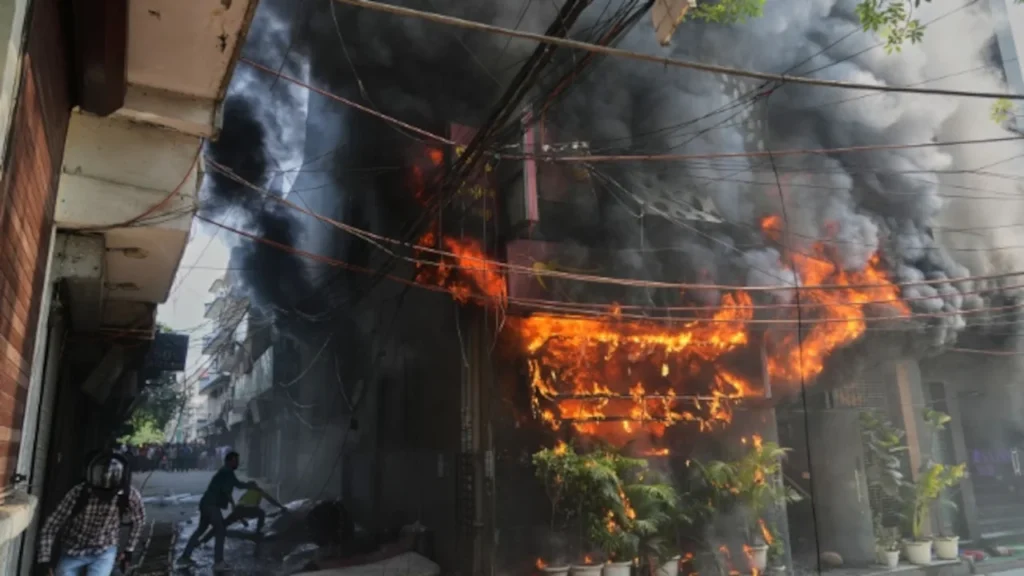
The deadly fire at the Flourish Stay B&B in Malviya Nagar, Delhi, that killed 21 people. [Photo Credit: PTI]
Delhi Hotel Fire Tragedy
A deadly fire at a bed-and-breakfast property in Delhi’s Malviya Nagar has now taken an even more disturbing turn, with sources saying the hotel owner, Lavkesh Bajaj, fled the scene in fear while people were trapped inside. The blaze, which broke out on Wednesday morning at Flourish Stay B&B in the congested Hauz Rani area, killed 21 people and exposed serious questions about licensing, occupancy, and fire safety compliance.
Bajaj was arrested hours after the fire and later allegedly admitted during questioning that he drove past the burning building instead of stopping to help rescue those inside. According to sources, he did not go home after fleeing the scene and instead wandered around. The incident has triggered outrage because it combines human loss with what appears to be a major failure of responsibility and building safety. Yeh tragedy kaafi serious hai because it raises questions not just about one fire but also about how such risky properties are allowed to operate in the first place.
What Happened
The fire is said to have started around 8:30 am in the basement of the B&B and then spread rapidly to the upper floors. Most guests were asleep when the blaze began, which made escape even more difficult. Fire officials deployed 17 fire tenders to control the flames, while rescue teams pulled out at least 58 people and rushed them to nearby Max Hospital. NDTV has covered the full story.
Of the 21 people who were declared dead on arrival, 12 were identified as foreign nationals. The dead also included eight members of a Gurugram family that had come to Delhi to visit an ailing relative at Max Hospital. That detail has added a heartbreaking human dimension to the case, because this was not just a hotel fire — it was a disaster that destroyed an entire family in one morning.
According to the report, the building had only a single entry and exit point, making evacuation extremely difficult. The windows were sealed, and the main door was sensor-operated. In a fire emergency, these design flaws can become deadly traps. When smoke fills a building and escape routes are limited, even a small delay can cost lives.
Why the Owner Is Under Scrutiny
Lavkesh Bajaj reportedly told investigators that he had acquired the building three years ago from another owner and was running a hotel-cum-guest house there. He also said the building had earlier housed a Khadi store and was already in a highly dilapidated condition when he took over.
But the bigger issue is that he was allegedly operating inside the property. Bajaj reportedly confirmed that he had a license under the Bed and Breakfast scheme, which allows only six rooms. Police, however, believe he was operating around 25 rooms, including some in the basement. That is a massive gap between permitted use and actual use.
If those claims are verified, the case is not only about one fire but also about a serious violation of occupancy and safety norms. The operation of extra rooms, especially in basement spaces, can increase the risk of overcrowding, blocked movement, and fire spread. In short, the property may have been functioning far beyond what the scheme allowed.
The B&B Scheme and Safety Norms
The Bed and Breakfast framework was introduced under the Incredible India B&B scheme in 2007 to promote safe and affordable homestays in residential neighborhoods. But the scheme comes with clear rules: a maximum of six double-bed rooms per property, mandatory owner residence on the premises, a strictly residential character for the premises, and compliance with fire safety, ventilation, and basic infrastructure norms.
These rules matter because the idea is to keep such guest houses small, manageable, and safe. If a property turns into a large hotel-like operation while still claiming B&B status, the safety logic collapses. That appears to be one of the central concerns in this case.
Police are now checking whether the property complied with those norms. The preliminary probe has already flagged that there was only one exit point, the windows were sealed, and the main door was sensor-operated. Those are major red flags in any fire investigation. Even if the property had a license, a license alone does not make a building safe.
Human Cost of the Fire
The most painful part of the story is the scale of the loss. Among the dead were 12 foreign nationals and a family from Gurugram who had come to Delhi to visit an elderly patient. Vivek Agarwal, a chartered accountant from Gurugram, had traveled with his wife, two daughters, and four relatives to see his father, Radhe Shyam Agarwal, who was being treated at Max Hospital.
The family had booked two rooms in the B&B and were having breakfast when the fire broke out. Eight members of that family died, leaving only Vivek’s father alive. That detail makes the tragedy especially devastating because it shows how quickly a normal family visit turned into an irreversible loss.
For the foreign nationals as well, the fire is likely to have international consequences. Their deaths could prompt diplomatic attention, additional identification procedures, and questions about safety standards for medical and leisure travelers staying in the capital. Delhi is a major destination for domestic and foreign visitors alike, which means fire safety failures have a broader reputational impact too.
Background
This case did not happen in isolation. It sits inside a bigger problem of weak enforcement, unsafe conversions, and informal expansion of hospitality properties in dense urban areas. Delhi has many commercial and residential hybrids where small guest houses, budget hotels, and home stays operate close to each other, often under pressure to maximize occupancy.
Timeline
Three years ago: Bajaj reportedly acquires the building from a previous owner.
Before the fire: The property functions as a B&B, though police suspect it may have been operating beyond license limits.
Wednesday morning, around 8:30 am: Fire breaks out in the basement and spreads upward.
During the blaze: Guests are trapped while rescue teams deploy 17 fire tenders.
After the fire: 58 people are rescued and rushed to the hospital.
Later the same day: 21 deaths are confirmed, including 12 foreign nationals.
Hours later: Bajaj is arrested.
Interrogation: Sources say he admits he drove past the burning hotel out of fear.
Also Read: Delhi Fire at Ministry of Education Office Triggers Swift Rescue Response
Why This Matters
This matters because fire safety is one of the most basic expectations in any hotel or guest house. When a building with sleeping guests has blocked exits, sealed windows, and likely over-occupancy, the risk is not just high—it is deadly. Such failures are preventable, which makes the loss even more tragic.
It also matters because the incident exposes how license rules can be ignored while inspections fail to catch violations. If a property licensed for six rooms is running 25, then the regulatory system is clearly under strain. Yeh issue kaafi important hai because weak enforcement can turn ordinary buildings into death traps.
The broader social impact is huge too. Families, tourists, medical visitors, and short-term guests all depend on the assumption that accommodation is safe. Once that trust breaks, the entire hospitality ecosystem suffers.
India Angle
The India angle here is deeply relevant because this is not just a Delhi story—it reflects a nationwide problem. Across Indian cities, small hotels and guest houses often operate in dense areas with limited parking, narrow lanes, and mixed-use buildings. If fire norms are ignored, the consequences can be catastrophic.
In Hinglish, seedhi baat yeh hai: license hona aur safe hona do alag cheezein hain. A building can have papers but still be dangerous if exits are blocked, rooms are overused, and safety systems are weak. For Indian readers, this story is a reminder that fire safety inspections are not a formality; they are a life-saving necessity.
It also affects India’s image as a destination for medical travel and tourism. Foreign nationals staying in Delhi expect minimum safety standards. When those fail, the reputational cost goes beyond one incident.
Analysis
My opinion is that the central issue is not simply that the owner fled in fear, but that the property may have been operating in a dangerously non-compliant manner long before the fire started. Fear can explain flight, but it does not explain poor compliance, over-occupation, or unsafe building modifications. If the allegations are confirmed, this case should force a broader review of guest house regulation in Delhi. The authorities need to ask how a property with such apparent safety issues was allowed to function with guests inside. The real lesson here is that fire disasters are often built slowly through ignored warnings, not just triggered by one spark.
What Next
The next step is likely to be a detailed police and fire department investigation into licensing, occupancy, and building safety compliance. Bajaj is expected to be produced before a court, and police may seek custodial remand to question him further about the property’s operation and the events before and during the fire.
Authorities will also continue identifying the deceased and coordinating with the families of foreign nationals. That process may take time, especially where travel documents and diplomatic communication are involved. Meanwhile, investigators will likely examine whether the building’s basement use, sealed windows, and single exit directly contributed to the death toll.
There is also likely to be administrative fallout. If violations are confirmed, the case could prompt stricter checks on B&Bs, guest houses, and budget hotels across Delhi. That would be a necessary response, because one incident should not be allowed to become tomorrow’s repeat tragedy.
Conclusion
The Delhi B&B fire is a devastating example of how poor safety standards, possible license violations, and human panic can combine into deadly disaster. With 21 lives lost, including foreign nationals and an eight-member family, the tragedy has cut across personal, national, and international lines.
The owner’s alleged decision to drive past the burning building “out of fear” has intensified public anger, but the deeper issue is the safety breakdown that allowed so many people to be trapped in the first place. As the investigation moves forward, the focus must remain on accountability, prevention, and the urgent need to make sure such a tragedy never happens again.
Written By A. Jack