The first T20I will be played on September 13, followed by matches on September 15 and 17, as Afghanistan formally hosts India on Indian soil for the first time.
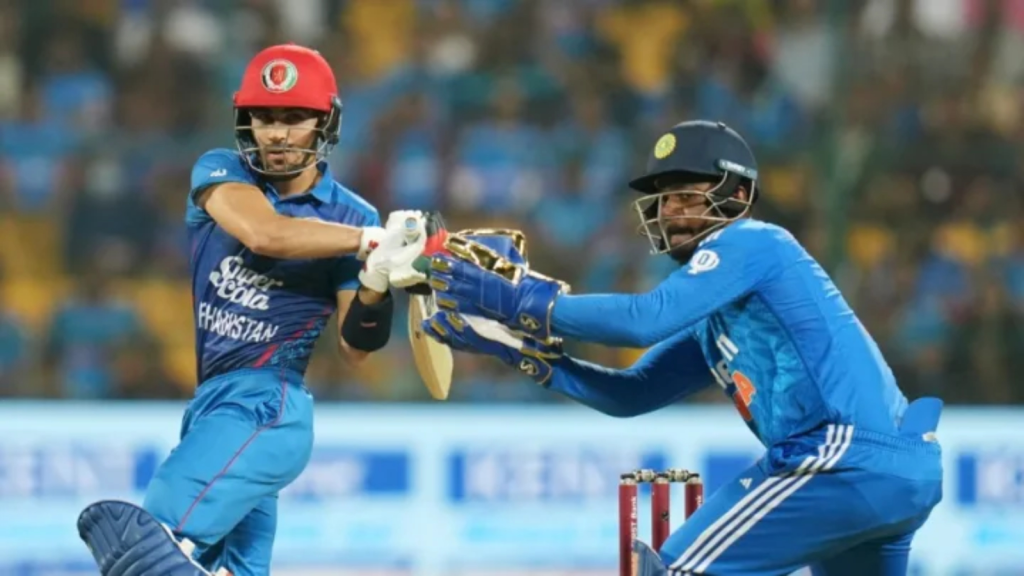
India and Afghanistan players during a cricket match. Image Credit: IndianExpress
The Afghanistan Cricket Board will host India in a three-match T20I series in New Delhi next month, marking a unique moment in international cricket. Although Afghanistan will be the designated home team, all three matches will be played at the Arun Jaitley Stadium in the Indian capital.
The first match is scheduled for September 13, with the second T20I on September 15 and the final match on September 17. The arrangement has been confirmed by the Afghanistan Cricket Board and the Board of Control for Cricket in India.
The series is expected to feature India’s T20 squad under Shreyas Iyer and Afghanistan’s growing group of international stars, including players who have become familiar to Indian fans through the Indian Premier League.
The BCCI said it was pleased to support the Afghanistan Cricket Board in hosting the series. BCCI secretary Devajit Saikia described India-Afghanistan contests as exciting encounters and said Afghanistan’s players had become popular among Indian supporters.
Why Afghanistan is hosting in Delhi
Afghanistan has often played its home matches outside the country because of security, infrastructure and logistical challenges. India has served as an important cricketing base for Afghan teams, with venues and facilities available for international-level preparation and competition.
The September series takes that relationship a step further. Afghanistan will officially be the host nation, but Delhi will provide the venue and operational setting. This is unusual in international cricket because the home team normally hosts matches within its own country. In this case, Afghanistan’s home series has been relocated to India, allowing the ACB to retain hosting rights while providing players with a suitable international venue. This story was also covered by The IndianExpress.
The arrangement also offers practical advantages. Both teams will avoid a lengthy overseas travel schedule, while Afghanistan can stage a high-profile bilateral series in front of a large Indian audience. The ACB confirmed that the series would run from September 13 to September 17 and that the dates and venue had been agreed with the BCCI.
Full schedule
The first T20I will be played at the Arun Jaitley Stadium on September 13. The second match will take place at the same venue on September 15, while the third and final T20I is scheduled for September 17.
All three matches will be played in Delhi. The BCCI and ACB have not yet released complete match timings, ticket details or final playing squads.
The compact schedule will require both teams to manage player workloads carefully. Three T20Is in five days can be demanding, particularly for fast bowlers and players returning from injury.
The series may also give both sides an opportunity to test bench strength ahead of larger international assignments.
Importance for India
For India, the series arrives at an important stage in the T20 calendar. The team is expected to begin preparations for its Asian Games campaign soon after the Afghanistan fixtures.
A short bilateral series provides India with a controlled environment to assess combinations before a multi-team event. The selectors can examine opening partnerships, middle-order roles, finishing options and the balance between spin and pace.
The T20I matches may also help players competing for limited places. Young batters and all-rounders could receive opportunities, while experienced players may be asked to provide leadership.
If Shreyas Iyer leads the side, the series will offer him an opportunity to shape the team’s approach. His leadership will be closely watched, especially if India selects a mix of established players and emerging talent.
India may also use the matches to assess players who have performed strongly in domestic cricket and franchise tournaments.
Afghanistan’s opportunity
For Afghanistan, the series is more than a set of three matches. It represents another step in the development of the country’s cricketing identity.
Afghanistan has produced a generation of highly skilled cricketers, especially in T20 cricket. Its spinners, all-rounders and aggressive batters have earned recognition around the world.
Playing India in a bilateral series gives Afghanistan valuable high-pressure experience. It also allows the team to compete against one of the deepest talent pools in international cricket.
The matches will help Afghanistan prepare for future global tournaments and improve its understanding of different game situations. A strong performance against India could further raise the profile of Afghan cricket.
The series will also have commercial value for the ACB. Indian audiences are familiar with Afghan players through franchise cricket, which can attract attention and viewership.
BCCI statement
BCCI secretary Devajit Saikia said the board was pleased to support Afghanistan in hosting the series in India.
“The India-Afghanistan cricketing rivalry has produced some thrilling encounters over the years, with both teams boasting quality cricketers,” Saikia said.
He added that Afghanistan’s players were popular among Indian fans and that this reflected the strong bond between the two cricketing nations.
Saikia also referred to India hosting Afghanistan for the historic first Test between the teams in 2018. He said regular bilateral engagements had continued since then.
The statement underlines the BCCI’s role in helping Afghanistan organise international cricket despite the limitations surrounding home fixtures.
Background of India-Afghanistan cricket
India and Afghanistan played their first Test match in Bengaluru in 2018. It was a significant moment for Afghanistan, which had only recently received Test status.
India won that one-off Test, but the match was important for the growth of Afghan cricket. It brought the two teams together in the longest format and created a stronger bilateral relationship.
Since then, India and Afghanistan have played each other in ODIs and T20Is. Their matches have often attracted attention because Afghanistan’s competitive style has challenged India in shorter formats.
Afghanistan’s players have also built a strong connection with Indian supporters through the IPL. Rashid Khan, Mohammad Nabi and other Afghan cricketers have enjoyed popularity among Indian fans.
That popularity has helped create a friendly sporting relationship, even though India remains the more experienced side in international cricket.
Also Read: Sai Sudharsan Ruled Out of Sri Lanka Test Series; Sarfaraz Khan Named Replacement
Timeline
In June 2018, India hosted Afghanistan for their historic first Test match in Bengaluru.
In the years that followed, the two teams continued to meet in limited-overs cricket, including major international tournaments and bilateral fixtures.
Afghanistan toured India in June 2026 for a one-off Test and three ODIs.
In July, reports emerged that Afghanistan would host India in a three-match T20I series in Delhi, with the Arun Jaitley Stadium expected to be the venue.
On August 12, the BCCI and Afghanistan Cricket Board confirmed the series dates and venue.
The first T20I will be played on September 13, the second on September 15 and the third on September 17, all in New Delhi.
Why This Matters
This matters because it is the first time Afghanistan will officially host India in a bilateral series on Indian soil. The arrangement is unusual but demonstrates how cricket boards can use neutral or relocated venues to keep international cricket active.
For Afghanistan, hosting India in Delhi gives the board an opportunity to strengthen its commercial and sporting profile. For India, the series provides competitive preparation before the Asian Games.
It also matters for fans. India and Afghanistan matches are often entertaining because Afghanistan’s players play with confidence and are particularly dangerous in the spin department.
The series may attract a large audience in Delhi, where Afghanistan’s players have developed a strong following. Indian fans are likely to watch the performances of Rashid Khan, Mohammad Nabi and other familiar names alongside India’s leading T20 players.
The event is also a reminder that cricket can build connections between countries. Sport cannot solve every political or social challenge, but it can create regular points of contact and mutual respect.
India angle
For Indian viewers, the Delhi series is an attractive home-season event. Fans will be able to watch international cricket at a major Indian venue without travelling overseas.
The Arun Jaitley Stadium is known for its passionate crowds and can offer conditions that test both teams. The pitch may assist spin, making the contest between India’s batters and Afghanistan’s spinners particularly interesting.
The series may also provide exposure to players who are not currently guaranteed a place in India’s first-choice T20 XI. Young cricketers can gain experience against a strong Afghanistan attack.
Yeh series kaafi important hai because Asian Games se pehle India ko team combinations test karne ka perfect chance milega.
The matches will also support Delhi’s sports economy. Hospitality, transport, local businesses and stadium operations may benefit from the three-match schedule.
Analysis
India should pay particular attention to its middle order and bowling balance. Afghanistan’s spin attack can expose weaknesses against turning deliveries, while its batters are capable of scoring quickly when they gain momentum.
Afghanistan, meanwhile, will need to maintain discipline against India’s deep batting line-up. The team’s best chance will likely come through aggressive powerplay cricket, quality spin and strong death-over execution.
The schedule also creates a challenge. With matches on September 13, 15 and 17, there is very little recovery time. Team managers may rotate fast bowlers and manage workloads to prevent injuries.
The series should not be judged only by the final score. It will also reveal how Afghanistan handles the pressure of hosting a global cricket powerhouse and how India manages expectations at home.
What Next
The next step will be the announcement of the India and Afghanistan squads. The selectors may finalise the teams after considering player workload, current form and the upcoming Asian Games campaign.
The BCCI and ACB will release ticketing information, match timings and broadcasting details before the series. Delhi authorities will also prepare security and crowd-management plans for the three fixtures.
India’s team management will decide whether to select its strongest T20 side or use the series to give opportunities to younger players.
Afghanistan will likely bring its leading T20 specialists, particularly its spin bowlers and experienced all-rounders.
Training camps and practice sessions will become important because the teams will have limited time between matches. The opening game on September 13 could provide an early indication of how both sides approach the series.
If the matches attract strong attendance and viewership, the arrangement could encourage Afghanistan to host more international fixtures in India or other neutral venues in the future.
Conclusion
Afghanistan will host India in a historic three-match T20I series at Delhi’s Arun Jaitley Stadium from September 13 to 17. The first match will be played on September 13, followed by fixtures on September 15 and 17.
The series is unique because Afghanistan will be the official host while all three games take place in India. It reflects the close cricketing relationship between the two boards and India’s support for the development of Afghan cricket.
For India, the matches will provide valuable preparation ahead of the Asian Games. For Afghanistan, they offer a chance to compete against India, strengthen its international profile and connect with a large fan base.
With Afghanistan’s quality spin attack and India’s deep batting resources, the series promises competitive and entertaining cricket. Fans can expect a lively contest in Delhi and another important chapter in the India-Afghanistan cricket relationship.
Written By A. Jack