
The landslide occurred after heavy monsoon rain in Mumbai, burying parts of a residential settlement near Rathod Medical and triggering a multi-agency search for survivors.
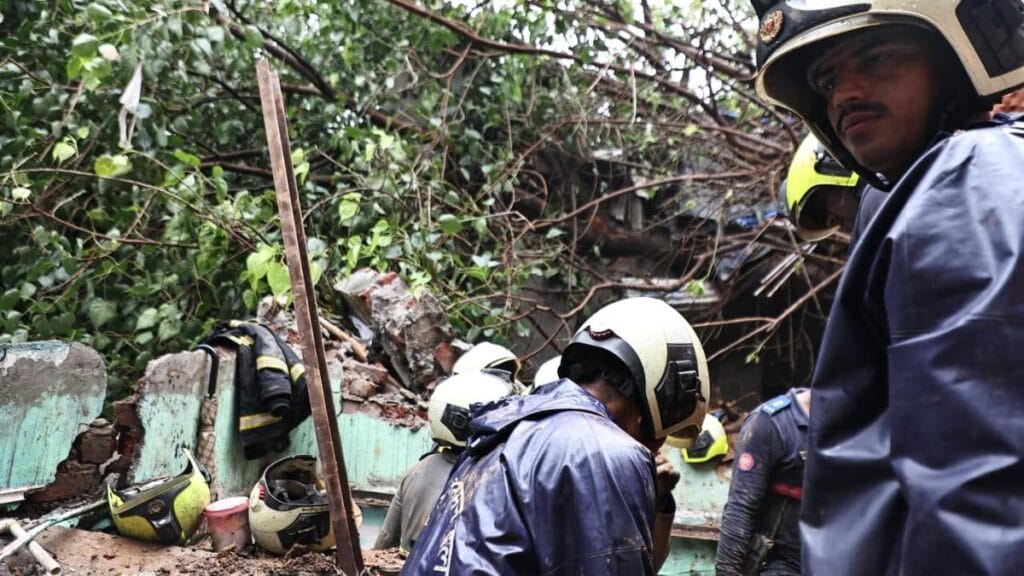
Rescue personnel clear debris at Gaushiya Chawl in Mumbai’s Kurla area after a rain-triggered landslide killed six people and injured four others. Image Credit: The Hindu
A rain-triggered landslide in Mumbai’s Kurla area has caused a major tragedy, killing at least six people and injuring four others. The incident took place in the Gaushiya Chawl locality of Chirag Nagar in the early hours of Wednesday, when a portion of a nearby slope collapsed onto residential structures.
The landslide was reported at approximately 3:48 a.m., when most residents were inside their homes. Debris buried parts of the settlement and trapped people underneath. Two people remained missing as rescue workers searched through the rubble.
Deputy Chief Fire Brigade officer K. R. Yadav said two people were trapped under the debris while rescue teams worked to locate them. The operation involved the NDRF, Mumbai Fire Brigade, police, ambulance services and approximately 50 BMC personnel.
The death toll and injury figures were updated as rescue operations progressed. Initial reports had mentioned two deaths and several people feared trapped, but later updates raised the toll to six, with four people injured.
What happened in Kurla?
The landslide struck a residential section of Gaushiya Chawl near Rathod Medical in Kurla. A portion of the adjoining hill or slope gave way after heavy rain, sending soil, stones and debris towards the homes below.
The impact was severe because the settlement consisted of closely packed structures. When debris enters a dense residential area, it can bury multiple rooms and block narrow access lanes, making it difficult for emergency vehicles and heavy equipment to reach the affected location. This story was also covered by The Hindu.
Rescue workers had to proceed carefully. Removing debris too quickly can cause secondary collapses, while operating heavy machinery near trapped people can create additional danger.
Fire brigade teams initially began clearing the rubble and searching for signs of life. NDRF personnel then joined the operation with specialised equipment designed for collapsed-structure rescue.
The four injured people were shifted to nearby hospitals for treatment. Earlier reports identified two injured residents as Sohel Ansari, 18, and Mohamad Ansari, 14; both were reported to be stable after being admitted to Kurla Bhabha Hospital.
The rescue operation continues.
The rescue operation is being led by multiple agencies because the incident involves both a landslide and a possible structural collapse. The BMC has deployed ward staff and labourers to remove loose soil, broken construction material and stones. The NDRF is using search tools and trained personnel to check voids beneath the debris.
The Mumbai Fire Brigade and police have secured the surrounding area and restricted movement near the site. Ambulances have been kept ready to transport injured people and anyone rescued from the rubble.
Rescuers are listening for sounds from beneath the debris and checking areas where residents reported that people were present before the landslide.
The operation is difficult because monsoon rain can destabilise the slope further. Rescue teams must also monitor water accumulation, electrical wires, damaged walls and the possibility of additional debris falling.
Authorities have asked residents to stay away from the site unless they are involved in the rescue effort. Crowds can obstruct emergency vehicles and make it harder for responders to work.
Officials’ response
The BMC disaster-management system and the Mumbai Fire Brigade were activated soon after the incident was reported. District-level officials and police officers reached the site to coordinate rescue, medical assistance and crowd control.
Deputy Chief Fire Brigade officer K. R. Yadav said two people were trapped under the debris and confirmed that rescue efforts were continuing.
Officials are also assessing the safety of nearby homes. A landslide can weaken the ground beyond the initial collapse, particularly when rainwater continues to flow through the soil.
Residents living close to the damaged slope may be moved temporarily if engineers determine that their homes are at risk.
The administration is expected to prepare a detailed report covering the cause of the landslide, the number of affected homes, the deaths and injuries, and the condition of the surrounding slope.
Why the landslide occurred
Mumbai has received heavy monsoon rain, and intense rainfall can saturate soil on slopes. When soil absorbs too much water, it becomes heavier and loses stability.
Water can also seep into cracks and create pressure between soil layers. If the slope is steep or has been disturbed by construction, vegetation loss or drainage changes, the risk of a landslide increases.
The Kurla incident appears to have been triggered by heavy rain, but the precise cause will require a technical assessment. Authorities will need to examine the slope, drainage channels, retaining structures and construction patterns around Gaushiya Chawl.
Rain alone may not explain every landslide. Poor drainage, encroachment, unprotected slopes and informal construction can make the consequences much worse.
The settlement’s location near a slope and the density of the homes likely contributed to the scale of the tragedy. A falling section of land can travel quickly and strike structures with little warning.
Mumbai’s monsoon vulnerability
Mumbai’s geography makes it vulnerable to waterlogging, flooding, landslides and building collapses during the monsoon. The city has expanded into areas close to hills, drains, railway lines and low-lying land.
The eastern and western suburbs contain several settlements located near hillocks and slopes. During intense rain, these areas can face soil erosion and rockfall.
Urban expansion has also placed pressure on natural drainage systems. When rainwater cannot flow freely, it can accumulate against slopes and weaken the ground.
The city’s disaster-management agencies conduct monsoon inspections, but the scale and density of Mumbai make preventive action difficult. Thousands of residents live in areas that may be classified as vulnerable, and relocating families requires land, funding and long-term planning.
The Kurla landslide has again brought attention to the safety of informal settlements located below unstable slopes.
Timeline
At around 3:48 a.m. on Wednesday, August 12, a portion of a slope collapsed near Gaushiya Chawl in Chirag Nagar, Kurla.
The debris fell onto residential structures, trapping residents and injuring others.
Mumbai Fire Brigade, BMC personnel, police and ambulance teams reached the site and began rescue operations.
Initial reports indicated two deaths, two injuries and several people trapped under the debris.
As the operation progressed, the reported toll increased to six deaths and four injuries.
NDRF teams joined the rescue effort, while around 50 BMC personnel continued removing debris and searching for the missing residents.
Two people remained trapped and feared as authorities assessed the stability of the area.
Also Read: Uttarakhand Flash Flood: Bailey Bridge Washed Away in Chamoli, BRO Driver Missing
Why This Matters
This matters because the landslide occurred in a densely populated residential area, where a single slope failure can affect several homes at once.
The death of six people has caused grief for families and raised concerns among residents who live near the affected slope. The four injured people may require continued medical care, while survivors may need temporary accommodation if their homes are damaged or declared unsafe.
The incident also highlights the importance of early warnings. If residents had received timely alerts about slope movement or dangerous rainfall, some may have been able to move to safer locations.
For Mumbai, the impact extends beyond Kurla. Roads may be affected by rescue traffic, emergency vehicles may be diverted and civic agencies may need to inspect other vulnerable slopes before more rain arrives.
The tragedy also has an economic and social impact. Many residents of low-income settlements depend on daily wages. Losing a home, belongings or a family member can push households into deeper financial hardship.
Yeh issue kaafi important hai because Mumbai’s monsoon danger is not limited to flooding on roads. Landslides and slope collapses can threaten entire communities.
India angle
The Kurla landslide reflects a wider urban-safety challenge across India. Cities such as Mumbai, Pune, Bengaluru, Shimla, Dehradun and Guwahati have all faced risks linked to heavy rain, unstable slopes, poor drainage or unplanned construction.
In Mumbai, monsoon preparedness must include more than pumping water from roads. Authorities also need regular inspections of hill slopes, retaining walls, drains and settlements near vulnerable terrain.
Residents should receive clear information about evacuation routes and nearby shelters. Local warnings can be delivered through mobile alerts, community leaders, police announcements and housing associations.
The incident also raises questions about affordable housing. Families often live in unsafe locations because safer accommodation is beyond their financial means. Relocation plans must therefore include practical housing alternatives rather than only eviction notices.
India needs better coordination between weather agencies, municipal corporations, disaster-response teams and local communities. A warning is useful only when residents understand it and can act quickly.
Analysis
The first priority is, of course, the rescue operation. The two people still feared trapped must be located as quickly as possible, while rescuers work safely. The second priority is to identify residents who may be missing. In densely populated settlements, official records may not immediately show how many people were inside each structure at the time of the incident. Police and local volunteers should prepare a verified list of residents and missing persons.
The third priority is a slope-safety audit. Nearby homes should be inspected for cracks, foundation damage and signs of ground movement. Residents should not be allowed to return simply because the rain has stopped.
The death toll update also demonstrates why early information must be treated cautiously. Initial reports mentioned two deaths, while later assessments raised the figure to six. Authorities should issue regular verified bulletins to prevent confusion among families and the public.
In the long term, Mumbai needs a transparent system identifying high-risk slopes and prioritising communities for drainage improvements, retaining walls, relocation or structural reinforcement.
What Next
Rescue teams will continue searching for the two people believed to be trapped beneath the debris. The operation may continue for several hours depending on the condition of the rubble and the possibility of further rain.
The injured residents will receive medical treatment, while officials will identify the deceased and assist their families with documentation and support.
Engineers and BMC officials will inspect the damaged slope and surrounding structures. Homes considered unsafe may be evacuated temporarily.
Authorities may also inspect other landslide-prone locations across Mumbai, particularly in the eastern and western suburbs, before the next spell of intense rain.
The BMC is likely to review drainage arrangements and assess whether a retaining wall or other protective structure is required at the site.
Families displaced by the incident may need temporary shelter, food, clothing and financial assistance. Local authorities will also need to ensure that children can continue their education if homes or nearby facilities are damaged.
A broader investigation may examine whether previous warnings were issued, whether the site had been marked as vulnerable and whether any construction or drainage-related factors contributed to the collapse.
Conclusion
The Kurla landslide has killed at least six people and injured four others after heavy rain caused a slope to collapse onto homes at Gaushiya Chawl in Chirag Nagar. Two people remain feared trapped, while NDRF teams, BMC workers, fire brigade personnel and police continue rescue operations.
The tragedy has exposed the dangers faced by communities living near unstable slopes during Mumbai’s intense monsoon. The immediate focus must remain on finding those trapped, treating the injured and supporting families who have lost loved ones.
But rescue alone will not be enough. Authorities must inspect nearby slopes, relocate residents from unsafe areas where necessary and improve drainage and early-warning systems.
Mumbai’s rain is a recurring reality, but deaths caused by landslides are not inevitable. Better planning, safer housing and faster warnings can reduce the risk before the next storm arrives.
Written By A. Jack