The hospital records add to the controversy over the police response during the Parliament march, although Delhi Police have denied using pellet guns against protesters.
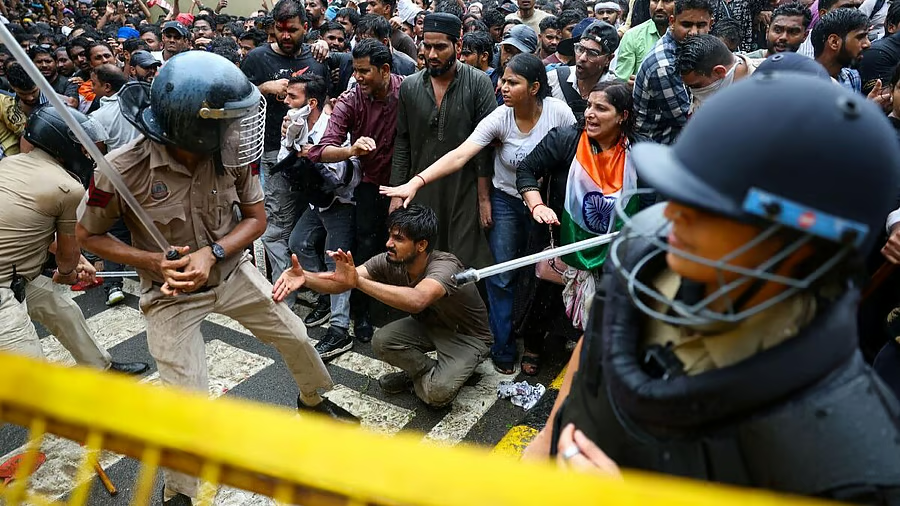
Protesters gather near Jantar Mantar during the July 20 march to Parliament, where several people were later treated for pellet, shot or projectile injuries.
Fresh hospital records have intensified questions about the use of force during a July 20 protest in New Delhi. According to responses provided under the Right to Information Act, at least 10 people were treated at Lady Hardinge Medical College and Safdarjung Hospital for pellet, shot or projectile injuries during the Jantar Mantar protest and the march towards Parliament.
Lady Hardinge Medical College said nine people with such injuries were treated at the hospital. Safdarjung Hospital recorded one additional pellet-injury case. Hospital sources confirmed the authenticity of the responses, which were obtained by All India Trinamool Congress spokesperson Saket Gokhale.
The figures are significant because earlier reports had put the number of confirmed pellet injuries at five. Gokhale said the hospital records showed that the confirmed number was at least double the earlier figure.
The records do not, by themselves, establish which security unit fired the projectiles or identify the precise circumstances of every injury. However, they provide official medical documentation that people were treated for pellet-related wounds during a protest in which police had denied using pellet guns.
What the RTI responses show
The RTI response from Lady Hardinge Medical College, dated August 7, stated that nine patients were treated for “pellet, shots or projectile injuries” connected to the events of July 20.
The same response said 81 injured people were admitted to the hospital. Of them, 35 were police personnel and 46 were protesters. The injuries recorded included head and facial injuries, fractures, lacerations, contusions and ocular, respiratory and skin-related injuries.
Safdarjung Hospital’s response, also dated August 7, recorded one case of pellet injury. It said a patient with “pellet injury” was treated at the hospital on July 20. This story was also covered by TheHindu.
Together, the two responses establish at least 10 hospital-recorded cases involving pellets, shots or projectiles. The actual number could be higher if injured people went to other hospitals, received treatment at private facilities or did not seek medical care.
The wording used by the hospitals is important. The records confirm the nature of the injuries as reported or medically recorded, but they do not necessarily provide a forensic determination of the weapon used in each case.
The July 20 protest
The protest was organized by the Cockroach Janta Party, or CJP, and involved a march from the Jantar Mantar area towards Parliament. Protesters had been demonstrating over alleged irregularities connected with recruitment examinations.
The protest escalated when demonstrators attempted to move beyond the permitted protest zone. Security personnel used crowd-control measures as the march moved through central Delhi.
Several people were injured during the confrontation. Some protesters reported being struck by pellets, while others described injuries from batons, barricades and crowd-control equipment.
One of the reported victims was a 19-year-old protester whose family said he could lose vision in his right eye following a pellet injury. Another injured protester was reported to have suffered multiple pellet wounds to the face and required surgery.
The clash also caused injuries among police personnel and led to the detention of protesters. The incident quickly became a political controversy, with opposition leaders demanding an explanation and an independent inquiry.
Police deny using pellet guns
Delhi Police denied allegations that its personnel used pellet guns during the protest. In a public statement, the police said they neither possessed nor used pellet guns during the ongoing protest and described claims to the contrary as false and misleading.
The police position created a direct conflict with the accounts of injured protesters and medical records. The RTI responses now add documentary evidence that at least 10 people had pellet, shot or projectile injuries, but they do not independently determine who caused those injuries.
A separate police station record later became part of the controversy. Reports citing a general diary entry at Parliament Street police station said Rapid Action Force personnel used anti-riot guns twice during the protest, firing ballistic cartridges with plastic pellets. The entry reportedly recorded the use of 55 non-electric shells, 15 electric shells, five tear-smoke grenades and two anti-riot-gun rounds.
The police denial and the reported diary entry will need to be examined together. A full investigation would have to review deployment orders, weapon logs, CCTV footage, medical reports, recovered projectiles and statements from protesters and security personnel.
Why the distinction matters
The distinction between “pellet injuries” and “proof of pellet-gun use by a particular force” is legally and factually important. A hospital can identify wounds consistent with pellets or projectiles, but it may not be able to determine whether the injuries came from a particular weapon or security unit. That would require ballistic analysis and a detailed reconstruction of the incident.
At the same time, the hospital records cannot be dismissed simply because they do not name the shooter. They show that at least 10 people arrived with injuries classified as pellet, shot or projectile wounds.
This is why an independent probe is necessary. The investigation should establish what weapons were deployed, which units carried them, whether the use of force was authorized, and whether it complied with standard crowd-control procedures.
Statements and competing claims
Saket Gokhale said the latest hospital records doubled the previously known number of people with pellet-gun injuries. He argued that the documented cases showed the need for accountability. Delhi Police, however, have maintained that they did not use pellet guns during the protest and warned the public against circulating what they called unverified claims.
Protesters and their families have given a different account. They have described wounds to the face, eyes and other parts of the body and demanded that the authorities explain how the injuries occurred.
The strongest conclusion at this stage is that the medical records confirm at least 10 pellet, shot or projectile injury cases. The question of responsibility remains disputed and requires independent verification.
Background and context
The July 20 protest took place against the backdrop of a wider public debate over recruitment examinations and alleged irregularities. Candidates and supporters had gathered at Jantar Mantar before attempting to march towards Parliament.
Jantar Mantar is a designated protest venue, but marches towards Parliament are subject to security restrictions because the area around the legislature is heavily protected.
Crowd-control operations in central Delhi involve the Delhi Police, paramilitary units and, in some circumstances, the Rapid Action Force. Different units may carry different types of equipment, making it important to maintain a complete record of deployment and weapon use.
The controversy has echoes of earlier debates in India over the use of pellet guns. Pellet weapons have been associated with severe injuries, particularly to the eyes and face. Their use in densely populated urban protests raises questions about proportionality, public safety and accountability.
Timeline
On July 20, protesters gathered at Jantar Mantar and attempted to march towards Parliament. The demonstration escalated as security forces tried to stop the march from moving beyond restricted areas.
During the confrontation, dozens of protesters and police personnel were injured. Some protesters reported pellet wounds, including serious facial and eye injuries.
On July 21, Delhi Police denied using pellet guns or shock batons against peaceful protesters. The police said allegations that its forces used pellet guns were false and misleading.
On July 22 and July 23, reports emerged about protesters with medically documented pellet injuries. One injured protester underwent surgery after suffering multiple pellet wounds to the face.
On July 28, reports citing a general diary entry from Parliament Street police station said Rapid Action Force personnel had fired two anti-riot-gun rounds containing plastic pellets.
On August 7, Lady Hardinge Medical College and Safdarjung Hospital issued RTI responses recording nine and one pellet-related injury cases, respectively.
On August 10, the findings were made public, prompting renewed demands for an investigation.
Why This Matters
This matters because the incident involves the use of potentially dangerous crowd-control equipment in the national capital. Injuries to the eyes, face and head can cause permanent disability and lifelong medical costs.
It also matters because the incident has raised questions about the reliability of official statements. If a police department denies the use of pellet guns while medical records document pellet-related injuries and a police diary reportedly records anti-riot-gun rounds, the public deserves a clear explanation.
For protesters, the issue is about their right to demonstrate without suffering disproportionate harm. For the police, the issue is about managing a potentially volatile crowd while protecting Parliament and public property. A transparent investigation would serve both sides. It could establish whether the police acted within the law and provide accountability if excessive force was used.
The incident also highlights the need for better crowd-control standards. Non-lethal equipment can still cause life-changing injuries, so deployment must be carefully regulated.
India’s angle
For India, the Delhi protest raises a familiar but urgent question: how should police manage large demonstrations in a democracy? Peaceful protest is an important constitutional right, but it does not permit violence, forced entry into restricted zones or damage to public property. At the same time, law-enforcement agencies must use only necessary and proportionate force.
The RTI process has played an important role in this case. By seeking hospital records, the applicant created a documentary trail that can be examined independently of political claims.
Yeh issue kaafi important hai because transparent records help citizens understand what happened when official accounts and eyewitness testimonies differ.
Indian police forces also need clearer public reporting after major crowd-control incidents. Authorities should disclose the units deployed, broad categories of equipment used, number of injuries and the process for reviewing complaints.
Analysis
They do not conclusively prove which force used the weapon or whether every injury occurred at precisely the same location. That is why the next stage should be a fact-finding inquiry, not further political speculation. Medical records, CCTV footage, police logs, body-camera footage, weapon registers and forensic evidence should be examined together.
The reported general diary entry makes the controversy more serious, but it too should be independently authenticated and placed in context. Authorities must explain what “anti-riot guns” and “plastic pellet” rounds were used for, who authorized them, and whether protesters were warned.
The government should also ensure that injured protesters receive medical support and compensation if an investigation establishes unlawful or excessive force.
What Next
The RTI findings are likely to lead to renewed demands for an independent investigation by a judicial panel, a human-rights body or another impartial authority.
Authorities may be asked to preserve CCTV footage, police communication records, weapon-deployment documents and medical evidence before it is lost or altered.
The Delhi Police may issue a fuller response to the hospital data and the reported Parliament Street police diary entry. It may clarify whether Rapid Action Force personnel were deployed, what equipment they carried and how the weapons were used.
The injured protesters and their families could pursue legal action, particularly in cases involving permanent damage to eyesight or other serious injuries.
The courts may also be asked to examine whether the use of pellet or plastic-pellet rounds was proportionate under the circumstances.
In the longer term, the incident could lead to new guidelines for protests near Parliament, stronger documentation of police action and restrictions on weapons capable of causing severe eye and facial injuries.
Conclusion
RTI responses from Lady Hardinge Medical College and Safdarjung Hospital show that at least 10 people were treated for pellet, shot or projectile injuries during the July 20 Jantar Mantar protest and march towards Parliament. Nine cases were recorded at Lady Hardinge and one at Safdarjung.
The figures add weight to the claims of injured protesters, but they do not yet resolve the central question of who fired the projectiles. Delhi Police have denied using pellet guns, while reports citing a police diary indicate that anti-riot guns and plastic-pellet rounds were used by Rapid Action Force personnel.
The only credible way forward is an impartial investigation based on medical evidence, forensic analysis, weapon logs, CCTV footage and witness accounts. The public deserves clarity, and the injured deserve accountability and support.
In a democracy, crowd control must protect public order without causing unnecessary or permanent harm. The July 20 incident has made that balance impossible to ignore.
Written By A. Jack