DMRC says Delhi Metro’s strict punctuality standard counts a train as delayed if it reaches its destination more than 59 seconds late, while nearly 29% of its network now operates under driverless train technology.
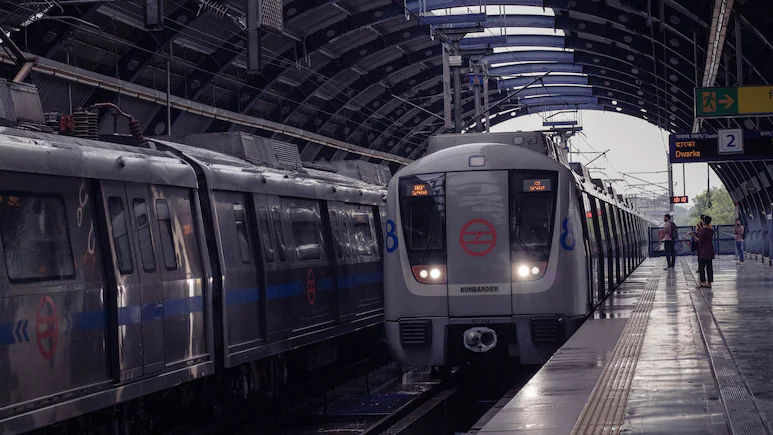
A Delhi Metro train arrives at a station. Image Credit: NDTV
The Delhi Metro Rail Corporation has announced a major operational milestone, claiming that the Delhi Metro has emerged as one of the world’s most reliable urban rail systems. According to DMRC, the network recorded train punctuality of 99.95% in 2026 and outperformed established systems including the Hong Kong Metro, Paris Metro and New York Subway.
The claim was shared by DMRC in a post on X. The corporation said the achievement was particularly significant because Delhi Metro uses a strict definition of delay. A train is counted as delayed if it reaches its destination more than 59 seconds behind schedule.
The reliability record comes despite the network’s enormous expansion. Delhi Metro began operations on December 25, 2002, with an 8.4-kilometre route between Shahdara and Tis Hazari. It now covers 416.5 kilometres, operates across 12 lines and serves 303 stations, including 31 interchange stations connecting Delhi with the wider National Capital Region.
What the 99.95% Figure Means
Punctuality is one of the most important measures of a metro system because it determines how reliably passengers can reach offices, colleges, airports, hospitals and transport hubs. DMRC’s 99.95% figure means that almost all trains reached their destinations within the corporation’s defined time limit. The organisation says its definition is stricter than systems that may count a train as delayed only after it falls several minutes behind schedule.
The difference of a few minutes can be important in a metro network. Delhi Metro has closely spaced services, large interchange stations and high passenger volumes. A small delay on one line can affect connections across the system.
According to DMRC, train punctuality stood at 98.27% in 2003 and increased to 99.64% in 2005. The corporation said the network has maintained around 99.9% punctuality in later years. It also said train headway on busy corridors has reduced to 2 minutes and 18 seconds, compared with approximately seven minutes during the early years. This story was also covered by NDTV.
Train headway refers to the time gap between two consecutive trains. A shorter headway allows more passengers to be moved during peak hours, but it also requires precise coordination between signalling systems, train operators, station teams and control rooms.
Yeh issue kaafi important hai because reliable public transport allows people to plan their workday without depending entirely on unpredictable road traffic.
DMRC’s Global Comparison
DMRC said Delhi Metro has outperformed established networks in Hong Kong, Paris and New York on punctuality and reliability. The comparison is based on DMRC’s own statement and should be understood in the context of each system’s operating conditions and measurement methods.
Metro networks differ in size, track design, signalling systems, passenger volumes, maintenance schedules and definitions of delay. A direct comparison therefore requires common data and an identical measurement system. Even with these differences, Delhi Metro’s reported performance is notable. It shows that a large and heavily used network in a densely populated region can maintain a high degree of schedule discipline.
Delhi Metro’s punctuality record also strengthens its image as one of India’s major infrastructure success stories. The network has become a model for metro expansion in cities such as Bengaluru, Mumbai, Hyderabad, Chennai, Pune and Ahmedabad.
From Six Stations to 303
Delhi Metro began operations with a small 8.4-kilometre stretch and just six stations. Since then, it has expanded across Delhi, Gurugram, Noida, Ghaziabad, Faridabad and Bahadurgarh. The growth has transformed daily commuting in the National Capital Region. Passengers can now travel between distant parts of Delhi and neighbouring cities without depending entirely on road transport.
The increase in ridership reflects the importance of the network. Delhi Metro carried around 82,000 passenger journeys during its first year. Its highest single-day patronage crossed 81 lakh passenger journeys on August 8, 2025, while its current average daily ridership stands at approximately 64.06 lakh journeys.
This scale creates significant operational challenges. A delay at a major interchange can lead to crowding on platforms and trains across several lines. Maintaining punctuality at such passenger volumes requires careful planning and consistent maintenance.
Driverless Metro Operations
Delhi Metro also operates India’s largest driverless metro network. Around 29% of its entire network runs under Unattended Train Operation, commonly known as UTO. Under UTO, trains are controlled by an operations centre without a driver required to operate the train from the front cabin. Staff may still be present for passenger assistance, safety, emergency response and other operational duties.
Delhi Metro’s Line 7, commonly associated with the Pink Line, is 71.55 kilometres long and has 45 stations. DMRC describes it as the world’s longest driverless metro line and one of the longest circular metro routes globally.
Driverless operations can support punctuality by enabling precise acceleration, braking and station dwell times. Automated control can also help maintain consistent gaps between trains during peak hours.
Automation, however, does not remove the need for human supervision. Control-room personnel, maintenance engineers, station teams and emergency responders remain essential to safe and efficient operations.
How Delhi Metro Maintains Reliability
High punctuality depends on several systems working together. Automatic train control, centralised operations monitoring, preventive maintenance, signalling coordination, quick responses to technical faults and trained station staff all contribute to reliable service.
Delhi Metro has also benefited from long-term planning and phased expansion. Instead of treating each corridor as an isolated project, the system has developed interchange stations and common operational standards across the network.
Station design affects punctuality as well. If passengers can enter and exit trains quickly, dwell time at stations remains controlled. Platform crowd management is therefore closely linked to train performance.
Delhi Metro’s control rooms continuously monitor train movement, station conditions and technical systems. If a fault occurs, response teams can be deployed before it causes wider disruption.
Background and Context
Delhi’s transport system faces daily pressure from congestion, air pollution and a large commuter population. The Metro provides an alternative to private vehicles, buses, taxis and two-wheelers.
Its reliability has helped make it a preferred mode of transport for office workers, students, tourists and airport passengers. The system also supports economic activity by allowing workers to travel longer distances without spending several hours in road traffic.
Metro expansion has created new connections to residential areas, industrial centres, educational institutions and commercial hubs. The network’s role is expected to increase as Delhi-NCR continues to grow.
Other Indian metro systems have expanded rapidly, but Delhi Metro remains the country’s largest by network length and ridership. Its reported punctuality record may influence future metro planning and technology choices in India.
Timeline
Delhi Metro began operations on December 25, 2002, with an 8.4-kilometre route and six stations. In 2003, its train punctuality stood at 98.27%, according to DMRC. By 2005, the figure had increased to 99.64%.
In the following years, DMRC said the network consistently maintained around 99.9% punctuality. On August 8, 2025, the system recorded more than 81 lakh passenger journeys on its busiest single day.
In 2026, the network recorded 99.95% punctuality while operating across 416.5 kilometres and 303 stations. Approximately 29% of the system now operates under driverless technology.
Also Read: SpiceJet Pune-Delhi Flight Delayed, Flyers Say They Were Left Without Food or Beverages
Why This Matters
This matters because public transport reliability directly affects the lives of millions of people. A punctual Metro allows passengers to plan work, examinations, medical appointments and flights with greater confidence.
It also matters for the environment. Reliable Metro services can encourage people to leave private vehicles at home, reducing road congestion and emissions.
For Delhi-NCR, the Metro is more than a transport service. It is a daily connection between homes and workplaces, colleges, markets, airports and government offices.
The achievement also matters for India’s urban development. Cities need reliable mass-transit systems to manage population growth and reduce dependence on cars and motorcycles.
There is also a technology angle. Delhi Metro’s driverless operations show that automation is becoming an important part of India’s public transport future. In simple Hinglish, Metro sirf travel ka option nahi hai; yeh city ki daily economy ko move karta hai.
India Angle
For Indian readers, the Delhi Metro achievement offers a benchmark for public transport systems across the country. As urban populations grow, Indian cities need Metro networks that are punctual, safe, accessible and affordable.
The reported performance could encourage other cities to invest in automated signalling, driverless technology, integrated ticketing and better interchange design.
However, reliability must be considered alongside the passenger experience. A punctual train is important, but commuters also need clean stations, functioning escalators, adequate security, accessible facilities and reasonable fares.
Metro systems must also expand carefully. New lines should connect underserved neighbourhoods rather than focus only on already developed areas.
Delhi’s experience demonstrates that expansion and operational discipline can progress together, but both require regular investment.
Analysis
The more important achievement is that Delhi Metro has maintained high punctuality while expanding from six stations to more than 300. Managing a large network with multiple interchanges and millions of daily journeys is a significant operational challenge.
The next test will be whether the system can maintain this reliability as expansion continues. More lines and stations can create additional points of failure, especially at busy interchange stations.
DMRC should also publish regular, independently verifiable data on punctuality, cancellations, breakdowns and passenger complaints. Greater transparency would strengthen the credibility of the achievement.
What Next
The immediate focus will be maintaining punctuality as Delhi Metro expands and passenger demand continues to rise. DMRC will need to invest in signalling, rolling stock, maintenance facilities and station infrastructure.
Driverless operations may be extended to more corridors after safety and technical assessments. The experience of Line 7 could help guide future automated Metro projects across India.
The corporation may also improve real-time passenger information through station displays, mobile applications and public announcements. During disruptions, clear communication can reduce confusion even when punctuality is temporarily affected.
Long term, Delhi Metro will need to integrate more effectively with buses, regional rapid transit, railways and last-mile transport. A reliable train is most useful when passengers can reach the station and complete their journey efficiently. The network must also continue improving accessibility for elderly passengers, people with disabilities, children and travellers carrying luggage.
Conclusion
Delhi Metro has reported a 99.95% train punctuality rate in 2026 and says it now ranks among the world’s most reliable metro systems. The claim is particularly notable because DMRC counts a train as delayed if it arrives more than 59 seconds late.
The network has grown from an 8.4-kilometre route with six stations in 2002 to 416.5 kilometres, 303 stations and 12 lines. It now carries an average of 64.06 lakh passenger journeys every day and operates India’s largest driverless Metro network.
The achievement is a major milestone for Delhi and Indian urban transport. But continued success will depend on maintenance, expansion planning, affordability, accessibility and transparent performance data.
Written By A. Jack