The new corridor will extend the Namo Bharat network from Modipuram in Meerut to Rishikesh via Haridwar, creating direct high-speed connectivity with Delhi, Ghaziabad, Noida and upcoming transport hubs like Jewar Airport.
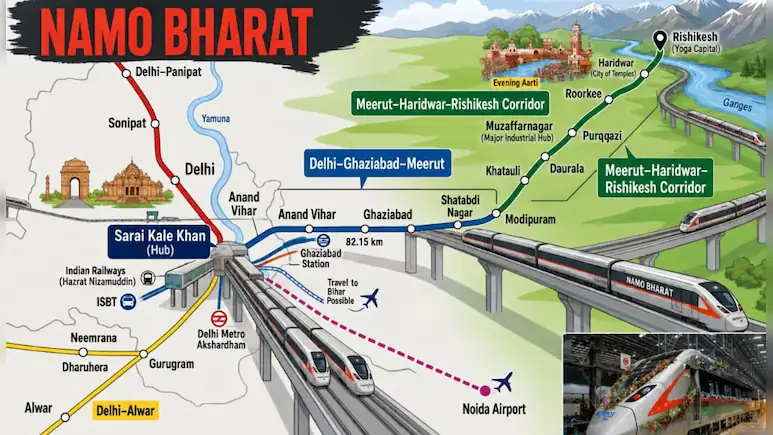
Namo Bharat services are set to expand from Delhi-NCR to Rishikesh, linking major religious, tourist and business destinations through a new rapid rail corridor. Image Credit: NDTV
The Delhi-NCR rapid rail map is preparing for another big leap, with the Meerut-Haridwar-Rishikesh Namo Bharat corridor moving ahead after receiving in-principle approval. The proposed route, which will stretch roughly 150 km, is being developed as an extension of the existing Delhi-Meerut Namo Bharat line and will connect key cities across Uttar Pradesh and Uttarakhand.
According to the current plan, the corridor will begin in Modipuram in Meerut and run through Daurala, Khaatauli, Muzaffarnagar, Purkazi, Roorkee, Haridwar and finally near Lakshman Jhula in Rishikesh. The project is being taken forward by the National Capital Region Transport Corporation along with the Uttar Pradesh and Uttarakhand governments. Yeh development kaafi important hai because it could reshape travel between Delhi-NCR and one of North India’s most visited spiritual corridors.
What the New Corridor Means
This expansion is not just about adding another rail line. It is about connecting pilgrimage, tourism, daily commuting and regional economic movement in one integrated high-speed network. The corridor is expected to cover 72 km in Uttar Pradesh and 78 km in Uttarakhand, linking districts and cities that already see heavy passenger movement by road.
The idea is to extend the existing Delhi-Meerut rapid rail system beyond Modipuram, which will act as the last major station on the current stretch. Once extended, passengers from Delhi, Ghaziabad and Noida will be able to travel further into Uttarakhand without shifting to conventional long-distance road transport. That is a major convenience shift, especially for people visiting Haridwar and Rishikesh for religious travel, tourism or work. This story was also covered by NDTV.
Officials have also appointed coordination officers to avoid delay in land acquisition and route surveys. The Uttarakhand government has named Additional Secretary Reena Joshi as nodal officer, while the Uttar Pradesh side and NCRTC have also assigned officers to keep the project moving. This is a signal that the corridor is no longer just an idea; it is entering the serious planning stage.
How the Route Will Connect the Region
The proposed route has been designed to link multiple levels of regional transport. In Uttar Pradesh, the line will pass through Meerut and Muzaffarnagar before entering Uttarakhand. In the Uttarakhand stretch, it will connect Roorkee, Haridwar and Rishikesh. That gives the corridor both commuter value and tourism value.
One of the biggest strengths of this proposal is its integration with the existing Delhi-Meerut Namo Bharat route. The new Rishikesh line will connect through Modipuram, which means the entire rail chain will become part of a broader NCR transport system. Passengers from Sahibabad, Duhai, Guldhar, Partapur and Shatabdi Nagar will be able to move toward Haridwar and Rishikesh through the same network.
This is where the project becomes more than just a regional line. It creates continuity between Delhi and Uttarakhand in a way that India’s current conventional rail system often struggles to provide in terms of speed and convenience. For everyday travellers, that means less dependence on road traffic and more predictable journey times.
Links to Other Major Corridors
The expansion also fits into a much larger NCR transport plan. The new Rishikesh corridor will connect with the Delhi-Ghaziabad-Meerut route and create access to other future or ongoing lines. These include the Delhi-Alwar corridor, the Delhi-Sonipat-Panipat corridor and the Ghaziabad to Noida International Airport route in Jewar.
Sarai Kale Khan is expected to become a major interchange hub in this network. It is being positioned as Delhi-NCR’s largest transport interchange and will allow seamless movement between different Namo Bharat corridors. That means passengers from Haridwar and Rishikesh could travel to Alwar, Panipat or Jewar with minimal disruption, depending on the final alignment and interchange structure.
This matters because modern transport networks are no longer just about point-to-point travel. They are about connections. The more corridors that connect at major hubs, the more useful the system becomes for commuters, tourists and business travellers. In simple terms, this is not just rail expansion — it is network building.
Why This Matters
This matters because the Delhi-NCR region is one of India’s busiest travel zones, and Uttarakhand is one of the country’s biggest religious and tourism destinations. Haridwar and Rishikesh attract lakhs of visitors every year, and most of that movement currently depends on roads and conventional rail services. A faster and more reliable Namo Bharat corridor could reduce travel stress significantly.
The economic impact could also be substantial. Better connectivity can support hotels, local transport, food businesses, pilgrimage services and tourism-based employment in Haridwar and Rishikesh. It can also help traders, students and office-goers who move between western Uttar Pradesh, Delhi and Uttarakhand. Yeh issue kaafi important hai because infrastructure growth often creates ripple effects far beyond the railway line itself.
For the wider NCR, the corridor supports the government’s goal of building a more integrated and less road-dependent regional transport system. That can reduce congestion, improve accessibility and make long-distance commuting more practical. If implemented smoothly, it may also encourage more people to shift from private vehicles to rapid rail.
Background and Context
The Namo Bharat project, earlier known under the RRTS framework, was originally planned to transform regional travel across the NCR. The Delhi-Meerut corridor became the first major live example of this vision. The new extension to Haridwar and Rishikesh shows that the model is now being expanded into newer geographies.
This is important because India’s transport growth is increasingly focused on intercity connectivity rather than only metro-style local movement. Rapid rail offers a middle layer between city metros and long-distance trains. It is faster than regular rail on short and medium routes and more suitable for daily or frequent regional travel. That is why the new corridor is drawing attention.
The Rishikesh extension also reflects Uttarakhand’s strategic importance. The state depends heavily on religious tourism, and better access from Delhi-NCR can improve visitor flow while also making the journey more structured. With Har Ki Pauri and Lakshman Jhula included in the alignment plan, the route has a strong spiritual and cultural relevance as well.
Timeline
Earlier: The Delhi-Meerut Namo Bharat line became the first major rapid rail project in the region.
Recent meeting: Uttarakhand Chief Minister Pushkar Singh Dhami and Union Housing and Urban Affairs Minister Manohar Lal Khattar discussed the proposal.
Now: The corridor has received in-principle approval.
Current stage: DPR survey work is underway.
Next phase: Land acquisition, route finalisation and coordination across Uttar Pradesh and Uttarakhand.
Future: The line may extend rapid rail connectivity from Delhi-NCR all the way to Rishikesh.
Also Read: Mumbai AC Local Cooling Failure Leaves One Hospitalised, Two Struggle to Breathe at Mulund
India Angle
For Indian readers, this project is a strong example of how infrastructure can reshape travel habits. In Hinglish, seedhi baat yeh hai: agar aap Delhi, Ghaziabad ya Noida se Haridwar ya Rishikesh ja rahe ho, toh aage chal kar yeh journey much smoother ho sakti hai. That is a big deal for families, pilgrims and tourists.
This also matters because Indian cities are growing fast, and regional transport has to keep up. Rapid rail systems like Namo Bharat are meant to solve exactly that gap. They offer speed, comfort and better station integration compared with many current intercity options. For the average traveller, that can mean less road fatigue and more reliable arrival times.
The religious tourism angle is especially significant in India. Haridwar and Rishikesh are not just travel destinations; they are emotional and spiritual destinations for millions. Direct rail connectivity from NCR can make yatra planning easier, safer and more efficient. That combination of faith, travel and infrastructure gives the project a very strong Indian relevance.
Analysis
My opinion is that the strongest part of this project is its connectivity logic. It does not operate in isolation. Instead, it plugs into Delhi-Meerut and then links to Sarai Kale Khan, Jewar Airport, Alwar and Panipat corridors. That network effect is where the real value lies. A single new route is useful, but a connected system is transformative.
I also think the project will be watched closely for execution quality. India has seen many ambitious transport plans, but the real test is how smoothly land acquisition, alignment approvals and station integration happen. The appointment of nodal officers is a good sign because it suggests coordination is being taken seriously. Still, the success of this corridor will depend on whether planning turns into timely construction.
From a public-facing perspective, this is the kind of infrastructure story that people can immediately understand. It affects travel time, convenience and regional access. That is why it has strong SEO potential too. It sits at the intersection of news, transport and tourism — three topics that consistently draw reader interest.
What Next
The next step is the Detailed Project Report survey, which will help determine the precise route, stations, engineering requirements and implementation timeline. Once the DPR is completed, the project can move toward formal approvals and land-related processes. That phase will be crucial because transport projects often rise or slow depending on planning accuracy.
After that, the governments of Uttar Pradesh and Uttarakhand, along with NCRTC, will need to align on execution responsibilities. Station placement, interchange planning and integration with existing corridors will need careful handling. If these steps move quickly, the corridor could become one of the most important mobility projects in North India.
Travellers should watch for clearer updates on station design and whether major tourism points receive easy access. If planned well, this route could become a model for future regional rail extensions in India.
Conclusion
The proposed Meerut-Haridwar-Rishikesh Namo Bharat corridor is a major step in the expansion of Delhi-NCR’s rapid rail network. With in-principle approval already in place and DPR survey work underway, the project could soon connect the capital region to Haridwar and Rishikesh through a faster, modern and more integrated transport system. Its impact could be felt across tourism, commuting, regional trade and spiritual travel. For North India, this is more than a rail project — it is a sign of how connectivity is evolving.
Written By A. Jack