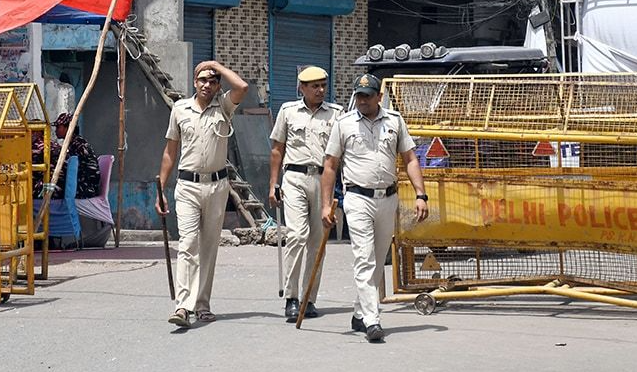
A 26-year-old man was allegedly stabbed to death by his brother-in-law and an associate during a family dispute in the Mangolpuri area of northwest Delhi late on Monday night. The attackers fled after the assault, police say, and CCTV footage and local intelligence are being used to trace them.
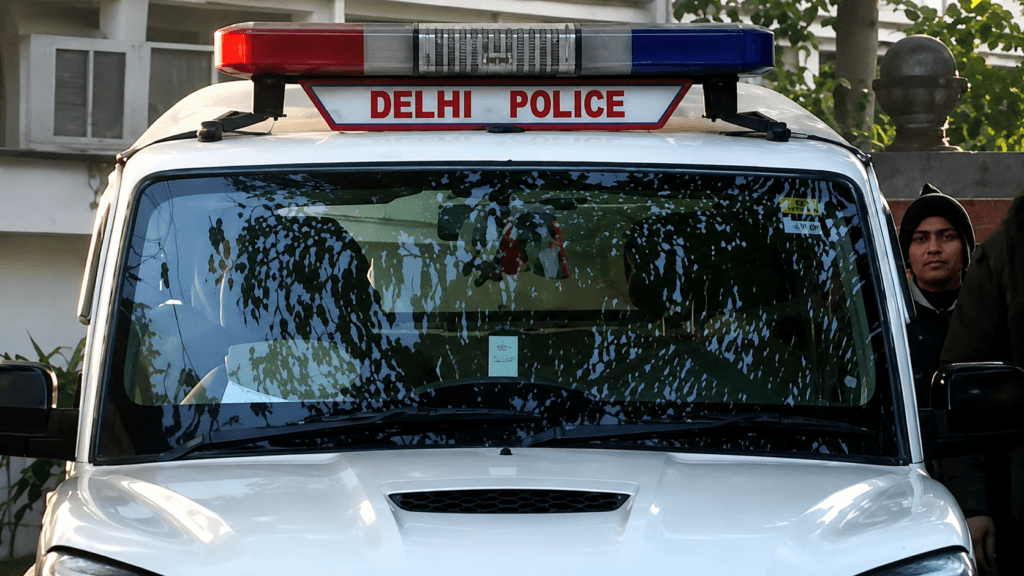
Police investigate the Mangolpuri crime scene after a 26-year-old man was allegedly stabbed to death in a late-night attack linked to a family dispute.
Delhi Stabbing Case
A shocking murder in northwest Delhi’s Mangolpuri has once again highlighted how domestic disputes can spiral into fatal violence. According to police, Abhishek Jha, 26, was stabbed to death near a public toilet around 11:30 pm on Monday after being called aside by his brother-in-law Aryan and one of Aryan’s associates.
The attack happened in front of Abhishek’s father, Shambhu Nath, who alleged that the assailants suddenly started stabbing his son repeatedly. The accused fled after the incident, while the injured man was rushed to Sanjay Gandhi Memorial Hospital, where doctors declared him dead during treatment. Police have now registered a murder case and begun a search for the suspects.
What Happened
The incident took place in Mangolpuri, a densely populated residential area in northwest Delhi, where a family dispute allegedly turned deadly in a matter of minutes. Police said Abhishek was approached near a public toilet by Aryan and another man, who called him aside before attacking him with knives. NDTV has covered the full story.
According to the victim’s father, the assault was sudden and brutal. He said he tried to intervene, but the attackers pushed him to the ground before fleeing. That detail suggests the crime may have been planned rather than spontaneous, although police have not publicly confirmed premeditation at this stage.
The injured man was taken by his father to Sanjay Gandhi Memorial Hospital, but his condition was too severe. Doctors later declared him dead, confirming the case as a homicide. The scene was later inspected by police, who found bloodstains and began collecting evidence from the area.
Family Dispute Angle
Early information shared by the family points to an ongoing marital dispute as the possible trigger for the attack. Relatives said Abhishek’s wife had been living at her parental home for nearly a year because of differences in the marriage.
The family further alleged that Aryan had earlier orchestrated attacks on Abhishek and had been threatening him. If verified, that would mean this was not a one-off confrontation but part of a longer pattern of hostility. In many such cases, domestic tensions become dangerous when personal anger, family alliances, and revenge overlap.
This is where the story becomes more serious. A family dispute is one thing; repeated threats and an eventual killing are another. It shows how unresolved conflict, if left to escalate, can move from arguments to violence. Yeh issue kaafi important hai because it highlights how family breakdowns can spill into public safety risks.
Police Response
Police said they received information about the assault and immediately sent a team to the spot. When officers arrived, they found bloodstains at the scene and began gathering details from witnesses. They later learned that the injured man had already been taken to the hospital by his father.
A murder case has now been registered, and a search is underway for Aryan and the other accused. Police said CCTV footage from the area is being examined, and local intelligence inputs are also being used to trace the suspects.
That approach is standard in a case like this, where quick identification of escape routes and witness accounts can be crucial. CCTV may show the movement of the accused before and after the attack, while local intelligence can help identify where they might have gone after fleeing. Investigators are also likely to examine any prior complaints or threats if those exist.
Why the Case Matters
This case matters because it is not just another street crime story. It sits at the intersection of family conflict, urban violence, and law-and-order concerns in Delhi. When a dispute inside a family leads to murder in a public area, it raises uncomfortable questions about warning signs and prevention.
It also matters because the victim’s father was present at the scene and could not stop the attack. That makes the incident even more tragic and emotionally disturbing. For ordinary residents, this is the kind of crime that creates fear beyond one household because it shows how quickly violence can erupt in everyday spaces.
From a broader public-safety standpoint, the murder adds to concerns about knife violence in crowded neighborhoods. Delhi’s densely packed localities often make such crimes harder to prevent and easier to disappear from quickly. The aftermath then depends heavily on CCTV, eyewitnesses, and rapid police action.
Background and Context
Delhi has seen several recent cases where personal disputes have turned violent in residential and semi-residential localities. Mangolpuri, like many parts of northwest Delhi, is densely inhabited, with narrow lanes and mixed-use spaces where a crime can happen fast and the accused can vanish into the crowd.
Family disputes are among the most common triggers for serious assaults in urban India. When marital differences remain unresolved for long periods, they can pull in relatives, create ongoing tension, and sometimes lead to retaliation. In this case, the alleged presence of Aryan in the dispute suggests the conflict may have widened beyond just the husband and wife.
The fact that the victim’s wife had been staying with her parents for nearly a year also indicates that the relationship had already broken down significantly. Such prolonged separation often makes disputes harder to resolve, especially when communication has already deteriorated. But even then, murder is never a response that can be justified.
Timeline
Around one year ago: Abhishek’s wife reportedly begins living at her parental home due to marital differences.
Before the attack: Family alleges Aryan had earlier threatened Abhishek and may have been involved in previous assaults.
Monday, 11:30 pm: Abhishek is called aside near a public toilet in Mangolpuri.
Moments later: He is allegedly stabbed repeatedly by Aryan and an associate.
Immediately after: The attackers flee the scene.
After the attack: Abhishek is taken to Sanjay Gandhi Memorial Hospital and declared dead.
Tuesday onward: Police register a murder case and begin examining CCTV footage and local inputs.
What the Family Says
The victim’s father, Shambhu Nath, alleged that the attack was deliberate and tied to the ongoing dispute between his son and daughter-in-law. He said Aryan had previously orchestrated attacks on Abhishek and had been issuing threats.
While these are allegations at this stage, they are important because they may help investigators establish motive and a pattern of intimidation. In murder cases involving family disputes, witness statements from close relatives often become critical, especially when other evidence such as CCTV and phone records is being collected.
A family member in such a situation often becomes both the emotional witness and the key source of the sequence of events. That is why police will likely record detailed statements from everyone present or aware of the conflict.
Why This Matters
This matters because family violence is often underestimated until it becomes irreversible. A dispute that begins with separation, arguments, or threats can quickly become dangerous if there is no intervention. The loss of a 26-year-old life in this case shows the final cost of unresolved anger.
It also matters because public areas should not become crime scenes in residential neighborhoods. When a man can be attacked and killed near a public toilet at night, it raises questions about safety, policing, and how vulnerable urban spaces can be after dark. For Delhi residents, that is a very real concern.
The social impact is also significant. Such crimes deepen fear within communities and reinforce the need for stronger conflict resolution, quicker police response, and better protection for people facing threats from known individuals.
India Angle
The India angle here is clear: family disputes remain one of the most common but least visible sources of violent crime in the country. Many people treat domestic tension as a private issue until it turns into police action or tragedy. This case shows why those warning signs should never be ignored.
In Hinglish, seedhi baat yeh hai: family mein conflict ho toh baat suljhani chahiye, na ki badla lena chahiye. A one-year separation, previous threats, and alleged earlier attacks all point to a problem that may have needed stronger intervention much earlier. For Indian audiences, this is a reminder that unresolved domestic disputes can have public consequences too.
Analysis
My view is that the most important angle here is not just the murder, but the escalation pattern. The alleged prior threats, the wife’s long stay at her parental home, and the family’s claim of earlier attacks suggest this may have been a conflict that was allowed to fester. When such tensions are not addressed through mediation, legal steps, or protection, they can become deadly. Police now need to establish whether there were prior complaints and whether preventive action could have been taken.
What Next
The immediate next step is the search for the accused. Police will likely intensify checks in nearby localities, review CCTV footage, and speak to witnesses who may have seen the two men before or after the attack. If previous threats or complaints existed, investigators may also verify those records.
Once the suspects are caught, police will build the murder case using witness statements, hospital records, forensic evidence, and video footage. The postmortem report will also be important in confirming the number and nature of injuries. If the allegations of prior attacks are supported, that could strengthen the prosecution’s case significantly.
For the family, the next phase will be legal and emotional. For the police, it will be about proving motive, tracing the accused, and ensuring the case moves forward without delay.
Conclusion
The Mangolpuri stabbing is a grim reminder of how a family dispute can turn into fatal violence when anger and threats go unchecked. Abhishek Jha’s death, allegedly at the hands of his brother-in-law and an associate, has left another Delhi family in mourning and another neighborhood shaken.
Police are now pursuing the accused, examining CCTV and gathering local intelligence to piece together the chain of events. But beyond the investigation, the story is a cautionary one: personal conflict, when not contained, can spill over into public tragedy. That is what makes this case both deeply disturbing and widely important.
Written By A. Jack