
At least seven people were killed and around 15 injured in a horrific road accident in Gujarat’s Surat district when two Maharashtra State Transport buses and a tractor collided violently near Uva-Manekpor village in Bardoli taluka. The crash caused one bus to cross the divider and smash head-on into another bus, flip several times, and catch fire.
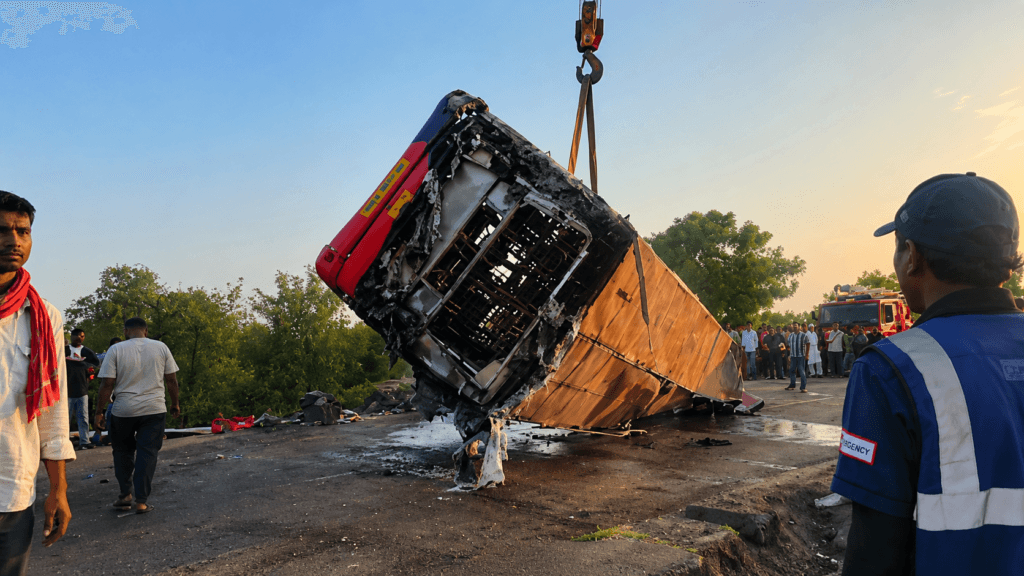
Rescue teams work at the Surat highway crash site after two Maharashtra ST buses and a tractor collided in a fatal accident near Uva-Manekpor village.
A devastating highway accident in Surat district on Tuesday left at least seven people dead and many others injured after two Maharashtra State Transport buses were involved in a high-impact collision near Uva-Manekpor village in Bardoli taluka. According to officials, the crash began when a bus traveling from Dhule to Surat hit a tractor in front of it, sending the vehicle across the central divider and into another Maharashtra ST bus coming from the opposite direction.
The force of the impact was so severe that one of the buses overturned multiple times, burst into flames, and rolled down an embankment. Around 15 injured passengers were rescued and taken to hospitals, while emergency teams continued searching for anyone trapped in the wreckage. The incident has once again raised urgent questions about highway safety, vehicle speed, visibility, and emergency response on busy interstate routes. Yeh accident bahut serious hai because it shows how quickly a road crash can turn into a mass-casualty disaster.
What Happened
Preliminary reports suggest that the first bus, which was traveling from Dhule to Surat via Navapur, collided with a tractor on the highway. The impact appears to have pushed the bus out of control. It crossed the central divider and crashed directly into another Maharashtra ST bus approaching from the opposite side.
That second collision created a chain reaction. One of the buses overturned several times, caught fire, and then rolled down an embankment. With flames spreading and passengers trapped inside, rescue became extremely difficult. Firefighters, police officers, and ambulance teams rushed to the spot and launched a large-scale operation to control the blaze and evacuate the injured. NDTV has covered the full story.
Officials have confirmed seven deaths so far, but the toll could rise because some of the injured are in serious condition. Around 25 to 26 passengers were traveling in one bus and 33 to 35 in the other, making the number of people affected significant. The fact that the buses were operating on a highway route with heavy traffic further complicated the situation.
Why the Crash Turned Deadly
The immediate cause appears to be the initial collision with the tractor. On highways, even a momentary loss of control can become catastrophic when a large vehicle crosses lanes or a divider. Once the first bus hit the tractor, the momentum, speed, and direction of the vehicle changed sharply, which likely caused it to veer into the opposite carriageway.
The presence of a divider does not always guarantee safety if a bus becomes uncontrollable at high speed. In this case, the bus appears to have been thrown into the path of another vehicle, turning one collision into two. The fire and overturning made the situation much worse, because trapped passengers had very little time to escape.
This is why highway crashes involving public transport vehicles often become mass emergencies. A bus carries many people, and any mechanical failure, driver error, sudden obstruction, or road hazard can affect dozens at once. When fire breaks out after the impact, the danger multiplies rapidly.
Rescue and Emergency Response
Fire brigade personnel, police, and ambulance teams arrived quickly and began rescue and relief work at the crash site. Firefighters battled the blaze while rescue workers searched the damaged buses for survivors and passengers trapped inside.
Officials said the flames made the operation more difficult because rescuers had to work around fire, smoke, and twisted metal. Even after passengers were pulled out, emergency teams continued checking the condition of those injured and arranging hospital transfers. Several injured people were shifted to different medical facilities for treatment.
The highway also saw a long traffic jam as vehicles were diverted and cleared away from the crash scene. This kind of delay is common after major accidents, especially when fire, debris, and an ongoing rescue operation block the road. In such situations, the priority shifts from traffic movement to life-saving response.
Background and Context
Large road accidents involving buses are especially tragic because they often affect passengers who have no control over the vehicle’s route or speed. Interstate buses also tend to travel long distances, often during early morning or late-night hours, when fatigue, visibility, and road conditions can become more dangerous.
This accident also highlights the risk posed by highway traffic mix in India, where heavy passenger buses, tractors, trucks, and smaller vehicles often share the same road space. When a slower-moving or uneven vehicle like a tractor is on a busy highway, the danger rises if surrounding traffic is moving fast or if visibility is poor.
Surat district is a major transit corridor, which means accidents there can disrupt not only local travel but also movement between states. Public transport buses on such routes carry families, workers, and daily commuters, making every crash a wider social tragedy rather than just a traffic incident.
Timeline
Tuesday, early movement on highway: A Maharashtra ST bus travels from Dhule to Surat via Navapur.
Initial impact: The bus collides with a tractor moving ahead of it.
Immediately after: The bus crosses the central divider and hits another Maharashtra ST bus.
After the second impact: One bus overturns several times, catches fire, and rolls down an embankment.
Rescue phase: Fire brigade, police, and ambulance teams arrive and begin a large-scale operation.
Current status: Seven deaths confirmed, around 15 injured rescued, and an investigation underway.
Also Read: 26-Year-Old Man Killed in Mangolpuri Over Family Dispute, Brother-in-Law on the Run
Why This Matters
This matters because road safety is not just about traffic rules; it is about lives lost in seconds. A single collision on a highway can kill multiple people, injure many more, and leave families shattered. When public transport vehicles are involved, the human cost becomes even larger.
It also matters because India continues to struggle with highway safety, especially on long routes where vehicles move fast and heavy traffic is common. If accidents like this keep happening, it becomes clear that better regulation, stronger enforcement, and more cautious driving are not optional—they are urgent. Yeh issue kaafi important hai because every such crash is a reminder that road safety is still one of the country’s biggest public concerns.
The impact also goes beyond the victims. Such tragedies place heavy pressure on hospitals, police, fire services, and local administration. They also expose the fragility of emergency response systems when multiple passengers are trapped and conditions are rapidly worsening.
India Angle
The India angle here is strong because this is exactly the kind of accident that affects ordinary travelers across the country. Maharashtra ST buses carry people across state routes every day, and Gujarat highways are key transit corridors for labor, business, and family travel. A crash like this can happen to anyone using inter-state public transport.
In Hinglish, the seedhi baat yeh hai: a highway पर एक galat moment poori bus ko danger mein daal sakta hai. That is why drivers, transport departments, and highway authorities all have to treat safety as a constant priority. For Indian readers, the story feels familiar because road accidents remain one of the most common and heartbreaking forms of sudden loss.
It also reminds us that public transport safety is a national issue. When buses are overcrowded, roads are shared by slow and fast vehicles, and emergency response is delayed by traffic congestion, the risk becomes much higher. India cannot afford to treat these accidents as routine news.
Analysis
My opinion is that the most concerning part is the chain-reaction nature of the crash. A collision with a tractor should not normally lead to a divider crossing and another head-on impact unless speed, road conditions, or control failure made the situation worse. That is why the investigation into the exact cause will matter so much. The authorities need to determine whether the tractor was improperly positioned, whether the bus was speeding, whether the driver reacted late, or whether some mechanical issue played a role. Until that is known, the focus should stay on the victims, but the lessons must extend to highway planning and bus safety enforcement.
What Next
The next step will be a detailed investigation by police and transport authorities to establish exactly how the crash unfolded. Officials will likely examine vehicle damage, witness statements, road conditions, and any available CCTV or dashcam evidence from the highway.
Victim identification will also continue, along with hospital monitoring for the injured passengers. If any of the seriously injured cases worsen, the death toll could rise further. Authorities may also review whether the stretch of highway needs better signage, traffic enforcement, or safety barriers to prevent similar accidents in the future.
There may also be administrative follow-up if the buses or the tractor were found to have violated road rules. In the coming days, families will be waiting for answers, while investigators try to piece together the full sequence of events.
Conclusion
The Surat highway crash is a heartbreaking reminder of how quickly a routine road journey can turn into a mass tragedy. Seven lives have already been lost, and several others remain injured after two Maharashtra ST buses and a tractor collided in a deadly sequence that ended in fire and chaos.
As rescue work continues and the investigation moves forward, the focus must remain on the victims and their families. But this accident also sends a broader message: highway safety in India still needs urgent attention. Better enforcement, safer driving, and stronger transport planning are not just policy points—they are lifesaving necessities.
Written By A. Jack