Delhi has launched a major Water Rationalisation Project based on a new government survey which shows sharp variations in per capita water supply in Assembly constituencies. The study reveals that some densely populated areas are getting far less water per person than smaller constituencies, underscoring a long-standing imbalance in the water distribution system for the capital.
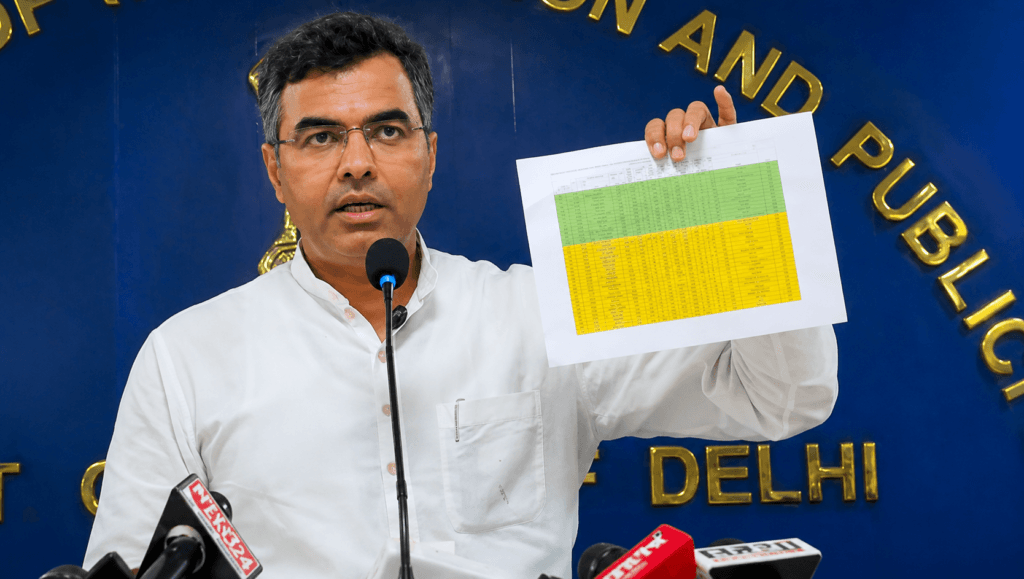
Delhi’s new water rationalisation plan seeks to address uneven supply across the city following a survey that found major disparities between constituencies.
The Delhi government has launched a fresh push to fix unequal water distribution across the capital after a Delhi Jal Board survey revealed a striking mismatch between population size and water supply in several Assembly constituencies. The findings show that some of the city’s most populated areas are receiving much less water per person than smaller constituencies, creating a serious equity issue for residents.
Water Minister Parvesh Verma said the government is now working on a Water Rationalisation Project to rebalance supply based on population, demand, and infrastructure. The plan comes at a time when water scarcity, leakage losses, and summer complaints remain persistent problems across Delhi. Yeh issue kaafi important hai because it affects everyday life, from cooking and bathing to sanitation and public health.
What the Survey Found
The survey mapped water availability across Delhi’s 70 Assembly constituencies and found wide differences in per capita supply. In several densely populated areas, residents are receiving much lower quantities of water per day compared with constituencies that have fewer people.
Among the constituencies receiving relatively lower supply were Karawal Nagar, Badli, Kirari, and Burari. Karawal Nagar, with a population of around 5 lakh, gets 4.7 million gallons per day, which works out to about 42.73 liters per person daily. Badli, with around 5.5 lakh residents, receives 6.5 MGD, or 53.73 liters per person. Kirari, home to about 6.6 lakh people, gets 8.5 MGD, translating to 58.55 liters per capita per day. Burari, with around 9 lakh residents, receives 12.5 MGD, or 63.14 liters per person. NDTV has covered the full story.
In contrast, some smaller constituencies are receiving much higher per capita supply. Rohini gets 13.73 MGD for about 2.75 lakh residents, which equals 227.3 liters per person per day. Matia Mahal receives 12.3 MGD for about 2.58 lakh people, or 216.73 liters per capita per day. Chandni Chowk gets 9.9 MGD for around 2.10 lakh residents, or 214.31 liters per person daily. Rajendra Nagar receives 10.6 MGD for roughly 2.4 lakh residents, which comes to 200.78 liters per person.
Why the Gap Exists
The government says the imbalance is not a new problem. According to Minister Verma, the same constituencies keep generating the bulk of water-related complaints every summer. That suggests the issue is structural rather than seasonal alone.
One reason is likely a mix of old planning assumptions, unequal infrastructure, and uneven network efficiency. In a city as complex as Delhi, water supply does not depend only on how many people live in an area. It also depends on pipeline strength, local demand patterns, pumping systems, storage capacity, and leakage levels. If the network is outdated or poorly balanced, some zones receive too much while others receive too little.
The minister said the new project will use a scientific approach to assess population density, demand, supply levels, and infrastructure availability. In simple terms, the government is trying to move away from patchwork distribution and toward a more data-driven system. That sounds logical, because water planning should follow actual need, not just legacy arrangements.
The 30-Year Pipeline Problem
A major concern highlighted by the government is the age of Delhi’s water distribution network. Officials said that out of the city’s 16,634-kilometer water distribution network, nearly 5,500 kilometers of pipelines are more than 30 years old. That is a huge amount of aging infrastructure.
Old pipelines are more likely to leak, break down, or allow contamination. They also waste treated water before it reaches consumers. In other words, Delhi may already be losing a significant amount of usable water just because of infrastructure failure. That is why the government is now prioritizing the replacement of old lines and strengthening the system.
The logic here is straightforward. If water is being produced but not delivered efficiently, then the problem is not only production capacity. It is also distribution loss. Replacing pipelines, reducing leakages, and modernizing the system can improve supply without necessarily requiring large new sources of water. That makes this reform both practical and necessary.
Cutting Non-Revenue Water
Along with pipeline replacement, the Delhi Jal Board is also focusing on reducing Non-Revenue Water, or NRW. This refers to treated water that is lost through leakages, theft, or inefficiencies before reaching consumers.
This is one of the biggest hidden problems in urban water systems. Water may be treated, pumped, and paid for, but if it leaks out or is diverted, the system loses both quantity and money. Officials believe reducing NRW could significantly improve availability even without increasing total production. That is a smart policy angle because it targets waste before demanding more resources.
For residents, this could mean better pressure, fewer supply shortages, and more reliable water flow over time. For the government, it could mean better use of existing assets. For Delhi as a whole, it could reduce the summer cycle of complaints and emergency fixes.
DSB Canal Plan
Another major proposal under review is converting the open DSB Canal system into a closed pipeline-based network. According to the minister, nearly 40 to 45 per cent of water is currently lost through the canal system. That is an enormous loss level for any city.
To examine the feasibility of this shift, IIT Roorkee has been engaged to conduct a study. If the canal system is converted into pipelines, the government expects water losses to fall sharply and supply efficiency to improve. This is important because open channels are harder to protect, harder to monitor, and more vulnerable to evaporation, seepage, and contamination.
A closed pipeline system would likely be more efficient, though it could also require major investment and technical planning. Still, if the feasibility study confirms the benefits, this could become one of the most important water reforms in Delhi in years.
Recycled Water and Dual Piping
The government is also pushing a long-term shift toward a Dual Piping System. Under this model, highly treated recycled water would flow through a separate network for non-drinking uses such as toilet flushing, horticulture, landscaping, construction, and vehicle washing.
Freshwater would be reserved mainly for drinking and household use. This is a modern water-management approach already used in several global cities, and it makes sense for Delhi too. If nonpotable tasks can be shifted to recycled water, the pressure on the drinking water supply will reduce.
This is especially relevant in a city where every drop matters. Delhi faces high demand, uneven distribution, and infrastructure loss all at once. A dual network could help stretch resources further and reduce waste. It may not solve everything immediately, but it is the kind of policy that can create long-term resilience.
Also Read: Delhi Hikes Crop Loss Compensation by Over 50%, 10,000 Farmers to Get Relief
Background and Timeline
Delhi’s water issues have been building for years, especially during summer when demand rises sharply. Residents in several constituencies have long complained about low pressure, irregular supply, and tanker dependence. The new survey now gives official data to what many households have been experiencing for a long time.
Timeline
Past years: Residents in multiple constituencies complain of low water supply every summer.
Recent months: Delhi Jal Board conducts a constituency-wise survey of supply and demand.
Survey results: Major disparities in per capita water availability are found across constituencies.
Current announcement: The Delhi government launches a Water Rationalisation Project.
Next phase: Authorities plan scientific assessment, pipeline replacement, and possible canal reform.
Why This Matters
This matters because water is not just another utility. It is a basic necessity tied to health, hygiene, schooling, work, and dignity. When some areas get much less water per person than others, the result is inequality in daily life.
It also matters because Delhi is a city of contrasts. Some neighborhoods are water-rich while others struggle to meet basic needs. That imbalance creates frustration, political pressure, and social unfairness. If the government can fix this, it would improve both service delivery and public trust. Yeh issue kaafi important hai because water access is one of the clearest tests of urban governance.
The broader impact goes beyond Delhi too. Other Indian cities face similar problems with old pipelines, leakage, and uneven supply. If Delhi’s rationalization project works, it could become a model for better urban water planning elsewhere in India.
India Angle
The India angle here is strong because unequal water access is a major issue in many Indian states and cities. From metro cities to semi-urban belts, residents often deal with shortages, tanker dependence, and infrastructure failure. Delhi’s case is especially visible because it is the national capital and a policy showcase.
In Hinglish, seedhi baat yeh hai: agar ek area ko 40 litres mil rahe hain aur doosre ko 200 litres se zyada, toh system fair nahi lagta. That kind of imbalance creates resentment and everyday hardship. For Indian readers, this story is important because it reflects a larger question of fairness in public services.
It also connects to climate stress and urban growth. As populations rise and summers get harsher, cities can no longer depend on old water systems. Better planning, leak control, and recycled water use are becoming necessities, not luxuries.
Analysis
My opinion is that the government is finally addressing the right problem. For years, public debate around water in Delhi has focused too much on shortages alone. But this survey shows that distribution fairness and infrastructure efficiency are equally important. If a dense constituency is getting far less water than a smaller one, the answer is not just to produce more water — it is to redesign the system. The challenge, of course, will be implementation. Rationalization sounds good on paper, but changing entrenched distribution patterns is politically and technically difficult. Still, this is the right direction, especially if the government backs it with real data, pipeline upgrades, and measurable targets.
What Next
The next step will be a detailed review of constituency-wise demand and infrastructure before any redistribution changes are made. The government will likely need to identify which areas can be rebalanced quickly and which require major network upgrades.
If the old pipelines are replaced and the canal-to-pipeline study supports the plan, Delhi could see more stable water supply over time. The dual piping idea may also move forward as part of a long-term conservation strategy. The real test will be whether the same constituencies that now complain every summer see visible improvement in the coming months.
There will likely be political scrutiny too, because water distribution is always a sensitive issue in Delhi. Residents will want to know whether the new plan actually changes supply on the ground. That makes monitoring and transparent communication very important.
Conclusion
Delhi’s Water Rationalization Project is a significant step toward fixing one of the capital’s most persistent urban problems. The survey has made the imbalance clear: some densely populated constituencies receive far less water per person than smaller areas with much higher supply levels.
By focusing on scientific planning, pipeline replacement, leakage reduction, and recycled water, the government is trying to address both fairness and efficiency. That is the right approach. In the long run, Delhi will not become water secure just by producing more water. It will become water secure when the system distributes what it already has more fairly and more efficiently.
Written By A. Jack