A Dubai-to-Mumbai IndiGo flight carrying 194 passengers and crew made an emergency landing at Rajkot International Airport on Monday after smoke was detected in the cargo hold area. Officials said the aircraft landed safely, all passengers were evacuated without injury, and the airline’s technical team is now inspecting the plane.
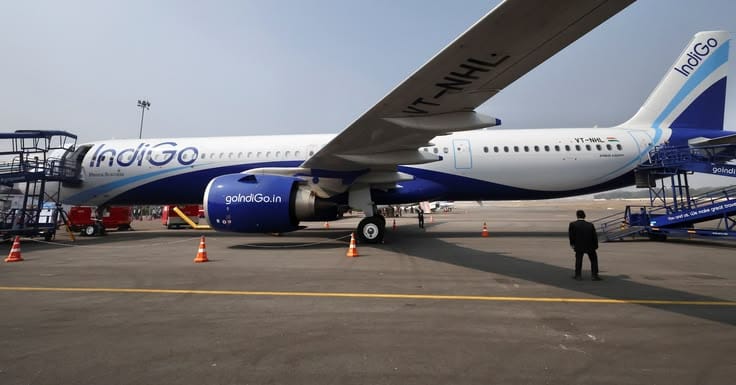
This Image is only an illustration.
A Dubai-Mumbai IndiGo flight carrying 194 people onboard made an emergency landing at Rajkot International Airport in Gujarat on Monday after smoke was detected in the cargo hold area. Airport authorities confirmed that the aircraft was diverted as a precautionary measure after the pilot reported the issue to Air Traffic Control.
The plane landed safely at 3:27 pm after an emergency was declared at 2:45 pm. Officials said all passengers and crew were evacuated without injuries, and the airline’s technical team arrived at the airport to investigate the cause of the smoke. The situation was brought under control quickly, preventing what could have become a more serious aviation scare.
What happened onboard
According to the airport management, Flight IGO 1452 from Dubai to Mumbai was diverted to Rajkot after smoke was noticed in the cargo hold area of the aircraft. In aviation, any sign of smoke is treated with utmost seriousness because it may indicate overheating, an electrical fault, or a potential fire risk.
Inspector KP Taretiya of the Airport Police Station said the pilot informed Air Traffic Control and requested permission for an emergency landing at Rajkot. He explained that the pilot suspected smoke inside the aircraft and landed there as a precaution. The aircraft touched down safely, and the passengers were moved to a designated area inside the terminal. This story was also covered by Telegraph India.
Taretiya also clarified that there was no fire in the aircraft. That is a crucial detail because it suggests the response was preventive rather than reactive. In simple terms, the crew acted quickly before the situation could escalate. Yeh issue kaafi important hai because aviation safety depends on fast decisions and strict protocols.
Why the landing was diverted
The diversion to Rajkot was the safest operational choice once smoke was suspected. Airlines and pilots are trained to prioritize the nearest suitable airport when there is any sign of risk in the cabin or cargo area. Even if the smoke turns out to be minor or unrelated to fire, the standard approach is to land first and investigate later.
That is why the aircraft did not continue to Mumbai. The decision reflects aviation caution, where avoiding risk is more important than staying on schedule. In a situation like this, safety always comes before passenger convenience or flight timing.
The fact that the aircraft landed without any injury suggests that emergency procedures were followed properly. Passengers were evacuated calmly, and the technical team began checking the plane soon after landing. That sequence shows how airport and airline teams work together in real time during a mid-air concern.
Official statements
The airport management said the flight was diverted after smoke was detected in the cargo hold area, and an emergency was declared shortly before landing. The aircraft landed safely, and all passengers were evacuated without injuries.
Police officer KP Taretiya said, “The pilot suspected smoke inside the aircraft and, as a precautionary measure, made an emergency landing at the Rajkot airport. The aircraft landed safely.” He added that the airline’s technical team had reached the airport and was inspecting the aircraft, and that there was no fire onboard.
Those remarks matter because they distinguish between suspicion and confirmed danger. At this stage, the incident appears to have been handled as a precautionary emergency rather than a full-scale aircraft fire. That gives some reassurance, even as the technical investigation continues.
Background and context
Emergency landings happen in aviation for several reasons, including technical faults, medical emergencies, fuel issues or suspicious smells and smoke. In most cases, pilots are trained to act quickly and avoid taking unnecessary risks once a warning sign appears.
Cargo hold smoke alerts are taken especially seriously because cargo areas can be harder to inspect during flight. Even a small issue can become dangerous if ignored. That is why airlines often divert aircraft to the nearest airport that can safely handle the landing and inspection.
This incident comes at a time when passengers are highly alert to flight safety. Even without an actual fire, the word “smoke” triggers concern because it raises the possibility of damage to wiring, baggage, or systems located in the lower compartments of the aircraft. Aviation systems are designed to err on the side of caution, and this event is a good example of that principle in action.
Timeline
Before 2:45 pm: Flight IGO 1452 departs Dubai for Mumbai with 194 people onboard.
Around 2:45 pm: Emergency is declared after smoke is reported in the cargo hold area.
3:27 pm: The aircraft lands safely at Rajkot International Airport.
After landing: All passengers are evacuated without injuries.
Later: Airline technicians begin inspecting the aircraft to determine the cause of the smoke.
Also Read: Navi Mumbai International Airport Launches First International Flight to Abu Dhabi
Why this matters
This matters because aviation safety is built on fast response, not just final outcomes. A smoke alert in a flight could have become dangerous if the crew delayed action or tried to continue to Mumbai. The fact that the aircraft landed safely without injuries shows the system worked as intended.
It also matters for passengers because such incidents remind people how many layers of safety are built into air travel. Crew training, Air Traffic Control coordination, airport emergency response and technical inspections all played a role here. That combination is what prevents a precaution from becoming a tragedy.
For Indian travellers, especially those on busy domestic and international routes, this incident is a reminder that emergency diversions are not failures. They are often the reason a situation stays under control. In plain Hindi, safe landing ka matlab hai ‘the system did its job’.
India angle
For Indian readers, this is especially relevant because air travel in India has grown rapidly and route traffic is heavy on major corridors like Dubai-Mumbai. When something goes wrong on a flight entering Indian airspace, airports such as Rajkot become critical backup points. That makes regional airport readiness a national safety issue.
The story also reflects how Indian aviation has become more operationally mature. A pilot reports a concern, ATC clears an alternate airport, emergency services prepare, and passengers are evacuated safely. That is a strong example of coordinated crisis management.
There is also a local angle for Gujarat. Rajkot International Airport’s ability to handle the diversion quickly may reassure passengers and airlines about emergency readiness outside the biggest metro airports. That is a positive signal for India’s expanding aviation network.
Analysis
My opinion is that the most important part of this story is not the smoke itself, but the response. A properly handled precaution is exactly how aviation should work. The pilot’s decision to divert, the airport’s emergency declaration and the technical team’s inspection show a chain of safety action that likely prevented any escalation.
I also think this story should not be sensationalised. “Smoke in cargo hold” sounds alarming, but the reported absence of fire and the safe evacuation change the tone significantly. Readers need the facts, not fear. That is why the emphasis should be on the safe outcome and ongoing inspection.
What next
The next step will be the technical inspection of the aircraft by the airline’s team to determine what caused the smoke alert. Depending on the findings, the issue could range from a minor electrical or mechanical problem to a sensor-related false alert.
Passengers may be re-accommodated on another flight to Mumbai once the aircraft is cleared or once an alternative travel plan is arranged. The airline is also likely to issue a formal update once the investigation confirms the source of the smoke.
If the cause is identified as a technical fault, the aircraft may undergo maintenance before returning to service. If the alert was triggered by a non-critical issue, the incident may be logged as a safety precaution successfully handled by the crew. In either case, the focus remains on ensuring the plane is fully safe before it flies again.
Conclusion
The Dubai-Mumbai IndiGo flight’s emergency landing in Rajkot was a serious aviation incident, but one that ended safely. Smoke detected in the cargo hold triggered a prompt diversion, an emergency declaration and a smooth landing, with all 194 passengers and crew evacuated without injury.
This is a reminder that the safety systems in aviation are designed to act quickly when something looks wrong. The absence of fire and the lack of injuries are reassuring, but the technical investigation will still be important in understanding what triggered the alarm. For now, the key takeaway is clear: the situation was handled calmly, and the precaution worked.
Written By A. Jack