Jofra Archer, Josh Tongue and Ollie Robinson dismantle Pakistan’s fragile batting twice as Joe Root begins his second captaincy stint with a dominant three-day victory.
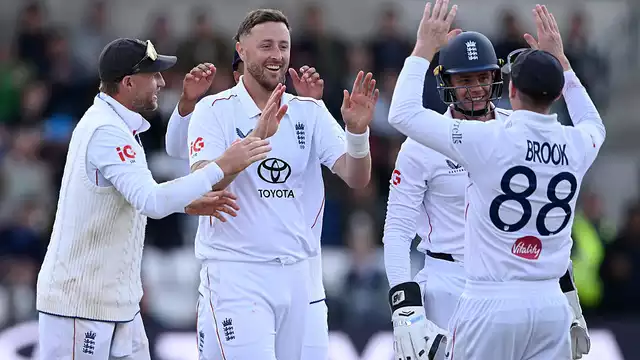
England players celebrate a wicket during the first Test against Pakistan at Headingley, Leeds. Image Credit: Cricbuzz
ENGvsPak 1st Test: England defeated Pakistan by an innings and 103 runs in the opening Test at Headingley, Leeds, on Friday, August 21, 2026, taking a 1-0 lead in the three-match series.
Pakistan were dismissed for just 171 in their first innings and then collapsed again for 135 in the second. England’s fast bowlers Jofra Archer, Josh Tongue and Ollie Robinson shared nine wickets in Pakistan’s second innings as the visitors were bowled out in only 37.3 overs.
The defeat exposed major weaknesses in Pakistan’s batting, which failed to withstand England’s pace attack in helpful Headingley conditions. England, meanwhile, completed their seventh consecutive Test win at the venue and gave Joe Root an outstanding start after his return as permanent captain.
How England Took Control
England won the toss and chose to field, allowing their seamers to exploit the early movement and cloud cover at Headingley. Pakistan never established a reliable first-innings platform and were bowled out for 171.
Josh Tongue and Ollie Robinson were the principal destroyers, taking five wickets each in Pakistan’s first innings. Their accuracy, movement off the pitch and ability to attack the stumps left Pakistan’s batters unable to build partnerships. This story was also covered by The Cricbuzz.
England responded with 409, creating a first-innings lead of 238 runs. Harry Brook top-scored with 91, while James Rew made 73, Joe Root contributed 66 and Dan Lawrence scored 51.
The hosts were eventually dismissed, but the lead had already placed Pakistan in an almost impossible position. To save the match, Pakistan needed to bat for two full days against a fresh and aggressive England attack.
Instead, the collapse continued.
Archer Strikes Immediately
Jofra Archer played an important role even before he began bowling. With England’s innings nearing its end, he scored quickly enough to push the home side’s lead beyond 200.
After England were bowled out for 409, Archer returned with the ball and struck in his very first over. He dismissed Imam-ul-Haq, immediately putting Pakistan under pressure in the second innings.
The early wicket meant Pakistan were again forced to rebuild from a difficult position. Shan Masood responded with several boundaries, attempting to counterattack rather than allowing Archer and England’s other quicks to settle into long spells.
But the approach brought only temporary relief.
Tongue and Robinson Break Pakistan
Ollie Robinson soon joined Archer among the wickets. Abdullah Shafique attempted to defend but edged the ball to second slip, leaving Pakistan vulnerable just before lunch.
Pakistan’s problems became worse after the interval. Josh Tongue removed Saud Shakeel and then dismissed Shan Masood and Salman Agha in the same over. That burst effectively ended Pakistan’s hopes of saving the Test.
The dismissals showed the difference between the two teams. England’s bowlers worked in partnerships, attacking the crease and maintaining pressure from both ends. Pakistan’s batters, by contrast, repeatedly gave away wickets while defending or attempting to force the scoring rate.
Mohammad Rizwan provided brief resistance and top-scored with 41, but the damage was already too extensive. Robinson added to his tally with further wickets, while Gus Atkinson finally dismissed Rizwan. Archer then returned to complete the innings in the 38th over.
Pakistan’s second innings lasted only 37.3 overs. Their combined total across both innings was 306, fewer than England’s first-innings score alone.
Scorecard Summary
| Team | Innings | Score |
|---|---|---|
| Pakistan | First innings | 171 all out |
| England | First innings | 409 all out |
| Pakistan | Second innings | 135 all out |
| Result | — | England won by an innings and 103 runs. |
Ollie Robinson finished the match with 8/80, while Josh Tongue also took eight wickets across the two innings. Archer claimed three wickets in the second innings, and Gus Atkinson took one.
Robinson was named Player of the Match for his match-winning bowling performance.
Statements and Reactions
The result marked a superb beginning to Joe Root’s second spell as England’s permanent Test captain. England’s all-seam attack delivered the kind of performance Root would have wanted in his first match back in charge.
Root was reportedly delighted with the effort and spoke positively about what the pace attack could achieve. England’s victory also marked their seventh successive Test win at Headingley, their longest winning sequence at any home venue.
The result was especially significant because it represented England’s first Test of the post-“Bazball” era. While the team still played positively with the bat, the defining feature of the victory was disciplined, conventional fast bowling rather than reckless aggression.
Pakistan’s side, meanwhile, faced criticism for producing two poor batting displays in the same match. The visitors were unable to respond to England’s seam movement and repeatedly lost clusters of wickets.
Headingley’s Fast-Bowling Challenge
Headingley is one of England’s most influential Test venues for fast bowlers. Its surface can offer movement through the air and off the pitch, particularly when there is moisture or cloud cover.
Teams batting first at Leeds often need to survive the opening spells before they can begin to score freely. England used those conditions perfectly. Tongue and Robinson extracted maximum value from the pitch, while Archer added speed and attacking energy.
Pakistan’s top order faced a difficult technical challenge. Batters needed to leave the ball carefully, play late and avoid chasing deliveries outside off stump. Instead, several players edged defensive shots or attempted risky counterattacks under pressure.
The match also showed the importance of batting depth. England’s middle order produced enough runs to take the score beyond 400, while Pakistan’s batting failed to provide even one substantial innings in either effort.
Also Read: IND vs SL 1st Test: Manav Suthar’s 10-Wicket Haul Powers India to 165-Run Win in Galle
Timeline
August 19, 2026: The First Test between England and Pakistan begins at Headingley, Leeds.
Pakistan’s first innings: England’s seamers dismiss Pakistan for 171; Josh Tongue and Ollie Robinson take five wickets each.
England’s response: Harry Brook scores 91, James Rew 73, Joe Root 66 and Dan Lawrence 51 as England reach 409.
England’s lead: The hosts establish a 238-run first-innings advantage.
Pakistan’s second innings begins: Jofra Archer dismisses Imam-ul-Haq in his first over.
Middle-order collapse: Robinson removes Abdullah Shafique, while Tongue dismisses Saud Shakeel, Shan Masood and Salman Agha.
Pakistan’s late resistance: Mohammad Rizwan tops the scores with 41, but Gus Atkinson and Robinson continue the collapse.
Final wicket: Archer completes the innings in the 38th over as Pakistan are bowled out for 135.
Result: England win by an innings and 103 runs and lead the series 1-0.
Why This Matters
Yeh result kaafi important hai because it gives England a powerful start in a three-Test series and exposes Pakistan’s major batting concerns.
England leads 1-0: The hosts now need only one more victory to secure the series.
Headingley dominance: England have won seven consecutive Tests at the venue, reinforcing their exceptional home record there.
Pace-bowling strength: Robinson, Tongue and Archer showed that England have variety, control and wicket-taking ability.
Pakistan’s batting crisis: Scoring 171 and 135 in consecutive innings suggests technical and mental weaknesses, not just bad luck.
World Test Championship points: The win gives England valuable points in the 2025–27 World Test Championship cycle.
For Pakistan, the immediate priority is not simply changing one batter. The team needs a clearer plan for playing high-quality seam bowling in English conditions.
India Angle
Indian fans will recognise many of the challenges Pakistan faced. Asian teams touring England often struggle when the ball moves late, especially if their batters are accustomed to playing more spin-friendly conditions at home.
The match offers several lessons for India and other South Asian teams:
Leave the ball consistently outside the off stump.
Avoid aggressive strokes before settling at the crease.
Build partnerships rather than relying on individual counterattacks.
Prepare for short, high-intensity spells from fast bowlers.
Select technically reliable batters for seaming conditions.
Pakistan’s collapse will be closely watched by Indian cricket analysts because India’s own overseas success has often depended on surviving the opening spells. Headingley has once again shown that England’s fast bowlers can turn a Test within a session.
Agar Asian teams England mein early movement ko handle nahi kar paayengi, toh big totals banana bahut mushkil ho jayega.
Analysis
England’s batting was strong, but Pakistan’s repeated collapses were the decisive factor. England scored 409 after bowling Pakistan out for 171. Once the hosts had a lead of 238, the match was effectively under their control.
The most worrying aspect for Pakistan was the lack of resistance in the second innings. A team can lose wickets against a strong attack, but the batting unit must still create one major partnership. Pakistan never managed that.
For England, the victory demonstrates that the side can play forceful Test cricket without depending entirely on the old Bazball template. The bowling attack was aggressive but also patient, repeatedly asking Pakistan’s batters to play difficult deliveries.
The second Test will reveal whether Pakistan can respond or whether England’s dominance continues.
What Next
The second Test will be important for both teams.
Pakistan selection review: The visitors may consider changes to the top order or middle order after two poor batting efforts.
Technical preparation: Pakistan’s batters will need to work on leaving the ball, playing late and handling short spells from Archer and Tongue.
England’s confidence: Root’s side will be keen to maintain momentum and take a 2-0 lead.
Bowling continuity: England may retain the same pace attack because Robinson, Tongue and Archer were highly effective.
Series pressure: Pakistan must win the second Test to prevent England from securing the series with a match to spare.
Weather and conditions: The next venue may offer different conditions, giving Pakistan an opportunity to reset their approach.
Conclusion
England have taken a 1-0 lead in the Pakistan series after a ruthless innings-and-103-run victory at Headingley.
Pakistan’s batting failed twice, with totals of 171 and 135, while England’s pace attack dominated from start to finish. Jofra Archer, Josh Tongue and Ollie Robinson shared nine wickets in the second innings, and Robinson finished with outstanding match figures of 8/80.
Joe Root’s return as captain could not have begun better. England have won seven straight Tests at Headingley and now look well placed to control the series.
Pakistan, however, faces an urgent batting rethink. Unke liye second Test sirf series bachane ka mauka nahi, balki batting confidence wapas laane ka bhi test hoga.
Written By A. Jack