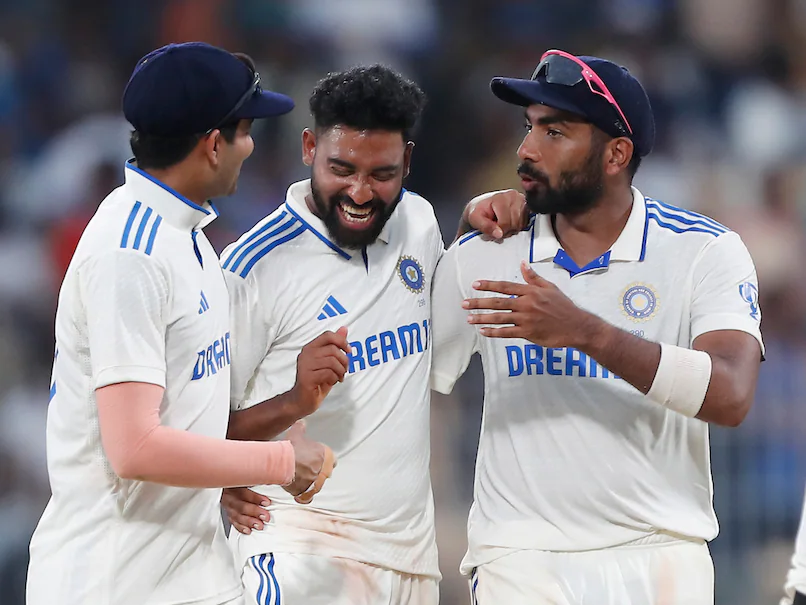
Young left-arm spinner Manav Suthar takes 10/131 in only his second Test as India bowl Sri Lanka out for 206, taking a 1-0 lead in the two-match series.
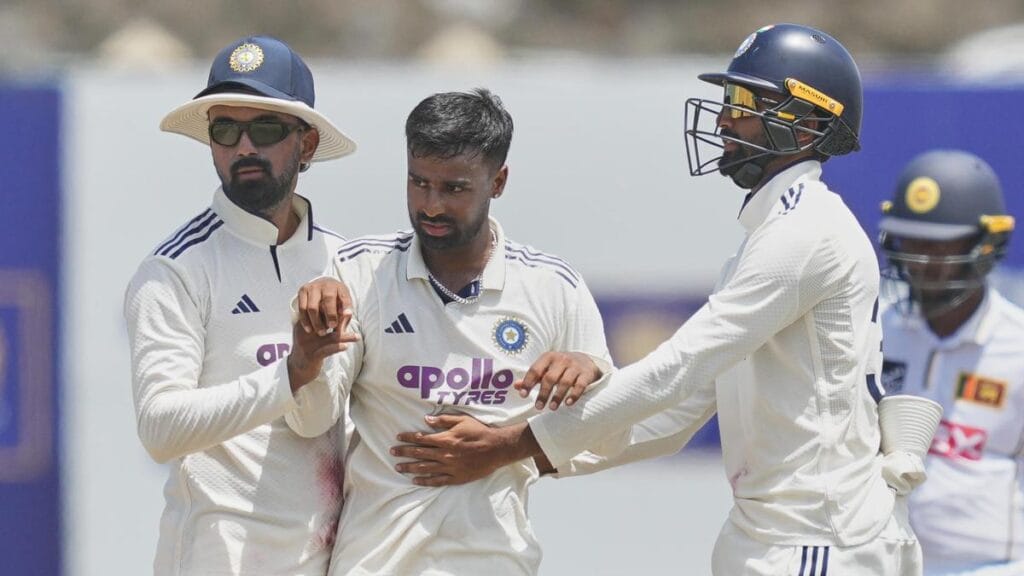
India’s Manav Suthar celebrates a wicket during the first Test against Sri Lanka at Galle International Stadium. Image Credit: The Hindu
Galle Test: The victory was powered by Manav Suthar’s first 10-wicket match haul in Test cricket. The 24-year-old left-arm spinner claimed 6/55 in Sri Lanka’s second innings and finished with 10/131 across the match in only his second Test appearance.
Sri Lanka, set a daunting target of 372 after India’s second innings, were bowled out for 206 in 77.4 overs. Dhananjaya de Silva made 59 and Sonal Dinusha scored 84, but their resistance was not enough to stop India from completing a comprehensive win shortly before heavy rain arrived in Galle.
How India Won the Galle Test
India’s 165-run victory was built over five days through superior batting, a crucial first-innings lead, aggressive second-innings scoring and disciplined spin bowling.
The visitors made 462 in their first innings, putting Sri Lanka under pressure immediately. Devdutt Padikkal’s 167 was the centrepiece of that total, while other Indian batters ensured that the side crossed 450 and created a strong platform.
Sri Lanka responded with 284, conceding a first-innings deficit of 178 runs. Sonal Dinusha’s century and Niroshan Dickwella’s 80 helped the hosts recover from a difficult position, but India’s bowlers prevented them from getting close to the visitors’ total. This story was also covered by TheHindu.
India then scored 193 in their second innings. Rishabh Pant’s counterattacking 66, along with useful contributions from Padikkal and KL Rahul, gave the visitors enough runs to set Sri Lanka a target of 372.
A 372-run chase at Galle was always going to be extremely difficult, particularly on a final-day surface offering increasing assistance to spin. Sri Lanka began Day 5 at 84/4 and needed another 288 runs, while India needed six wickets.
The hosts fought through Dhananjaya de Silva and Dinusha, but Suthar broke the resistance and cleaned up the lower order. His three wickets in the 76th over tilted the contest decisively, and he took the final wicket in the 78th over to end Sri Lanka’s innings at 206.
Suthar’s Match-Winning Spell
Manav Suthar was the clear hero of India’s victory.
The Rajasthan left-arm spinner took 4 wickets in Sri Lanka’s first innings and followed it with 6/55 in the second innings. His match figures of 10/131 came from 45.2 overs of sustained, disciplined bowling.
Suthar did not rely only on a sharp turn. He used flight, changes in pace, angle from over and around the wicket, and relentless accuracy to pressure Sri Lanka’s batters. On a Galle pitch that was not always unplayable, that control was decisive.
His second-innings wickets came at crucial moments:
He removed key batters as Sri Lanka attempted to survive the final day.
He broke partnerships that were beginning to give the hosts hope.
He ran through the tail shortly before rain could have saved Sri Lanka from defeat.
Suthar’s 6/55 was his second five-wicket haul in only his second Test. The performance has immediately placed him among India’s most exciting red-ball prospects.
Former India batter Cheteshwar Pujara has urged Suthar not to change his strengths by rushing toward white-ball cricket, arguing that he has the qualities to become a long-term Test specialist.
Sri Lanka’s Resistance Falls Short
Sri Lanka began the final day in trouble at 84/4, but Dhananjaya de Silva and Sonal Dinusha showed strong resistance. De Silva made 59, while Dinusha followed his first-innings century with 84 in the second innings. The pair kept Sri Lanka alive for much of the morning session and delayed India’s victory.
Dinusha’s performance across both innings was one of the few major positives for Sri Lanka. He made 100 in the first innings and 84 in the second, showing temperament and skill under pressure.
However, Sri Lanka’s middle and lower orders could not convert that resistance into a match-saving effort. Once Suthar found his rhythm, the wickets fell quickly.
Prasidh Krishna supported Suthar with 2/16, while Ravindra Jadeja also took 2/16 in the second innings. India’s spinners together accounted for 15 of Sri Lanka’s 20 wickets across the Test, underlining their control in Galle’s spin-friendly conditions.
Key Performances
| Player | Performance | Match impact |
|---|---|---|
| Manav Suthar | 10/131; 6/55 in second innings | Match-winning left-arm spin |
| Devdutt Padikkal | 167 in first innings | Built India’s decisive first-innings platform |
| Rishabh Pant | 66 in second innings | Lifted target to 372 with aggressive scoring |
| Sonal Dinusha | 100 and 84 | Sri Lanka’s standout batter |
| Dhananjaya de Silva | 59 in second innings | Led final-day resistance |
| Prasidh Krishna | 2/16 in second innings | Supported Suthar in the final push |
| Ravindra Jadeja | 2/16 in second innings | Maintained pressure and assisted spin attack |
Statements and Reactions
The result is a major personal breakthrough for Suthar, who has now become the latest Indian bowler to take 10 wickets in a Test match.
Reports after the match described his performance as a “spin masterclass”, particularly because he was able to maintain pressure despite Sri Lanka’s Dhananjaya de Silva and Sonal Dinusha showing significant resistance.
The timing of India’s victory was also dramatic. Suthar completed the final dismissal only minutes before a heavy downpour arrived, which could have created a frustrating weather interruption had Sri Lanka still been batting.
For Shubman Gill’s side, the win was a complete team performance. Padikkal’s runs gave India a first-innings advantage, Pant accelerated in the second innings, and Suthar finished the job with the ball.
India’s Galle Challenge
The Galle International Stadium is one of the most recognisable Test venues in world cricket. Fringed by the historic Dutch fort and the Indian Ocean, the ground is as visually striking as it is demanding for visiting teams.
The surface often rewards patient batting early in the match before offering more turn and variable bounce later. Winning in Galle typically requires a team to adapt quickly to spin, manage the first innings well and exploit the final-day conditions.
India did exactly that.
By scoring 462 first up, India placed Sri Lanka under pressure. Their 178-run first-innings lead meant that even a modest second innings would create a difficult chase.
The visitors then used Suthar and Jadeja’s left-arm spin combination to exploit the conditions. Sri Lanka’s inability to match India’s first-innings batting depth ultimately proved the difference.
Timeline
Day 1–2: India build a strong first innings, reaching 462, led by Devdutt Padikkal’s 167.
Sri Lanka’s first innings: Hosts make 284, with Sonal Dinusha scoring 100 and Niroshan Dickwella contributing 80; India take a 178-run lead.
India’s second innings: India are bowled out for 193, with Rishabh Pant scoring a rapid 66; Sri Lanka are set a target of 372.
End of Day 4: Sri Lanka finish at 84/4, needing 288 more runs; India require six wickets.
Day 5 morning: Dhananjaya de Silva and Sonal Dinusha resist, but India keeps applying pressure.
Late Day 5: Suthar takes three wickets in the 76th over and claims the final wicket in the 78th over.
Match result: Sri Lanka are bowled out for 206; India win by 165 runs and lead the series 1-0.
Next Test: The second Test begins in Colombo on August 23.
Also Read: Galle Test Day 4: India Need Six Wickets for Victory After Setting Sri Lanka 372
Why This Matters
Yeh win kaafi important hai because India has taken early control of a two-Test away series.
Series lead: India now lead 1-0 and need only avoid defeat in Colombo to secure the series.
Suthar’s arrival: A 10-wicket haul in just his second Test suggests India may have found another serious red-ball spin option.
Batting depth: Padikkal’s 167 and Pant’s 66 showed that India have multiple players capable of changing a Test from different situations.
Sri Lanka’s challenge: Sri Lanka must find a way to support Dinusha and improve their top-order batting before the Colombo Test.
Spin balance: India’s spinners took 15 of 20 Sri Lankan wickets, proving that their combination is well suited to subcontinental Test conditions.
The result is not simply a victory. It is a statement that India’s newer Test group can win overseas in conditions that require patience, skill and tactical clarity.
India Angle
For Indian cricket fans, Suthar’s performance offers a promising future narrative.
India has long relied on experienced spinners such as Ravindra Jadeja and Ravichandran Ashwin in subcontinental Tests. Suthar’s emergence provides an option for the next phase of the side’s red-ball transition.
At 24, Suthar has the time to develop his game further. His ability to bowl long spells, use flight and maintain control makes him especially valuable in Tests.
Padikkal’s 167 is another encouraging sign. His first major Test innings helped define the game, while Pant’s aggressive 66 showed why he remains such a high-impact player in the middle order.
Yeh victory isliye bhi special hai because it did not depend on one senior player alone. It was a team win built around a young spinner, a relatively new middle-order batter and an attacking wicketkeeper-batter.
Analysis
India followed a near-perfect Galle template:
Score big in the first innings.
Build a substantial lead.
Set a psychologically difficult fourth-innings target.
Attack with spin and avoid giving the opposition easy scoring options.
The only area India may review is their second-innings batting. A total of 193 was enough because of the 178-run lead, but Sri Lanka’s bowlers did find ways to take wickets. In Colombo, India will want more consistency if conditions are less spin-friendly.
Sri Lanka, meanwhile, must address their top-order batting. Dinusha and Dhananjaya offered resistance, but the hosts cannot keep recovering from early collapses. Against India’s spin attack, their top order needs to show better decision-making and stronger defensive discipline.
What Next
The cricketing focus now shifts to Colombo, where the second Test begins on August 23.
India’s selection question: India may retain the same winning combination, especially after Suthar’s 10-wicket haul.
Sri Lanka’s batting rethink: The hosts need stronger top-order contributions and may consider changes to their batting combination.
Pitch factor: Colombo’s surface will determine whether India again uses multiple spinners or adds pace options.
Series scenario: India lead 1-0; Sri Lanka needs a win to level the series, while a draw or victory will secure the series for India.
Suthar watch: All eyes will be on whether the young left-arm spinner can reproduce his Galle form in the next Test.
Conclusion
India’s 165-run win in Galle was shaped by several key performances, but Manav Suthar’s 10-wicket haul will be remembered as the defining story of the Test.
The left-arm spinner’s match figures of 10/131, including 6/55 in the second innings, turned Sri Lanka’s final-day resistance into a decisive Indian victory.
Devdutt Padikkal’s 167 laid the foundation, Rishabh Pant’s 66 set the match beyond Sri Lanka’s reach, and India’s bowlers completed a disciplined finish.
India now carries a 1-0 lead into the Colombo Test. Ab dekhna yeh hai ki kya Suthar’s Galle magic continues and whether Shubman Gill’s side can convert this strong start into a series win.
Written By A. Jack