Messi’s historic goal was the icing on the cake of a controlled performance from Argentina who also scored in the first half through Giovani Lo Celso and Lautaro Martinez. The win established Argentina as one of the best in form teams in the tournament going into the knockouts.
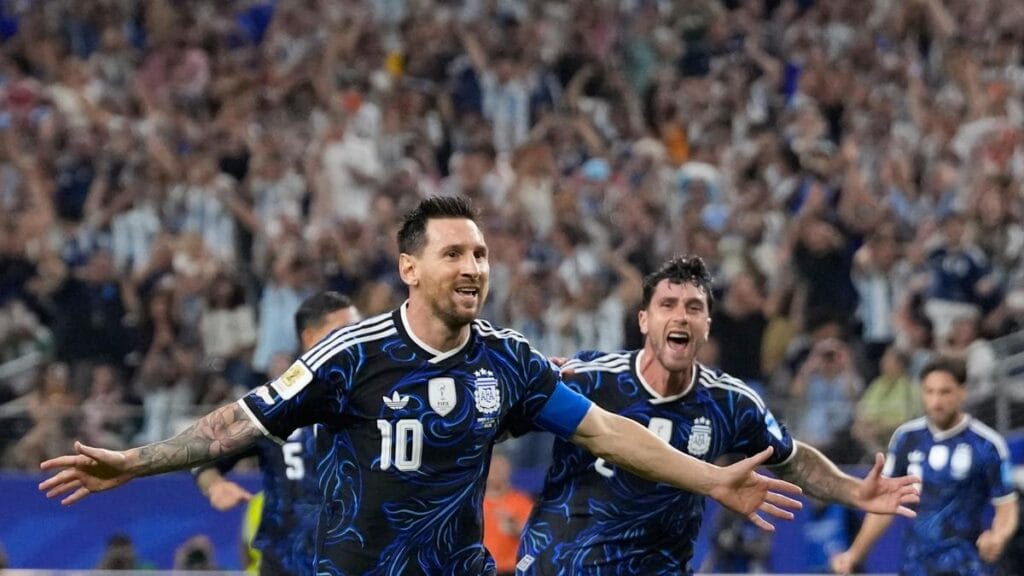
Lionel Messi celebrates after scoring a free kick in Argentina’s 3-1 win over Jordan at Arlington. Image Credit: The Hindu
Argentina beat Jordan 3-1 on Saturday, June 27, 2026, in Arlington, Texas, to finish top of Group J and continue their perfect run in the FIFA World Cup 2026. The match became a major individual and team moment when Lionel Messi, used as a second-half substitute, scored from a free kick and became the first player ever to score in seven consecutive World Cup appearances. Giovani Lo Celso and Lautaro Martinez had already given Argentina a commanding first-half lead before Messi added the final touch.
This was a game that summed up why Argentina remain one of the tournament favorites. They were organized, clinical and calm under pressure, and they had enough talent to decide the match well before the final whistle. Jordan competed bravely, but the difference in quality was clear in the key moments. In a World Cup, yeh issue kaafi important hai because group toppers often carry the strongest momentum into the knockout rounds.
How Argentina Won
Argentina controlled the match through a blend of possession, movement and sharp finishing. The first-half goals from Giovani Lo Celso and Lautaro Martinez set the tone early, giving Argentina a cushion and forcing Jordan to chase the game. That early advantage was crucial because it allowed Argentina to manage the second half without panic. The Hindu has covered the full story.
Once Messi entered the match, the atmosphere shifted immediately. Even as a substitute, he remained the focal point of attention, and his free-kick goal turned the game into a historic night. The goal itself was more than just a highlight. It was a record-breaking moment that underlined Messi’s longevity and ability to deliver on the biggest stage.
Argentina did not need to overextend. They had already established control, and by the time Messi scored, the result was effectively settled. That is the mark of a strong tournament team: score early, manage the middle phase and finish with authority. Argentina did exactly that.
Messi’s Historic Record
Messi’s achievement is the headline that will travel far beyond this match. By scoring in seven consecutive World Cup appearances, he has set a record that reflects both brilliance and consistency. World Cup history is full of great players, but records like this are rare because they require not just talent, but longevity and the ability to remain decisive across different tournaments.
What makes the milestone even more impressive is the variety of circumstances under which it was achieved. Messi has scored for Argentina across different stages of his career, in different World Cups, and under different tactical setups. That means this record is not just about one golden tournament; it is about sustained excellence over time.
The free kick also reinforces a familiar truth about Messi: even when he is not starting, he can change a match in an instant. For Argentina, that kind of weapon is priceless. For football fans worldwide, it is another reminder that some players do not just play the game — they keep rewriting its history.
Jordan’s Resistance
Jordan did not go quietly, and that should be noted. They reached the final group stage knowing the difficulty of the task, and they still competed with pride. Against an Argentina side in top form, however, small mistakes are punished quickly.
The two first-half goals made life difficult for Jordan, who had to open up more than they probably wanted to. That in turn created more space for Argentina to operate. Once a top team gets that kind of control, the match becomes much harder to turn around. Jordan’s resilience was visible, but the scoreboard reflected the gap in execution.
Even in defeat, Jordan can take some positives from the campaign. Competing on the World Cup stage itself is meaningful, and every match at this level provides experience that can help future tournaments. But on this day, Argentina was simply too sharp.
Background and Context
Argentina came into this tournament under the spotlight because of their pedigree and the presence of Messi. The expectation is always high when Argentina play, and a perfect group-stage record only intensifies that pressure. Finishing with 9 points from 3 matches shows consistency and control, two qualities that are often decisive in World Cup success.
They were one of three teams to finish the group stage with a perfect record, alongside France in Group I and co-host Mexico in Group A. That places Argentina in elite company and reinforces the idea that they are among the most balanced teams in the competition. Perfect records do not guarantee the trophy, but they do build belief and send a message to every opponent.
For Messi, this World Cup continues to add to a legacy that already includes major international and club-level triumphs. Records are part of his story now, and this one may become one of the more memorable because it spans seven consecutive World Cup appearances. That sort of longevity at the highest level is almost unheard of.
Timeline
First half: Giovani Lo Celso scores to put Argentina ahead.
Later in the first half: Lautaro Martinez adds a second for Argentina.
Second half: Messi comes on as a substitute.
Messi’s free kick: He scores to make it 3-1 and set the record for scoring in seven straight World Cups.
Full time: Argentina wins 3-1 and finishes top of Group J.
Why This Matters
This matters because Argentina are now into the knockouts with maximum points and strong momentum. In tournament football, that kind of start can shape the path ahead. Strong group-stage form often translates into confidence, and confidence is a major asset once the pressure increases. Yeh issue kaafi important hai because once the knockout rounds begin, every advantage matters.
It also matters because Messi’s record adds another layer to the global story of the World Cup. Tournaments are remembered not only for winners but also for moments of individual greatness. This one will be replayed for years because it connects record-breaking achievement with a team victory.
For fans and analysts, the result also confirms that Argentina are not relying on one moment or one player alone. Lo Celso and Martinez scored before Messi entered the picture, which shows squad depth. That balance is what makes them a serious title contender.
India Angle
For Indian football fans, this is exactly the kind of World Cup story that captures attention. Messi is one of the most followed athletes in India, and any record he breaks becomes a major talking point. In Hinglish, seedhi baat yeh hai: Messi jab history banata hai, toh fans usse miss nahi karte.
Argentina’s perfect group stage also gives Indian viewers a model of how top teams manage tournaments. They did not rely on drama. They handled the game, scored early and stayed in control. That is the sort of discipline Indian football supporters often admire because it reflects the difference between good teams and great teams.
There is also a cultural factor. Argentina have a huge fan base in India, and Messi’s milestones often trend well beyond football circles. This result will likely be discussed not just as a sports result but as another chapter in one of the most famous careers in global sports.
Analysis
My view is that this was a very mature performance from Argentina. They did not need fireworks to win. The first-half cushion, followed by Messi’s record-setting moment, made it a complete and efficient display. That is often the sign of a team that understands tournament football.
Messi’s record is the kind of detail that turns a routine group-stage win into a major headline. Many players score World Cup goals, but scoring across seven consecutive appearances is the sort of feat that separates legends from everyone else. It also gives Argentina a psychological lift as they head into the next round.
Jordan will likely leave with mixed feelings. They were outplayed, but they also gained valuable experience against one of the tournament’s strongest teams. The result was expected in some ways, but the lesson is still valuable: at the World Cup level, taking chances early matters enormously.
What Next
Argentina now moves into the knockout rounds as Group J winners and will likely approach the next stage with confidence and belief. Their biggest challenge will be maintaining this level against opponents who will be much harder to control over 90 minutes.
Messi will continue to be the focal point whenever he is involved, whether as a starter or substitute. His fitness and timing will matter a lot in the next round, but for now Argentina can enjoy both the result and the record.
Jordan will turn their attention to reflection and growth. Competing in the World Cup is an achievement in itself, and the experience should help them in future campaigns. The next step is learning how to convert moments of resistance into results against elite opposition.
Conclusion
Argentina’s 3-1 win over Jordan was both a team victory and a historic personal moment for Lionel Messi. The early goals from Giovani Lo Celso and Lautaro Martinez gave Argentina control, and Messi’s second-half free kick added a record that will be remembered across World Cup history. With a perfect group-stage record, Argentina head into the knockouts in strong shape, and once again Messi has reminded the football world why his name remains synonymous with greatness.
Written By A. Jack