A draw would have been enough for Canada to win the group but Switzerland had the better finishing in the battle to go through as group winners. Canada now travels to Los Angeles for its next last-32 game, while Switzerland remains in Vancouver.
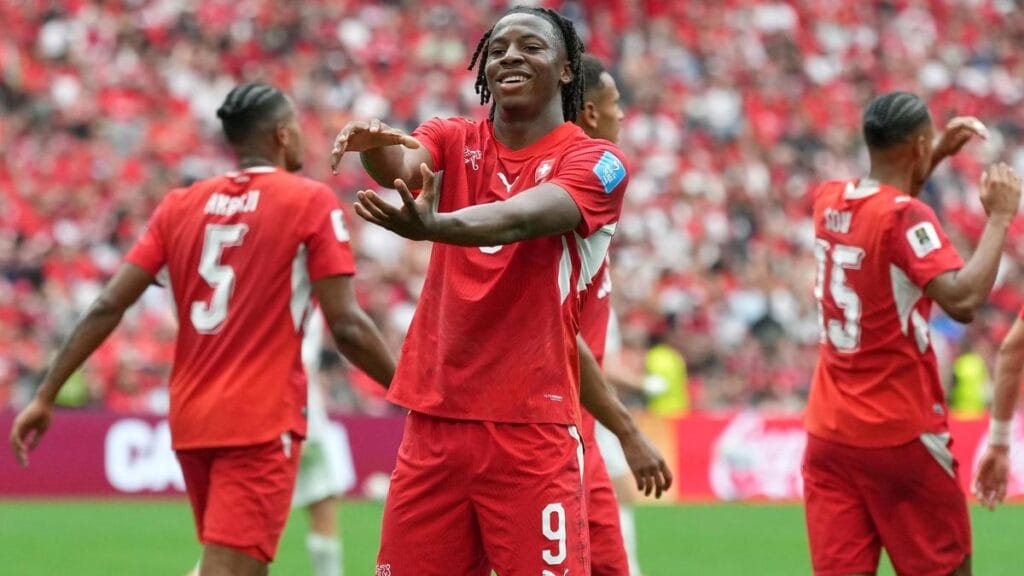
Switzerland celebrated after Ruben Vargas and Johan Manzambi scored second-half goals in a 2-1 win over Canada. Image Credit: The Hindu
FIFA World Cup 2026: Switzerland defeated Canada 2-1 on Wednesday in Vancouver to clinch top spot in World Cup Group B and qualify for the knockout stage as group winners. Ruben Vargas and Johan Manzambi scored second-half goals to overturn a match that was low on clear chances in the opening 45 minutes. The result still allowed Canada, one of the tournament co-hosts, to progress as runners-up and continue their World Cup campaign, though they missed the chance to win the group with a draw.
How Switzerland Took Control
The first half was unusually quiet for a World Cup match with so much at stake. The two teams created only three attempts on goal in total, which tells you how cautious and tactical the contest was before the break. There was more tension than action, and the clearest flashpoint came not from an attacking move but from a confrontation between Swiss captain Granit Xhaka and Canada striker Cyle Larin after a quick free kick. The Hindu has covered the full story.
That argument led to yellow cards for both players and briefly became the most memorable moment of the half. After the restart, though, Switzerland looked much more decisive in the final third. Ruben Vargas broke the deadlock, and Johan Manzambi added a second-half goal that put Switzerland in control. That was enough to see the European side over the line and secure first place in the group.
The result showed the value of patience and efficiency. Switzerland did not need to dominate from the first whistle. They just needed to stay compact, avoid mistakes, and take their chances when they came. In tournament football, that often matters more than long spells of possession.
Canada’s Missed Opportunity
Canada will probably feel this was a match they could have managed better. A draw would have been enough to top the group, and that is a big incentive in a tournament where finishing first can shape the path ahead. Instead, the hosts found themselves chasing after Switzerland struck twice in the second half.
That said, Canada still did enough overall to advance. Finishing runners-up means the campaign remains alive, and the team will now travel to Los Angeles for its next match. Even though they missed the group win, making it into the knockout rounds as co-hosts is still a meaningful achievement.
The challenge for Canada now is to recover quickly and turn this setback into motivation. The team’s defensive discipline in the first half was promising, but they will need a sharper attacking edge if they want to go deeper in the tournament.
Match Reaction and Key Moments
A football analyst would likely describe this game as “a match won by the more clinical side.” That sums it up well because Switzerland did not need a huge number of chances to win. They simply made more of the moments that mattered.
Another fair assessment is that the opening half was “all tension, little incision.” Both sides seemed aware of the stakes and were reluctant to overcommit. That kind of caution is common in late group-stage fixtures, especially when top spot is on the line.
The yellow cards to Xhaka and Larin also reflected the intensity behind the otherwise quiet game. Sometimes the emotional battle starts before the football does, and this one was no different. Once Switzerland found their goals after the break, the match became far more one-sided in terms of momentum.
Background and Context
This result comes in a group stage where every point and every goal can change the knockout route. Switzerland finishing on seven points is a strong return and gives them a better position going forward. Canada, despite finishing second, still moves on and keeps its World Cup hopes alive as co-hosts.
For Switzerland, this kind of result fits a familiar tournament profile: disciplined, compact, and efficient. They often succeed by staying organized and punishing opponents who fail to convert early pressure. For Canada, the story is different. They entered the match knowing a draw would be enough to win the group, but they could not protect that advantage.
The venue also matters. Staying in Vancouver for their knockout tie means Switzerland avoid unnecessary travel and can remain settled. Canada, meanwhile, heads to Los Angeles, where they will have to reset quickly in a new environment.
Timeline
First half: Switzerland and Canada play a cautious, low-chance opening period.
First-half flashpoint: Granit Xhaka and Cyle Larin clash over a quick free kick and both receive yellow cards.
Second half: Switzerland improves in attack and begins to create clearer opportunities.
Ruben Vargas scores: Switzerland takes the lead.
Johan Manzambi scores: The Swiss add a second goal to secure the win.
Full time: Switzerland wins 2-1 and finishes top of Group B.
After the match: Switzerland remains in Vancouver for their last-32 tie, while Canada travels to Los Angeles as the runner-up.
Why This Matters
This matters because group winners and runners-up do not just get different labels — they can face very different knockout paths. Switzerland’s victory may give them a more favorable route, while Canada must now prepare for the next round under slightly more pressure. In major tournaments, even one match can alter the entire shape of a campaign.
It also matters because the hosts staying alive adds energy to the tournament narrative. Canada moving on means local fans still have a team to support, and that keeps interest high in the later stages. Yeh issue kaafi important hai because host nations often become a major part of World Cup momentum, both on and off the pitch.
For Switzerland, the win reinforces the idea that they are a serious, organized side capable of handling high-pressure games. For Canada, it is a reminder that small margins matter. A draw would have changed everything, but football rarely rewards caution without efficiency.
India Angle
For Indian football fans, this match is a good example of how tournament football is often decided by discipline rather than flair. Switzerland’s ability to wait, stay calm and strike after the break is something Indian readers who follow the sport closely will appreciate. It is a reminder that at the highest level, smart game management matters just as much as attacking talent.
In Hinglish, seedhi baat yeh hai: Canada ke paas group jeetne ka chance tha, but Switzerland ne opportunity pakad li. Indian fans who enjoy World Cup tactics will see this as a textbook example of why finishing chances and staying focused are everything.
There is also an indirect lesson for Indian football development. If India wants to compete more consistently on the world stage, matches like this show the importance of structure, patience and defensive concentration. Little details decide big games.
Analysis
My view is that Switzerland’s win was less about brilliance and more about being better in the key moments. That is often the sign of a mature tournament team. They did not panic during the slow first half, and when the game opened up, they took control.
For Canada, the draw-that-could-have-won-the-group scenario makes this one sting a bit more. But the bigger picture remains positive: the co-hosts are through, the crowd support will stay strong, and the knockout rounds offer a fresh chance to respond. That balance between disappointment and progress makes the story more compelling.
What Next
Switzerland will remain in Vancouver for their last-32 tie, which gives them a stable base and a chance to recover physically and tactically before the next round. Their goal now will be to turn group-stage consistency into knockout success.
Canada will head to Los Angeles, where they must quickly shift from group-stage caution to elimination-stage urgency. The team’s next performance will likely depend on how well they bounce back mentally from the missed chance to win Group B.
For both teams, the next stage is where the real pressure begins. In a knockout setting, one mistake can end the tournament, so the margin for error will shrink sharply.
Conclusion
Switzerland’s 2-1 win over Canada was a clear example of how tournament football can pivot on second-half sharpness and composure. Ruben Vargas and Johan Manzambi delivered the goals that sent the Swiss through as Group B winners, while Canada also progressed despite missing the chance to top the group. With Switzerland staying in Vancouver and Canada moving to Los Angeles, both sides now enter the knockout phase with different emotions but the same goal: survive and advance.
Written By A. Jack