A France side already through were too sharp for a Norway side who rested most of their first choice players. Dembele’s hat-trick and France’s quick start confirmed their status as group winners going into the knockout stages.
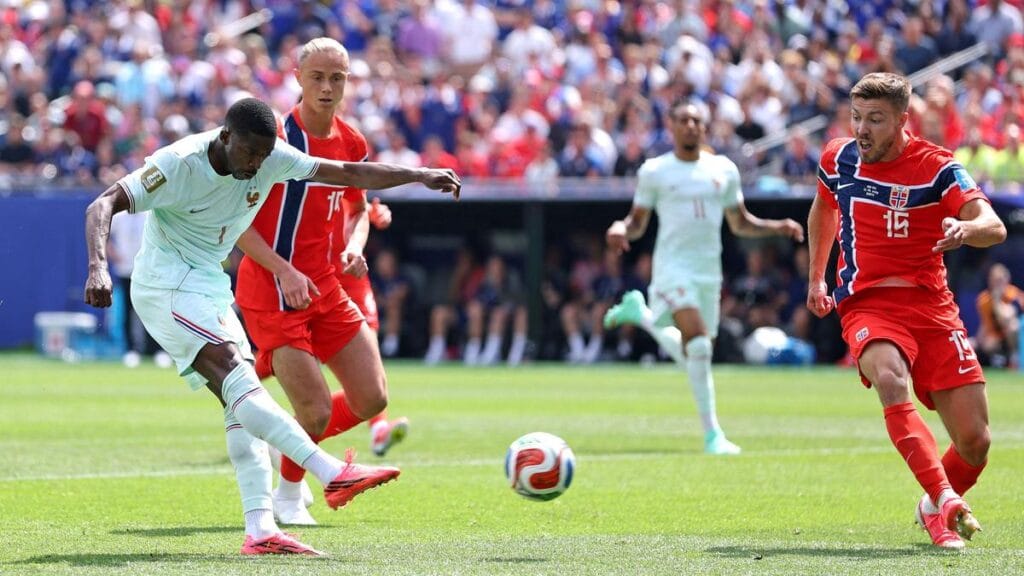
Ousmane Dembele’s hat-trick helped them defeat Norway 4-1 and finish top of World Cup Group I. Iage Credit: The Hindu
FIFA World Cup 2026: France defeated Norway 4-1 on Friday to finish first in World Cup Group I, with Ousmane Dembele producing a brilliant first-half hat-trick. The 2018 World Cup winners were already through to the next stage, but they still treated the match with intensity and purpose, racing into the lead through Dembele after just seven minutes. Norway, who had already qualified in second place and rested 10 of their 11 first-choice starters, briefly responded through Thelo Aasgaard, but France were far sharper in every decisive moment and finished the game as deserved winners.
This was not just a routine group-stage victory. It was a statement from France, who showed depth, pace and ruthless attacking quality against a Norway side that was clearly thinking ahead to the knockout rounds. In tournament football, even when a side is already through, finishing top can matter a great deal. France made sure of that.
How France Won the Match
France began at full tilt. Kylian Mbappe almost scored inside 25 seconds when his thunderous drive crashed against the crossbar, and that early threat immediately set the tone. Just moments later, Mbappe provided the kind of pass that only world-class players see, threading a superb ball through for Dembele, who finished calmly in the seventh minute to put France ahead. The Hindu has covered the full story.
That opening goal mattered because it forced Norway out of their comfort zone. They were already a rotated side, but once France scored early, the game tilted even further in the hosts’ favor. Dembele then doubled the lead with a beautifully angled shot, showing not just finishing quality but composure and awareness in a crowded attacking phase. A first-half hat-trick completed the picture and effectively killed the contest before the break.
Norway did pull one back when Thelo Aasgaard found space and scored just a minute after Dembele’s second, but the response was only temporary. They also had a penalty opportunity early in the second half, but Jorgen Strand Larsen saw his effort saved five minutes after the restart. That miss was a huge turning point because it could have made the match much tighter. Instead, France maintained control and kept Norway at arm’s length.
Dembele’s Standout Night
Ousmane Dembele’s hat-trick was the headline story, and rightly so. This was his first World Cup treble, and it came in a match where he had to be efficient, clinical and constantly alert. His movement was sharp, his finishing was precise, and his timing inside the box was excellent.
Dembele has often been praised for his ability on the ball, but nights like this also show the importance of final-third decision-making. A hat-trick at World Cup level is not easy, especially against a side with Norway’s athleticism and organization. But Dembele found space, attacked the right areas, and made the difference with composure.
For France, that kind of performance is extremely valuable. It means they are not dependent on just one attacking route. If Mbappe is creating and Dembele is finishing, the team becomes much harder to defend against. That combination is a major reason France will be viewed as one of the most dangerous sides in the tournament.
Norway’s Rotated Side
Norway’s approach to the match was clearly shaped by the fact that they had already qualified in second place. They rested 10 of their 11 first-choice starters, including top scorer Erling Haaland, which naturally changed the balance of the contest. That decision was understandable from a squad-management point of view, but it also made them more vulnerable against a France team that was moving with real purpose.
To Norway’s credit, they did not completely fold. They scored through Aasgaard and earned a penalty early in the second half. But their second-string lineup struggled to match France’s rhythm, especially in the first half. In tournament football, rotation is always a gamble. Sometimes it preserves legs; sometimes it removes momentum. On this occasion, Norway paid a price.
The key question is whether this result matters much for Norway in the long run. Since they had already advanced, the main objective was to avoid unnecessary fatigue. But the defensive gaps and the missed penalty will still be noted. Those moments can carry into the knockout rounds if not addressed.
Background and Context
France came into this match as the 2018 World Cup winners and an already-qualified side, but finishing top of the group still mattered. Topping Group I likely gives them a more favorable path in the knockout rounds and reinforces their status as a team capable of handling pressure even when the points no longer determine progression.
Norway’s situation was very different. They had already secured second place and used the match as an opportunity to rotate heavily. That means the result should be viewed in context rather than as a full-strength collapse. Even so, France’s quality was obvious.
This was also a classic example of the difference between a team chasing group supremacy and a team protecting its resources. France attacked early and with intent because they wanted control over their route forward. Norway, by contrast, was balancing rest, readiness and results. That difference shaped the match from the opening minutes.
Timeline
25 seconds: Mbappe hits the crossbar with a thunderous drive.
7th minute: Mbappe assists Dembele for France’s opening goal.
32nd minute: Dembele adds his second goal with a superbly angled finish.
Shortly after: Thelo Aasgaard pulls one back for Norway.
First half: Dembele completes his hat-trick, giving France a commanding lead.
Five minutes after halftime: Jorgen Strand Larsen misses a penalty, saved by the goalkeeper.
Full time: France wins 4-1 and finishes top of Group I.
Also Read: FIFA World Cup 2026: Australia Reach World Cup Knockouts After Goalless Draw With Paraguay
Why This Matters
This matters because World Cup group winners often get a better route into the knockout rounds, and that can shape the whole tournament. France now moves forward with momentum, confidence and a strong statement performance. Yeh issue kaafi important hai because at this level, even a group-stage result can have consequences for the next several rounds.
It also matters because it shows France’s depth. A team that can produce a hat-trick from Dembele while Mbappe creates chances and still finish top of the group is not just talented—it is dangerous. That is the kind of balance that wins tournaments.
For Norway, the match highlights the risks of rotation. Resting players can be smart, but it also changes chemistry. Their second-string lineup still showed flashes, but the difference in sharpness against elite opposition was clear. That may influence how other teams manage their own group-stage lineups.
India Angle
For Indian football fans, this match is a great reminder of how elite tournament teams manage form and squad depth. France did not need to panic or overcomplicate things. They simply started fast, kept their shape and let their star players decide the game. In Hinglish, seedhi baat yeh hai: jab quality aur planning dono ho, result nikal aata hai.
Indian viewers also enjoy watching players like Mbappe and Dembele because they bring flair, pace and finishing in a way that makes football feel exciting even before the knockout stage begins. This kind of performance keeps World Cup interest high in India, where fans closely follow major European teams and individual star players.
There is also a practical lesson here for Indian football development. Having depth matters. France could rotate and still dominate because they have multiple high-level options. That kind of squad depth is what separates regular contenders from real title favorites.
Analysis
My view is that France looked like a team with a clear plan and no need to force the issue. They used their first-half intensity to decide the game early, which is exactly what elite teams are supposed to do. Dembele deserves the headlines, but Mbappe’s role in shaping the match should not be overlooked. That one pass in the seventh minute set the entire tone.
Norway’s rotated lineup makes the loss easier to explain, but not entirely easy to dismiss. Missing a penalty and conceding four goals still matters, even if qualification had already been secured. The good news for them is that they did not need the result. The concern is that such a heavy loss could expose some depth issues.
Overall, France’s performance was efficient, powerful and mentally switched on. That combination is what makes them a serious threat in any tournament.
What Next
France now moves into the knockout rounds as Group I winners and will likely feel encouraged by the authority of this win. Their next challenge will be harder, but they will carry both confidence and momentum.
Norway will also advance, but they will want to reset quickly. The next stage will demand a stronger defensive performance and, likely, a more settled lineup. If Haaland and the other first-choice players return, the team could look very different.
For both sides, the knockout stage will be a different test altogether. One result can end the journey, so each team will now shift from group-stage management to full-scale survival mode.
Conclusion
France’s 4-1 win over Norway was more than just a comfortable group-stage victory. It was a showcase of attacking quality, with Ousmane Dembele scoring a first-half hat-trick and Kylian Mbappe orchestrating the opening moments with elite precision. Norway’s heavily rotated side made the contest less balanced, but France still had to deliver, and they did so in style to finish top of Group I. The result sends a clear message: France is ready for the knockout rounds.
Written by A. Jack